


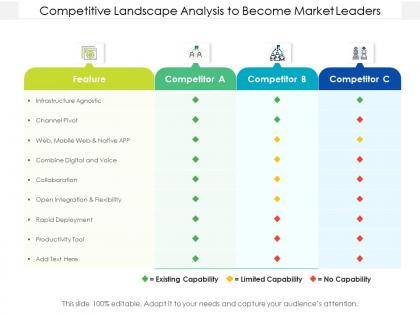
Competitive landscape analysis to become market leaders




Try Before you Buy Download Free Sample Product
 Impress Your
 Audience
 100%
100% Editable
 Save Hours
 of Time


Our Competitive Landscape Analysis To Become Market Leaders are topically designed to provide an attractive backdrop to any subject. Use them to look like a presentation pro.
People who downloaded this PowerPoint presentation also viewed the following :
Competitive landscape analysis to become market leaders with all 2 slides:
Use our Competitive Landscape Analysis To Become Market Leaders to effectively help you save your valuable time. They are readymade to fit into any presentation structure.
FAQs for Competitive landscape analysis to
Key metrics include market share, revenue growth rates, pricing strategies, customer acquisition costs, brand recognition, product differentiation, and operational efficiency measures. These indicators enable organizations to benchmark performance across sectors like retail, healthcare, and financial services, ultimately delivering strategic insights that enhance competitive positioning, identify market opportunities, and streamline resource allocation for sustained growth.
Organizations can identify emerging competitors through market intelligence tools, patent monitoring, venture capital tracking, technology trend analysis, and social media surveillance. These methods enable early detection of startups, new market entrants, and established companies expanding into adjacent sectors, with many businesses finding that proactive competitor identification delivers strategic advantages, faster response times, and ultimately better defensive positioning in increasingly dynamic markets.
Market share reveals competitive positioning, growth opportunities, market concentration levels, and relative company strength within an industry. Through market share analysis, businesses identify dominant players, emerging competitors, and potential acquisition targets, while understanding pricing power dynamics and customer loyalty patterns, ultimately enabling strategic positioning decisions that enhance competitive advantage in increasingly crowded markets.
SWOT analysis enhances competitive landscape evaluation by systematically assessing internal strengths and weaknesses against external opportunities and threats within market contexts. This strategic framework enables organizations to identify competitive advantages, anticipate market shifts, and develop positioning strategies, with many companies finding that regular SWOT assessments streamline decision-making and ultimately deliver more targeted competitive responses.
**INPUT**: What tools and techniques are best for visualizing the competitive landscape? **OUTPUT**: Effective competitive landscape visualization tools include market positioning maps, competitive matrices, SWOT analysis charts, Porter's Five Forces diagrams, and feature comparison frameworks. These techniques streamline strategic analysis by mapping competitor strengths, identifying market gaps, and highlighting differentiation opportunities, with many organizations finding that visual competitive intelligence ultimately delivers clearer strategic insights and faster decision-making capabilities. [Word count: 58 words]
Customer demographics and preferences fundamentally reshape competitive environments by driving product development, pricing strategies, market positioning, and service delivery approaches across industries. Companies increasingly segment markets based on age, income, lifestyle, and behavioral patterns, with retail brands tailoring offerings to millennial sustainability preferences while financial services customize digital experiences for different generational needs, ultimately creating competitive advantages through targeted customer experiences.
PESTEL analysis enhances competitive analysis by evaluating Political, Economic, Social, Technological, Environmental, and Legal factors that influence market dynamics and competitor positioning. This comprehensive framework enables organizations to identify external opportunities and threats affecting competitors, anticipate regulatory changes impacting industry leaders, and discover strategic gaps in competitor responses, ultimately delivering deeper market insights and sustainable competitive advantage.
Competitive landscape analysis informs strategic decisions by identifying market gaps, competitor strengths and weaknesses, pricing strategies, and emerging opportunities for differentiation. Through comprehensive market mapping, organizations can optimize resource allocation, anticipate industry shifts, and develop targeted positioning strategies, with many companies finding that regular competitive intelligence ultimately delivers faster market entry and sustainable competitive advantage.
Common pitfalls include focusing only on direct competitors, relying on outdated information, underestimating emerging threats, overlooking indirect competition, and conducting analysis too infrequently. These oversights can lead to strategic blind spots, with many organizations finding that comprehensive, regular competitor monitoring across multiple market segments ultimately delivers better market positioning and competitive advantage.
Technology revolutionizes competitive landscapes by enabling automation, enhancing customer experiences, and creating new business models across industries. Banks leverage AI for faster loan approvals, retailers use data analytics for personalized shopping, and manufacturers implement IoT for operational efficiency, ultimately delivering cost reductions and competitive advantages.
Social media influences competitor perception by amplifying brand visibility, showcasing customer satisfaction through reviews and testimonials, demonstrating thought leadership through content quality, and revealing market positioning through engagement metrics. Through strategic social media monitoring, businesses can assess competitor reputation, identify market gaps, and benchmark their own performance, ultimately enabling more informed competitive strategies and enhanced market positioning in an increasingly digital landscape.
**INPUT**: What ethical considerations should be taken into account when conducting competitive analysis? **OUTPUT**: Ethical competitive analysis considerations include respecting intellectual property rights, avoiding corporate espionage, protecting confidential information, ensuring data privacy compliance, and maintaining professional integrity throughout research processes. These principles enable organizations to gather market intelligence through legitimate channels like public reports, industry publications, and customer feedback, ultimately delivering strategic insights while preserving industry trust and regulatory compliance. [Word count: 58 words]
Competitor pricing strategy significantly influences product positioning by establishing market benchmarks, revealing value perception gaps, and identifying differentiation opportunities. Through strategic pricing analysis, companies can position themselves as premium alternatives, cost-effective solutions, or value-balanced options, with many organizations finding that understanding competitor pricing enables more targeted positioning and ultimately delivers competitive advantage in increasingly crowded markets.
Customer feedback provides crucial market validation, reveals competitor strengths and weaknesses, identifies service gaps, and highlights emerging customer expectations that competitors may be missing. Through surveys, reviews, and direct interactions, organizations can benchmark their offerings against competitors while uncovering unmet needs, ultimately delivering enhanced customer experiences and strategic positioning advantages in increasingly competitive markets.
Organizations leverage competitive analysis to anticipate industry trends by monitoring competitor strategies, product launches, market positioning, investment patterns, and customer engagement approaches. Through systematic tracking of competitor behaviors, partnerships, and technological adoptions, businesses can identify emerging market shifts, predict consumer demands, and position themselves strategically, ultimately gaining competitive advantage by staying ahead of industry evolution rather than reacting to changes.
-
Great product with effective design. Helped a lot in our corporate presentations. Easy to edit and stunning visuals.
-
Awesomely designed templates, Easy to understand.
-
Design layout is very impressive.
-
Appreciate the research and its presentable format.
-
Informative design.