Competitor Analysis Framework For Market Viability
Try Before you Buy Download Free Sample Product
Audience
Editable
of Time
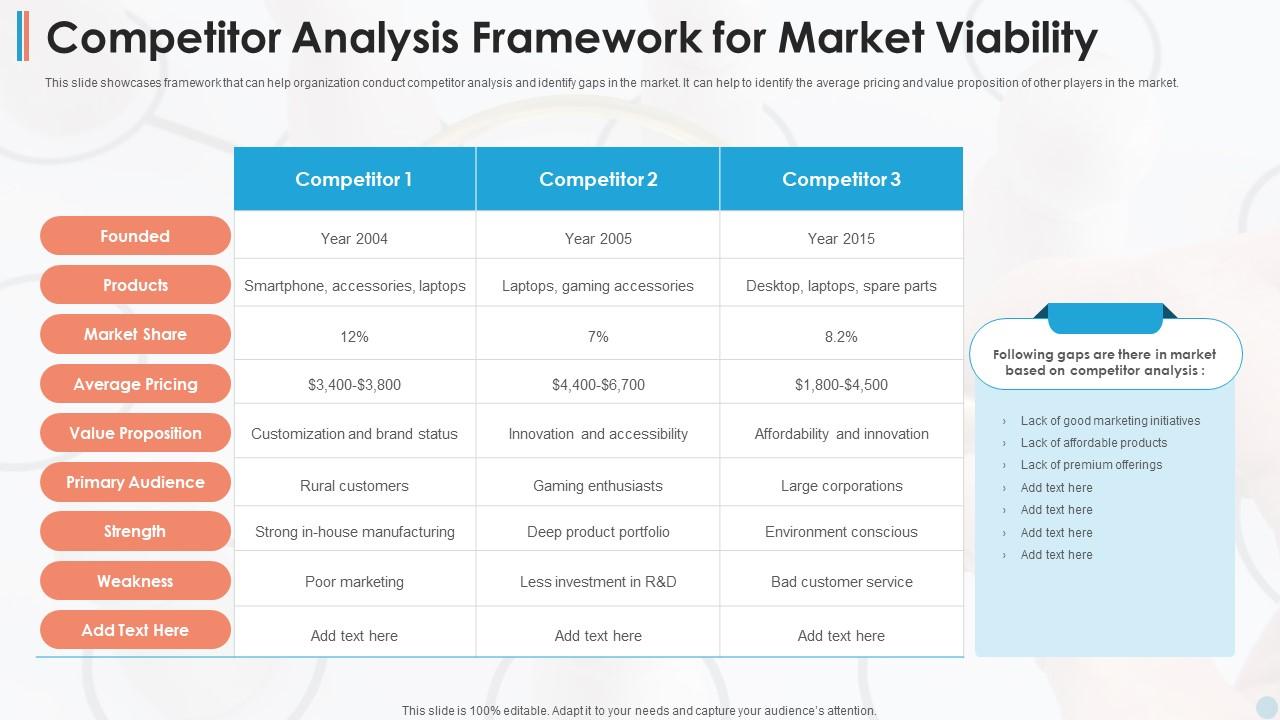
This slide showcases framework that can help organization conduct competitor analysis and identify gaps in the market. It can help to identify the average pricing and value proposition of other players in the market.
People who downloaded this PowerPoint presentation also viewed the following :
Competitor Analysis Framework For Market Viability with all 6 slides:
Use our Competitor Analysis Framework For Market Viability to effectively help you save your valuable time. They are readymade to fit into any presentation structure.
FAQs for Competitor Analysis Framework
When evaluating competitor presentation templates, key metrics include design quality, content structure effectiveness, audience engagement elements, customization flexibility, and brand consistency standards. These evaluation criteria streamline template selection by assessing visual appeal, information hierarchy, and adaptability across sectors like consulting, technology, and financial services, ultimately delivering presentations that enhance professional credibility and competitive advantage.
Competitors differentiate presentation templates through specialized design themes, industry-specific layouts, interactive elements, customizable color schemes, and varied animation styles. While some focus on minimalist aesthetics for corporate environments, others emphasize creative visuals for marketing teams, with many organizations finding that template variety ultimately enhances team productivity and presentation consistency.
Current presentation design trends competitors leverage include interactive elements, data storytelling, minimalist aesthetics, video integration, and mobile-responsive formats. These approaches enhance audience engagement by creating immersive experiences, simplifying complex information, and ensuring accessibility across devices, with many organizations finding that strategic visual communication delivers stronger stakeholder buy-in and competitive differentiation.
Competitors typically update template offerings monthly to quarterly, influenced by seasonal trends, customer feedback, design innovations, market demands, and technology advancements. Through systematic monitoring and competitive intelligence, businesses track these update patterns to anticipate market shifts, identify emerging design preferences, and strategically time their own releases, ultimately maintaining competitive positioning while delivering fresh, relevant content that meets evolving customer expectations.
Competitors often offer unique features like personalized dashboards, advanced analytics integration, collaborative editing capabilities, mobile-optimized interfaces, and AI-powered content suggestions. These enhancements streamline user workflows by reducing design time, improving team collaboration, and delivering more intuitive navigation, with many organizations finding that such features significantly boost productivity and user adoption rates.
Competitor pricing strategies for presentation templates typically range from freemium models with premium upgrades, subscription tiers based on usage volume, one-time purchases for template bundles, and enterprise licensing for unlimited access. These diverse approaches reveal market segmentation opportunities, with businesses increasingly finding that flexible pricing structures enhance customer acquisition while subscription models deliver predictable revenue streams and stronger customer relationships.
Competitors typically receive feedback on template design quality, customization flexibility, content relevance, and ease of use through reviews, surveys, and support channels. This feedback directly informs their product development by highlighting popular design trends, identifying feature gaps, and revealing user pain points, with many companies using these insights to enhance template libraries, streamline editing tools, and prioritize high-demand categories that drive customer satisfaction.
Competitors target industries through specialized template collections featuring sector-specific visuals, terminology, and frameworks, such as healthcare templates with medical icons, financial services designs with banking charts, and retail presentations with consumer analytics layouts. These niche-focused approaches enable businesses to create more relevant, professional presentations while reducing customization time, with many organizations finding that industry-specific templates enhance credibility and audience engagement.
Competitor analysis reveals gaps in your template offerings by comparing design styles, content categories, industry coverage, and feature sets against market leaders. Through systematic evaluation of competitors' portfolios, businesses can identify underserved niches, missing template types, and emerging design trends, while discovering opportunities to enhance their collections with unique formats, ultimately delivering more comprehensive solutions and competitive advantage.
Competitors effectively utilize content marketing through blogs and tutorials, social media platforms like LinkedIn and Pinterest, email campaigns targeting business professionals, SEO optimization for template-related keywords, and partnerships with design influencers. These channels work by demonstrating template value through visual content, reaching professional audiences where presentation needs arise, and building trust through educational resources, ultimately driving conversions while establishing market credibility.
Competitors leverage social proof through customer testimonials, user reviews, download statistics, and case studies showcasing successful presentations across industries like consulting, healthcare, and finance. These strategies build credibility by demonstrating real-world application and results, with many platforms featuring star ratings, client logos, and usage metrics that enhance trust and drive purchasing decisions, ultimately delivering competitive advantage through authentic validation.
Common platforms integrated with competitors' templates include CRM systems like Salesforce and HubSpot, analytics tools such as Google Analytics and Tableau, collaboration platforms like Microsoft Teams and Slack, and marketing automation software including Mailchimp and Marketo. These integrations streamline workflow efficiency, enhance data visualization capabilities, and enable seamless team collaboration, with many organizations finding that strategic template-platform combinations deliver faster project completion and improved competitive positioning.
Competitor customer service significantly influences user satisfaction by determining response times, resolution quality, and overall experience when users encounter template issues or need customization guidance. Organizations with responsive support teams, comprehensive tutorials, and proactive assistance often see higher retention rates and positive reviews, while poor service drives users toward competitors offering better technical assistance, ultimately impacting market share.
Competitors employ narrative frameworks like problem-solution arcs, customer journey mapping, data-driven storytelling, visual metaphors, and interactive case studies in their templates. These storytelling approaches enhance audience engagement by creating emotional connections, simplifying complex information, and guiding viewers through logical progressions, with many organizations finding that structured narratives significantly improve presentation effectiveness and message retention.
Competitors handle customizations through various approaches including modular template systems, drag-and-drop editors, brand-specific color palettes, font libraries, and layout adjustment tools. While some platforms offer basic customization features, others provide advanced flexibility with custom animations, interactive elements, and industry-specific templates, enabling organizations to maintain brand consistency while delivering personalized presentations that enhance client engagement and competitive positioning.
-
I loved the hassle-free signup process. A few minutes and, I had this giant collection of beautiful designs.
-
Eye-catching PPT designs, outstanding team, and best customer service. I’m a super satisfied customer here!