Swot Analysis Travel Agency Company Profile

Rating:
90%
Swot Analysis Travel Agency Company Profile
Slide 1 of 6

or

Favourites Favourites

Try Before you Buy Download Free Sample Product

Audience Impress Your
Audience
Editable 100%
Editable
Time Save Hours
of Time
The Biggest Sale is ending soon in
0
0
:
0
0
:
0
0
Rating:
90%
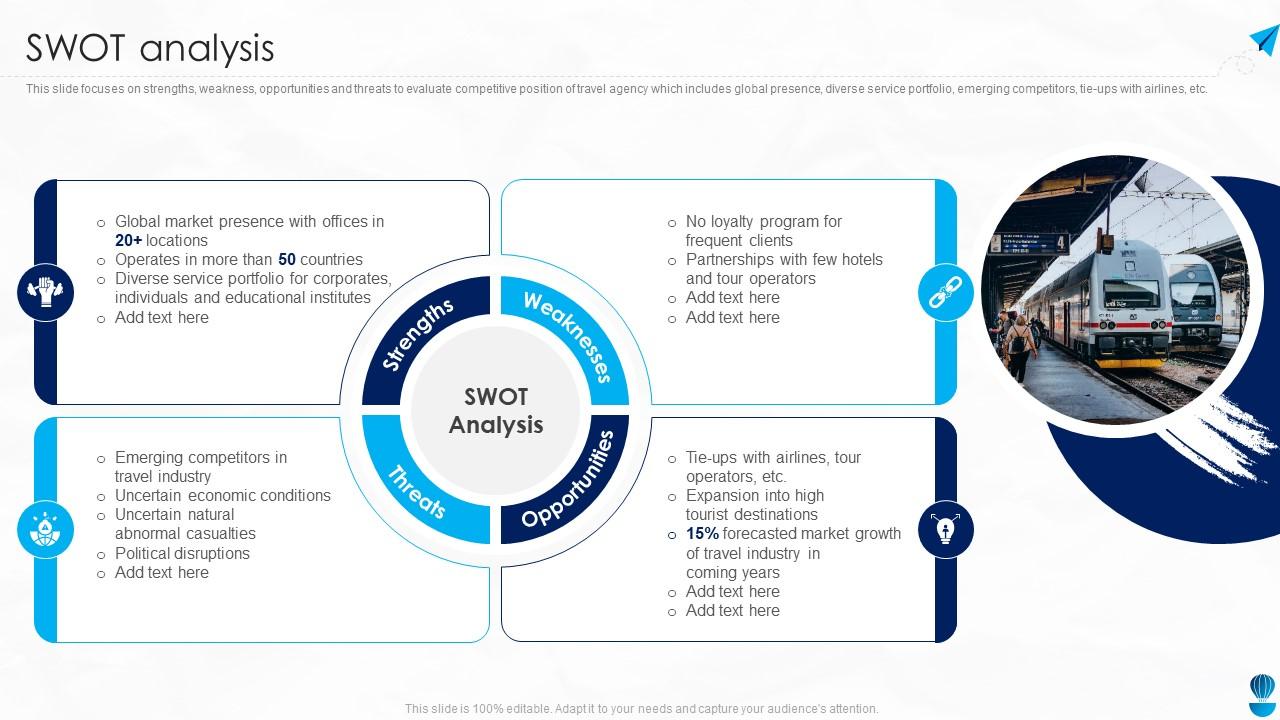
This slide focuses on strengths, weakness, opportunities and threats to evaluate competitive position of travel agency which includes global presence, diverse service portfolio, emerging competitors, tie-ups with airlines, etc. Increase audience engagement and knowledge by dispensing information using Swot Analysis Travel Agency Company Profile. This template helps you present information on four stages. You can also present information on Destinations, Growth, Competitors using this PPT design. This layout is completely editable so personaize it now to meet your audiences expectations.

FAQs for Swot Analysis Travel

SWOT breaks down into four parts - Strengths, Weaknesses, Opportunities, and Threats. Pretty straightforward names, honestly. Your strengths and weaknesses are internal stuff you can actually change - like your team's experience or how tight your budget is. Opportunities and threats come from outside your company. Market shifts, new competitors, whatever's happening in your industry that you can't really control. The real value comes when you start mixing and matching between the categories. That's where you'll spot the moves worth making.

Honestly, SWOT analysis is like giving your business a reality check. Map out your strengths and weaknesses first - be brutal about it. Then look at what opportunities are out there and what could totally screw you over. Simple concept but most people half-ass it. Once you've got everything laid out, it becomes way easier to figure out what to focus on next. I'd run through this with your team maybe every few months? Keeps everyone on the same page and stops you from chasing shiny objects that don't actually move the needle.

So SWOT's biggest advantage? It shows you the full picture - both what's happening inside your company AND what's going on outside. Most frameworks just pick one side. You get strengths, weaknesses, opportunities, and threats all in that neat little 2x2 box. Honestly, it's almost *too* basic sometimes, but that's why people love it. Porter's Five Forces gets super detailed about competition, BCG matrix is all about your product portfolio - but SWOT stays high-level. Makes it perfect when you need a quick overview or you're trying to get your whole team aligned without getting lost in the weeds.

Honestly, you've gotta be brutally honest about what you're actually better at than everyone else. Don't just make stuff up or list what sounds good on paper - that's useless. Ask your customers and team what they think makes you different. Look back at your wins and figure out why they happened. Your unique resources matter. So does your market position, brand rep, whatever operational stuff you do well. But here's the thing - be super specific instead of saying generic crap like "great service." What exactly makes it great? I see people mess this up all the time by being too vague.

Look, there's a bunch of ways to figure out where you're screwing up. Internal audits and employee surveys are obvious ones. Customer feedback is honestly the best though - they'll straight up tell you what sucks. Financial data shows you where money's bleeding out. Process mapping finds those annoying bottlenecks that slow everything down. Oh, and do anonymous feedback with leadership. People get way more honest when they're not worried about getting fired. Also dig into past failures - like actually ask why stuff went sideways instead of just moving on. Use multiple methods because each one catches different problems you'd totally miss otherwise.

Honestly, stop obsessing over what your competitors are doing and start looking at what they're missing. Check out customer reviews - people love to complain about gaps in the market. Social media's great for this too. Look for underserved customer groups or new tech that nobody's jumped on yet. Their job postings can tell you where they're struggling (weird, right?). Set up some Google alerts for industry stuff and maybe do a monthly check-in on the competition. The real money's in finding spots where customers want something but the competition's either weak or completely ignoring it.

Focus on the big scary stuff first - competitors dropping similar products, regulations that'll mess with your industry, economic changes hitting your customers hard. Honestly, I just go with whatever would make me panic if it actually happened. Rate each threat by how likely it is AND how much damage it'd cause. Skip the random doomsday planning though, that's just exhausting. Pick your top 3-5 worst-case scenarios and actually make backup plans for those. Everything else can wait.

Look, don't just wing your SWOT with gut feelings - you need actual data backing it up. Hard numbers are your friend here: market share percentages, churn rates, that kind of stuff. But also grab qualitative insights from customer interviews or employee feedback to explain the "why" behind those numbers. Honestly, I've seen way too many SWOT analyses that are basically just wishful thinking written on a whiteboard. Mix both types of data and your analysis will actually mean something. Oh, and try to get 2-3 solid data points for each major thing you list.

So a SWOT analysis is basically your cheat sheet for marketing decisions. It shows you what you're actually good at so you can highlight that stuff in your campaigns. Like if your customer service rocks, definitely play that up. You'll also spot your weak points before competitors do - which honestly saves you from some embarrassing moments later. Plus it helps you see what opportunities are out there and what threats might mess with your plans. I always think of it as a gut check before you blow your budget on something random. Use it to figure out which tactics will actually work for your specific situation.

Yeah totally! I did this when I was thinking about changing jobs - it's actually super helpful. So you'd map out your strengths (like your skills, who you know, experience), then weaknesses (stuff you need to work on or don't know yet). For opportunities, think job market trends, openings, maybe courses you could take. Threats would be things like competition or your skills becoming outdated. Honestly, the visual part is what made it click for me - seeing it all laid out like that. You'll probably notice some moves you hadn't thought of before.

Honestly? Do it quarterly if you can manage it. Markets move crazy fast now - I swear every week there's some new competitor or policy change that flips everything upside down. At minimum though, once a year is fine. The real trick is just being consistent about it. Major stuff happens? Run another one right away. I actually put mine in my calendar like a dentist appointment because otherwise I'd totally forget. Way better to do them regularly than stress about perfect timing. Plus you start seeing patterns in your business you'd miss otherwise.

Honestly, people get way too generic with these things. Like saying "good customer service" instead of "our 24/7 chat cuts response time by 60%." Be specific! Also everyone wants to focus on the fun strengths part, but the weaknesses and threats? That's where the gold is for actual strategy. Don't rush through it either - get different people involved so you're not missing obvious stuff. Oh and this drives me crazy... actually USE the damn thing to make decisions afterward. Don't just stick it in some folder and forget about it.

Get people from different departments - same team means same blind spots. Have everyone write ideas down first before talking, otherwise the loud ones take over (happens every damn time). Someone needs to run it or you'll spend forever on strengths while ignoring threats. Figure out what you're actually analyzing upfront too - whole company? Just one product? I've watched sessions spiral because nobody defined the scope. Mix up the discussion between all four areas. Don't forget to assign actual next steps with names attached, or it's just an expensive brainstorming session that goes nowhere.

Dude, you HAVE to get other people's input on your SWOT. Your internal team will miss so much stuff it's not even funny. Talk to customers, employees, suppliers - they'll tell you about strengths you didn't know you had and weaknesses that are actually driving them crazy. I've watched companies think they totally understood their position, then get blindsided by something obvious to outsiders. Each group sees different things too. Customers might spot market threats while employees know operational issues you're ignoring. Just do some quick surveys or interviews with your key stakeholders before you wrap up the analysis.

Honestly, just stick with the classic 2x2 grid - everyone knows what they're looking at immediately. Put strengths and weaknesses up top, opportunities and threats on the bottom. Different colors for each section help a ton (I always do green for strengths, red for weaknesses). Keep your bullet points super short though - walls of text in those boxes are the worst. Maybe throw in some little icons to jazz it up visually? The whole thing should be scannable in like 5 seconds. Oh, and definitely follow up with another slide showing how your strengths connect to opportunities - that's where the real insights happen.

Ratings and Reviews

90% of 100
Review Form
Write a review
Most Relevant Reviews
  1. 100%

    by Dwayne Matthews

    The designs are very attractive and easy to edit. Looking forward to downloading more of your PowerPoint Presentations.
  2. 80%

    by Damian Martin

    Every time I ask for something out-of-the-box from them and they never fail in delivering that. No words for their excellence!

2 Item(s)

per page: