

Swot Analysis Building Construction Company Profile




Try Before you Buy Download Free Sample Product
 Impress Your
 Audience
 100%
100% Editable
 Save Hours
 of Time


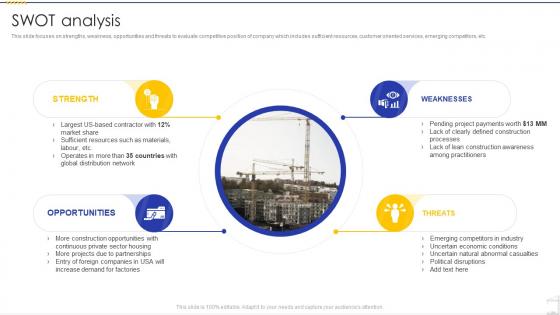
This slide focuses on strengths, weakness, opportunities and threats to evaluate competitive position of company which includes sufficient resources, customer oriented services, emerging competitors, etc.
People who downloaded this PowerPoint presentation also viewed the following :
Swot Analysis Building Construction Company Profile with all 6 slides:
Use our Swot Analysis Building Construction Company Profile to effectively help you save your valuable time. They are readymade to fit into any presentation structure.





FAQs for Swot Analysis Building
Key strengths include skilled workforce, established supplier relationships, proven project management capabilities, safety track record, and financial stability. These competitive advantages enable construction companies to deliver projects on time and within budget, secure larger contracts through demonstrated reliability, and maintain client trust, with many firms finding that combining technical expertise with strong vendor partnerships ultimately delivers superior project outcomes and sustained market positioning.
Weaknesses in project management significantly impact construction companies through cost overruns, delayed timelines, compromised quality control, resource misallocation, and strained client relationships. These inefficiencies ultimately reduce profit margins, damage reputation, and limit competitive positioning, with many firms finding that poor project oversight creates cascading operational challenges that affect future contract opportunities and long-term growth potential.
Construction companies should evaluate market demand trends, government infrastructure spending, regulatory changes, emerging technologies like green building standards, and economic conditions affecting real estate development. These external factors enable strategic positioning by identifying lucrative sectors, anticipating policy shifts, and leveraging technological advancements, with many firms finding that proactive opportunity assessment delivers competitive advantage in an increasingly dynamic construction landscape.
Regulatory changes in construction significantly impact strategic planning by requiring firms to reassess compliance costs, project timelines, safety protocols, and operational procedures. These shifts often present both challenges and opportunities, with many construction companies finding that proactive adaptation to new building codes, environmental standards, and safety regulations ultimately delivers competitive advantage, streamlines permitting processes, and enhances market positioning.
Economic downturns pose significant threats to building construction through reduced project funding, delayed developments, tighter credit access, decreased consumer demand for residential properties, and postponed commercial investments. These challenges force construction companies to navigate cash flow constraints, project cancellations, and intense price competition, while those with diversified portfolios and strong financial reserves often find opportunities in infrastructure projects and cost-conscious renovation markets.
A construction company can leverage brand reputation as a SWOT strength by attracting premium clients, commanding higher project fees, securing repeat business, and winning competitive bids more effectively. Strong reputation enables faster project approvals, easier financing access, and strategic partnerships with suppliers and subcontractors, ultimately delivering sustained competitive advantage and market positioning in an increasingly crowded construction landscape.
Technology advancements present opportunities for construction innovation through automated equipment, digital project management platforms, sustainable building materials, AI-powered safety systems, and IoT monitoring solutions. These technologies streamline operations by reducing labor costs, accelerating project timelines, and enhancing quality control, with many construction firms finding that early adoption delivers significant competitive advantages.
Skilled labor shortages create significant operational weaknesses by limiting project capacity, extending timelines, increasing wage costs, and compromising quality standards across construction operations. These workforce gaps force companies to rely on less experienced workers or expensive subcontractors, ultimately reducing profit margins and competitive positioning, with many construction firms finding that labor constraints directly impact their ability to scale operations and meet client deadlines effectively.
Environmental sustainability trends create strategic opportunities through green building certifications, renewable energy integration, sustainable material sourcing, and waste reduction technologies. Construction firms leveraging these approaches can differentiate themselves in competitive markets, attract environmentally conscious clients, reduce long-term operational costs, and position themselves for future regulatory compliance, ultimately delivering enhanced profitability and market leadership.
Risk mitigation strategies include diversifying project portfolios, building strategic partnerships, maintaining flexible financial reserves, investing in technology upgrades, and developing contingency planning frameworks. Construction companies increasingly find that combining these approaches with regular market monitoring and supplier relationship management enables them to navigate economic downturns, regulatory changes, and competitive pressures while maintaining operational efficiency.
Strong client relationships directly enhance a construction company's identified strengths by providing repeat business opportunities, positive referrals, reduced marketing costs, and valuable project feedback for continuous improvement. These relationships enable companies to leverage their reputation, expertise, and service quality more effectively, while many construction firms finding that loyal clients become strategic partners who provide larger projects, faster payment terms, and ultimately deliver sustained competitive advantage in an increasingly relationship-driven industry.
Construction companies should assess weakness responses using financial metrics like cost overruns, profit margins, and cash flow improvements, alongside operational measures including project delivery times, safety incident rates, and quality defect percentages. These metrics enable companies to track progress systematically, with many organizations finding that combining financial indicators with client satisfaction scores and employee retention rates delivers comprehensive insights into strategic improvements and competitive positioning.
Diversification enables construction companies to capture new revenue streams, reduce dependency on single markets, and leverage existing expertise across residential, commercial, and infrastructure sectors. While this strategic expansion enhances competitive positioning and provides recession resilience, it also presents resource allocation challenges and operational complexity, with many companies finding that successful diversification requires careful market analysis and phased implementation approaches.
Social media and digital marketing create new opportunities for construction firms through enhanced client outreach, project showcasing, talent recruitment, and strategic partnerships with suppliers and subcontractors. These digital platforms enable companies to demonstrate expertise through virtual project tours, client testimonials, and real-time progress updates, ultimately delivering broader market reach and competitive positioning in an increasingly connected construction landscape.
Competitive analysis significantly shapes a construction company's SWOT evaluation by revealing market positioning relative to rivals, identifying differentiation opportunities, and exposing operational vulnerabilities or advantages in bidding, project delivery, and resource allocation. Through systematic competitor assessment, construction firms can strategically enhance their strengths while addressing weaknesses, ultimately delivering more competitive proposals and sustainable growth advantages in an increasingly crowded marketplace.
-
“As you have innovative ideas and they are all customizable, this saves a huge chunk of your time to prepare well-read presentations.”
-
Innovative and creative templates with high-quality designs. Helped me with my presentation as the slides were easy to edit.