


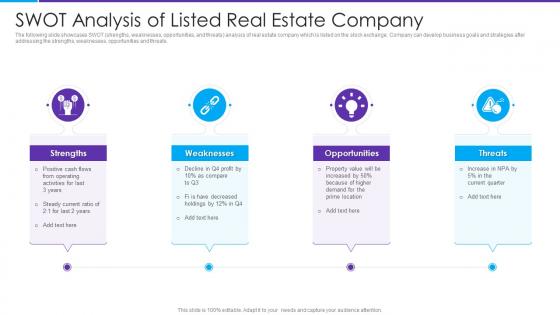
SWOT Analysis Of Listed Real Estate Company




Try Before you Buy Download Free Sample Product
 Impress Your
 Audience
 100%
100% Editable
 Save Hours
 of Time


The following slide showcases SWOT strengths, weaknesses, opportunities, and threats analysis of real estate company which is listed on the stock exchange. Company can develop business goals and strategies after addressing the strengths, weaknesses, opportunities and threats.
People who downloaded this PowerPoint presentation also viewed the following :
SWOT Analysis Of Listed Real Estate Company with all 6 slides:
Use our SWOT Analysis Of Listed Real Estate Company to effectively help you save your valuable time. They are readymade to fit into any presentation structure.






FAQs for SWOT Analysis Of Listed
So SWOT stands for Strengths, Weaknesses, Opportunities, and Threats. Pretty straightforward once you know what it means. Start by looking inward - what's your company good at? What resources do you have? Then flip it and figure out where you're weak or missing stuff. The external part is next: scan your market for opportunities and watch out for threats from competitors or industry shifts. Honestly, it's like giving your business a full physical exam. The real value comes when you start connecting the dots - using your strong points to grab those opportunities, or fixing weak spots before they become bigger problems.
Look, SWOT analysis is just a fancy way to map out where you're actually at. Write down your strengths, weaknesses, opportunities you could grab, and threats coming your way. Honestly, most people skip this step and wonder why they're flying blind later. The real trick is connecting the dots - like using your strengths to go after opportunities, or fixing weak spots before problems hit. I've seen it work for everything from launching products to expanding markets. It's basically your strategy cheat sheet. Don't overthink it, just be brutally honest about each section and you'll have a solid roadmap.
SWOT analysis is basically your way to find market openings by looking at what's going on inside and outside your company. The opportunities section shows you external stuff - new trends, where competitors are screwing up, regulatory shifts that might help you out. But honestly, the best part is when you match those opportunities with what you're already good at. Like maybe there's this gap in the market that you could totally crush because of your specific skills. Your competitors might be weak in areas where you shine. I'd start with the obvious opportunities first, then really think about how your strengths could actually turn those into real wins.
Honestly, SWOT is clutch for product development - most people just skip it and wonder why their stuff tanks. Map out what your team's already good at versus where you're weak internally first. Then scope out market gaps you could actually fill and any threats that might screw you over later. I've seen too many teams dive straight into building without this reality check. Once you've got your SWOT down, use it to figure out which features matter most and set timelines that aren't completely delusional. It's basically a sanity check before you burn through your budget.
Honestly, the main thing that trips people up is being way too vague. Like saying "we have good customer service" - okay, but how? What specifically makes it better? Also, tons of people mix up internal vs external stuff. Your strengths and weaknesses should be things YOU control, not market trends or whatever. That just confuses everything. Oh, and don't go overboard with the brainstorming. Three to five really solid points per section beats having twenty mediocre ones. The hardest part is actually being honest about your weaknesses instead of just sugarcoating them or focusing only on the good stuff.
Environmental scanning is basically doing detective work to figure out what's happening outside your company. You're tracking competitor moves, market trends, economic changes, regulatory stuff - anything that could mess with your business. Honestly, most people skip this part and their SWOT analysis ends up being total garbage. The opportunities and threats sections just become wild guesses based on old info. You can't just do it once either. Make it ongoing or you'll miss the shifts that actually matter. Think of it as staying ahead of the game instead of getting blindsided by changes.
Basically, SWOT looks at your company from the inside out - your strengths/weaknesses plus what opportunities and threats are out there. PESTLE is different though. It's all about those big external forces hitting your industry: political stuff, economic changes, social trends, tech disruptions, legal requirements, environmental factors. SWOT gives you more actionable insights for quick decisions. PESTLE? That's your macro view of what's happening in the world around you. Honestly think they're both pretty useful - I'd probably do PESTLE first to get the lay of the land, then jump into SWOT with that context.
So for nonprofits, you gotta flip the usual SWOT thing to focus on mission impact instead of just money stuff. Strengths could be your amazing volunteers, community trust, or those special programs nobody else runs. Funding issues and resource limits are probably your weaknesses - honestly, what nonprofit doesn't struggle there? Look for grant opportunities and new partnerships when thinking about opportunities. Oh, and watch for donor fatigue or new regulations as threats. The main difference is you're measuring success through actual social impact, not revenue. Get input from your board, volunteers, and the people you serve first.
Honestly, SWOT is great because it gives everyone a lane to contribute in. The quiet people on your team? They'll actually speak up when there's structure instead of just random brainstorming chaos. Your sales folks will spot totally different opportunities than your engineers will - that's the magic right there. Short sentences work. Building on each other's ideas becomes super natural when it's all laid out visually. I'd definitely try it for your next project kickoff. You'll probably be shocked how much more people engage when they're not just staring at a blank whiteboard wondering what to say.
SWOT's actually pretty solid for spotting what your competitors are sleeping on. Your strengths are where you should lean hard - maybe it's that personal touch or knowing the local scene inside out. Make those your biggest selling points. The opportunities part is honestly my favorite because small businesses can jump on market gaps way faster than the big guys. Most people totally ignore the threats section (huge mistake) but that's how you avoid getting caught off guard. Oh, and don't overthink it - just pick 2-3 concrete strategies that play up your strengths while hitting those real opportunities you found.
Honestly, don't overthink this one. A basic 2x2 grid is all you need - I've watched people waste way too much time on fancy setups when a whiteboard works just fine. Google Sheets or Excel are solid for the basics. Miro's great if your team needs to collaborate from different places (which, let's be real, is most of us these days). Lucidchart works too, or Canva if you need something that looks polished for presentations. The main thing is making sure everyone can actually jump in and add their thoughts without it being a pain.
SWOT analysis is great for catching risks before they hit you. It forces you to look at weaknesses and external threats systematically. The weakness part is honestly the best - makes you really face what's broken in your business, even if it stings a bit. Your strengths can actually help counter those risks once you map everything out. Plus threats sometimes become opportunities with the right planning. I'd suggest doing this quarterly and picking your top 3-5 risks to tackle first. Don't try to fix everything at once - you'll just burn out.
Tech companies do it all the time since everything changes so quickly in that space. You'll see it a lot in retail, healthcare, and finance too - those industries deal with tons of regulatory stuff and market chaos. Manufacturing uses it for supply chain decisions, which makes sense. Honestly though, any business making strategic calls can benefit from it. I mean, what company isn't doing some kind of planning, right? The competitive industries probably get the most value since they need that bird's eye view. Worth trying in your next quarterly meeting - even a basic one helps you spot things you might've missed.
Honestly, I'd say do it once a year minimum, but really whenever big stuff happens. New competitors pop up? Economic weirdness? Company restructuring? Time for a fresh look. Fast-moving industries might need quarterly updates - sounds excessive but it's really not. The worst thing is making decisions based on old info that doesn't match reality anymore. I actually set a reminder every 6 months or so to just quickly check if my strengths, weaknesses, opportunities and threats still make sense. Better safe than sorry, you know?
Yeah, totally! I used SWOT when I was thinking about switching careers - honestly pretty helpful. You just list your strengths (skills, connections, whatever), weaknesses (gaps you need to fill, maybe some bad habits), opportunities (job market stuff, training you could do), and threats (like AI taking over everything lol). The hardest part? Being real about your weak spots. Nobody wants to admit they suck at something. But once you've got it all down, you can actually plan around it. Use what you're good at to go after opportunities while fixing the stuff that's holding you back. Start simple though.
-
Perfect template with attractive color combination.
-
Very unique, user-friendly presentation interface.