


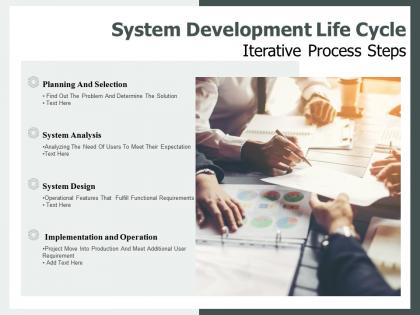
System development life cycle iterative process steps




Try Before you Buy Download Free Sample Product
 Impress Your
 Audience
 100%
100% Editable
 Save Hours
 of Time


Think of it and be sure we have it. Our System Development Life Cycle Iterative Process Steps offer you the widest possible range of options.
People who downloaded this PowerPoint presentation also viewed the following :
System development life cycle iterative process steps with all 5 slides:
Our System Development Life Cycle Iterative Process Steps come in all colours shades and hues. They help highlight every nuance of your views.




FAQs for System development life cycle
The SDLC comprises planning, analysis, design, implementation, testing, deployment, and maintenance phases that flow sequentially while allowing iterative feedback loops. These interconnected phases enable organizations to systematically build robust software solutions by ensuring each stage validates requirements from previous phases, ultimately delivering scalable systems with reduced development costs and enhanced operational efficiency.
The choice of SDLC model significantly impacts project timelines and resource allocation by determining development phases, team structure, and delivery schedules. Agile models enable faster iterations and flexible resource deployment, while Waterfall approaches require upfront resource commitment and longer timelines, with many organizations finding that hybrid approaches deliver optimal balance between predictability and adaptability.
Stakeholders provide requirements definition, feedback validation, resource allocation, and decision-making authority throughout each SDLC phase, from initial planning through deployment and maintenance. Their active involvement streamlines development timelines, reduces costly revisions, and ensures final solutions align with business objectives, with organizations finding that early stakeholder engagement ultimately delivers higher user adoption rates and project success.
Agile methodologies transform traditional SDLC phases by introducing iterative development cycles, continuous stakeholder feedback, and flexible requirement adaptation throughout the process. These approaches enable organizations to deliver working software increments faster, respond to changing market demands more effectively, and enhance collaboration between development teams and business users, ultimately reducing project risks while accelerating time-to-market in increasingly competitive environments.
Common challenges during SDLC planning include unclear requirements, insufficient stakeholder engagement, unrealistic timelines, inadequate resource allocation, and poor risk assessment. These obstacles can significantly impact project success, with many organizations finding that thorough upfront planning, regular stakeholder communication, and realistic scope definition ultimately deliver more efficient development cycles and better outcomes.
Risk management integrates into SDLC through phase-specific assessments, mitigation planning, continuous monitoring, and stakeholder communication at each stage. During requirements gathering, teams identify scope and technical risks, while development phases focus on implementation vulnerabilities, with testing phases addressing quality and performance risks, ultimately delivering more secure, reliable systems with reduced project failures.
SDLC success metrics include requirements completeness and stakeholder approval for planning, code quality and defect density for development, test coverage and bug detection rates for testing, deployment success rates for implementation, and user satisfaction scores for maintenance. These metrics enable organizations to streamline project delivery, minimize costly rework, and enhance software quality, with many development teams finding that phase-specific measurement ultimately delivers faster time-to-market and improved competitive advantage.
Requirements gathering techniques vary significantly across SDLC models, with waterfall emphasizing comprehensive upfront documentation, agile focusing on iterative user stories and continuous feedback, and spiral combining risk assessment with prototyping. While waterfall delivers detailed specifications early, agile enables adaptive requirements through regular stakeholder collaboration, ultimately allowing organizations to balance thoroughness with flexibility based on project complexity and market demands.
Essential SDLC tools include project management platforms like Jira, version control systems like Git, IDEs such as Visual Studio, testing frameworks like Selenium, and deployment tools including Docker and Jenkins. These technologies streamline development by automating workflows, enhancing collaboration, and ensuring quality control, with many organizations finding that integrated toolchains significantly reduce development cycles while improving software reliability and team productivity.
Feedback loops within SDLC can be established through regular stakeholder reviews, automated testing protocols, continuous integration systems, user acceptance testing cycles, and post-deployment monitoring dashboards. These mechanisms enable development teams to identify issues early, streamline code quality, and enhance user experiences, with many organizations finding that structured feedback processes ultimately reduce development costs and accelerate delivery timelines.
Documentation during SDLC serves as the foundation for project continuity, knowledge transfer, compliance requirements, and long-term maintenance, enabling teams to track requirements, design decisions, and system specifications effectively. Strategic documentation optimization through automated tools, standardized templates, and collaborative platforms streamlines development workflows while reducing costs, with many software organizations finding that well-structured documentation accelerates deployment timelines and enhances team productivity.
The SDLC adapts through iterative methodologies, continuous integration practices, modular frameworks, and regular methodology updates that incorporate emerging technologies and evolving industry standards. Modern SDLC approaches enable organizations to seamlessly integrate cloud computing, AI developments, and cybersecurity requirements, while agile and DevOps practices ensure faster deployment cycles, ultimately delivering competitive advantage in increasingly dynamic technological landscapes.
Not adhering to SDLC best practices can result in cost overruns, delayed deployments, security vulnerabilities, poor user experiences, and system failures that compromise business operations. These issues ultimately lead to reduced competitive advantage, increased maintenance costs, and customer dissatisfaction, with many organizations finding that shortcuts during development create exponentially higher remediation expenses later.
A well-defined testing phase identifies bugs, security vulnerabilities, and performance issues before deployment, significantly reducing expensive post-launch remediation costs. Through systematic testing protocols, organizations like financial services and healthcare providers catch critical defects early, ultimately delivering more reliable software while minimizing customer disruption and maintaining competitive advantage.
Quality assurance in SDLC ensures software reliability through systematic testing, code reviews, requirement validation, defect tracking, and compliance verification at each development phase. Effective QA structures integrate testing teams early in planning, establish automated testing frameworks, and implement continuous monitoring processes, with many organizations finding that this strategic approach reduces post-deployment costs while delivering higher-quality software products and enhanced user experiences.
No Reviews