


Organizational Behavior Theory Four Models For Organizational Behavior




Try Before you Buy Download Free Sample Product
 Impress Your
 Audience
 100%
100% Editable
 Save Hours
 of Time


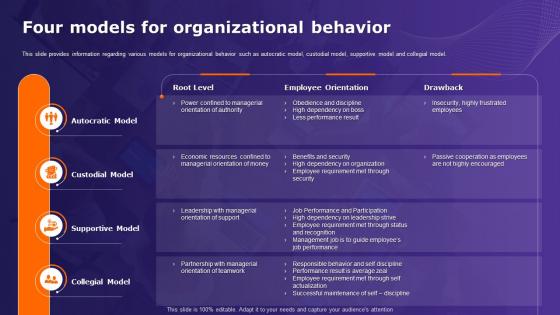
This slide provides information regarding various models for organizational behavior such as autocratic model, custodial model, supportive model and collegial model.
People who downloaded this PowerPoint presentation also viewed the following :
Organizational Behavior Theory Four Models For Organizational Behavior with all 9 slides:
Use our Organizational Behavior Theory Four Models For Organizational Behavior to effectively help you save your valuable time. They are readymade to fit into any presentation structure.








FAQs for Organizational Behavior Theory Four Models
So OB models basically have three main parts - individual stuff like personality and motivation, group dynamics (team communication, conflict, all that), and then organizational things like culture and leadership. Picture it as circles inside circles, you know? Individual behavior affects teams, teams affect the whole company. When you're trying to figure out workplace problems, you gotta look at all three levels since they're all connected. Start by figuring out which level is actually causing your issue - saves you from spinning your wheels trying to fix everything at once.
So basically, whatever OB model your company uses totally shapes how everyone acts and what gets rewarded. Autocratic places? Super hierarchical - decisions come from the top and everyone just waits around for orders. But collaborative models are way better honestly, people actually feel like they can speak up and share ideas. Then you've got human relations focused on keeping employees happy, and systems models looking at how everything connects. Oh, and here's the thing - figure out which model your org actually follows, not what they claim in meetings. Makes it way easier to navigate the whole thing.
So here's the thing - leadership is like the foundation for pretty much every organizational behavior model out there. Whether you're looking at transformational leadership, situational stuff, or systems theory, it all comes back to how leaders set the vibe. They shape culture through their communication style and what they decide to reward (or not reward, which honestly can be just as powerful). Take Kotter's model or contingency theory - your leadership approach determines if teams actually collaborate and innovate or just phone it in. Bottom line? Want to change how people behave at work? Start with changing leadership behaviors first.
Honestly, these models are game-changers for figuring out what actually makes your team tick. Like, maybe your people care way more about getting better at stuff than getting bonuses - who would've thought, right? Once you spot those patterns, you can ditch the cookie-cutter management advice that never works anyway. I'd start by just watching what behaviors keep happening and then trace back to why. Does your team light up with more freedom or do they want clear directions? Some of this stuff is totally backwards from what you'd expect, but that's what makes it useful.
So basically, good organizational behavior models hit D&I from multiple angles. Inclusive leadership is huge - plus they build psychological safety and fair decision-making processes. Most tackle unconscious bias in hiring (which honestly should've been happening decades ago, but whatever). Communication across cultural groups gets attention too. The smart ones don't treat diversity as some side project though. They weave D&I metrics right into performance reviews and day-to-day operations. Oh, and feedback systems that actually work for different people. My advice? Look at what your team's already doing first, then figure out where the biggest holes are.
Companies are totally ditching old-school micromanagement for trust-based approaches now. Remote work changed everything - managers focus on results instead of watching over shoulders all day. Flexibility isn't optional anymore, people just expect it. Teams collaborate async way more, and honestly the whole psychological contract thing has flipped. Your leadership style probably needs tweaking toward coaching rather than monitoring (took me forever to figure that out). Virtual team dynamics are huge now. Culture gets built through intentional digital stuff instead of water cooler chats. Maybe start rethinking how you actually measure your team's productivity?
Yeah, those old-school management models are pretty much useless tbh. They assume everyone's gonna act logically and predictably - which is laughable if you've ever worked with actual humans. Plus they completely ignore stuff like remote work, different cultures, and how fast companies pivot nowadays. Emotional intelligence? Individual motivations? Workplace drama? Nah, not their thing. They're way too rigid for most teams. I'd say use them as a rough guide but honestly, just go with what you're seeing work (or not work) with your specific people. That'll get you way further than following some textbook playbook.
So here's the thing - OB models have totally shifted to see tech as what actually drives behavior, not just some side tool. Remote work challenges? Covered. How AI messes with job roles? Yep. These frameworks dig into digital collaboration and what it does to trust levels (spoiler: it's complicated). They're also looking at algorithm influence on company culture and that tech stress we all pretend doesn't exist. The work-life boundary thing hits different when you're always "available," right? My advice? Start by checking how technology already shapes your team's patterns. That's where this stuff gets useful instead of just theoretical.
So basically, the way you structure your team totally changes how they actually work together. Hierarchical setups mean more formal emails and slower decisions - you know how that goes. Flat structures? People speak up more and solve problems faster. Micromanaging (autocratic style) pisses everyone off, but honestly it works when things are on fire. The collaborative approach where everyone gets a voice? That's where you see real creativity and people don't hate their jobs. You've gotta match your style to what's actually happening. Watch your next team meeting - you'll notice patterns pretty quickly.
So basically motivation theories are like the foundation for most OB models - they explain why people do what they do at work. Maslow's hierarchy, expectancy theory, all that stuff gets built into job design and performance systems. Pretty neat how it all fits together, actually. The OB models then give you a way to apply those insights across your whole team or company. My advice? Always start with the motivation theory when you're dealing with engagement problems or setting up incentives. Then use the broader OB frameworks to roll out solutions that'll actually stick.
Track the usual stuff - engagement scores, turnover, productivity numbers. But honestly? Sometimes those metrics lie. People can game surveys or just go through the motions. Set up regular one-on-ones and focus groups to hear what's really happening. I'd compare everything to your baseline from before you started this whole thing. Oh, and don't expect miracles overnight - give it at least 6 months before you panic. If nothing's improved by then, time to pivot.
Honestly, communication makes or breaks everything when you're rolling out any new organizational model. People need to understand the why behind changes, not just get handed some framework and told to figure it out. I've watched so many good ideas crash because leadership thought everyone would just "get it" automatically - spoiler alert, they don't. You've got to explain how it affects their actual day-to-day work. Both directions matter too. Listen when people push back or seem confused. My advice? Talk about it way more than feels necessary. Better to over-explain than watch your whole initiative fall apart.
Yeah, companies totally pick structures that fit what they're actually trying to do. Tech companies? They're all about flat teams and agile stuff since they need to innovate fast. Healthcare is the opposite - super bureaucratic because, honestly, you don't want loose protocols when someone's life depends on it. Consulting firms do this matrix thing where people jump between different client projects. Manufacturing usually sticks with old-school hierarchies since they need clear chains of command for safety reasons. Just figure out what your industry cares about most - is it speed, safety, creativity? Then pick whatever structure supports that.
Definitely check out Google's Project Aristotle - they figured out psychological safety is huge for team performance. Southwest Airlines has been crushing it with servant leadership for years, and Netflix's culture deck is pretty legendary for showing how transparency actually works. Oh, and Zappos tried that holacracy thing which was... interesting. Total disaster honestly, but you learn from failures too, right? Each one gives you solid examples of theories in action. I'd probably pick whichever company faces similar issues to what you're dealing with and really dig into their approach.
Think of OB models like a cheat sheet for predicting how people will react to change. Lewin's 3-stage thing walks you through unfreezing-change-refreezing, which sounds boring but actually works. Kotter's got 8 specific steps if you want more detail. ADKAR is great for individual stuff too - honestly probably my favorite because it's so straightforward. The whole point is they help you see why your team might lose their minds at first or when you absolutely need to communicate certain things. Just pick whichever one clicks with your situation and you'll spot problems way earlier.
-
Mesmerized with the fantastic collection! Super sleek, relevant infographics.
-
This design is not only aesthetically pleasing but it has many uses making the cost worthwhile. The graphics look stunning, and you can edit them as per your needs.