


Talent Management System for Effective Hiring Process complete deck




Try Before you Buy Download Free Sample Product
 Impress Your
 Audience
 100%
100% Editable
 Save Hours
 of Time


Talent management is the workforce recruitment, selection, and retention, involving a combination of human resource activities across the employee lifecycle. Its primary purpose is to motivate, engage and retain staff to increase productivity. Check out our efficiently designed Talent Management System for Effective Hiring Process PowerPoint presentation. It represents critical issues faced by the organization in managing talent and global statistics relating to talents, such as employee experience, turnover rate, talent retention, and employee engagement, enabling managers to understand the current scenario. This performance management system covers organizational effectiveness, workforce staffing, development, and staff management for assessing employee selection, orientation, leadership development, talent gap analysis, and planning. Lastly, it includes selecting talent management software, a budget plan, and the impact of integrating an employee management system, illustrating an increase in productivity and a low employee turnover rate, along with a metric dashboard to measure talent performance. Download our 100 percent editable and customizable template, which is also compatible with Google Slides.
People who downloaded this PowerPoint presentation also viewed the following :
Content of this Powerpoint Presentation
Slide 1: This slide introduces Talent Management System for Effective Hiring Process. State Your Company Name and begin.
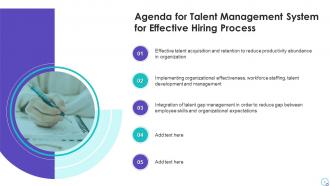
Slide 2: This slide states Agenda of the presentation.
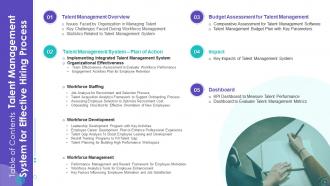
Slide 3: This slide presents Table of Content for the presentation.
Slide 4: This slide highlights title for topics that are to be covered next in the template.
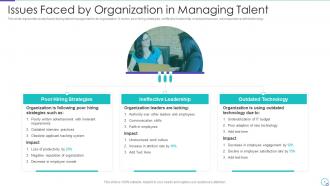
Slide 5: This slide shows Issues Faced by Organization in Managing Talent.
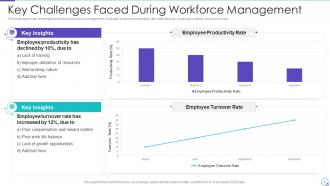
Slide 6: This slide presents Key Challenges Faced During Workforce Management.
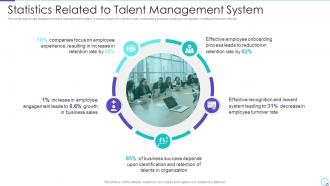
Slide 7: This slide displays Statistics Related to Talent Management System.
Slide 8: This slide highlights title for topics that are to be covered next in the template.
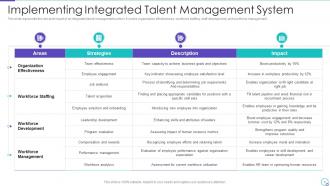
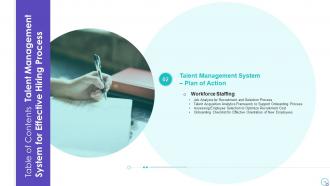
Slide 9: This slide represents Implementing Integrated Talent Management System.
Slide 10: This slide highlights title for topics that are to be covered next in the template.
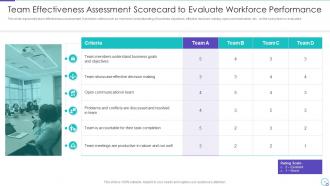
Slide 11: This slide showcases Team Effectiveness Assessment Scorecard to Evaluate Workforce Performance.
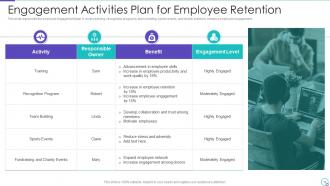
Slide 12: This slide shows Engagement Activities Plan for Employee Retention.
Slide 13: This slide highlights title for topics that are to be covered next in the template.
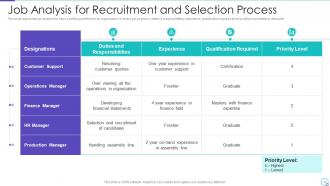
Slide 14: This slide presents Job Analysis for Recruitment and Selection Process.
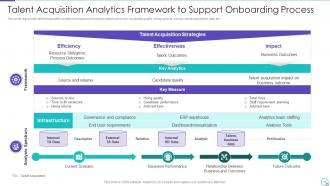
Slide 15: This slide displays Talent Acquisition Analytics Framework to Support Onboarding Process.
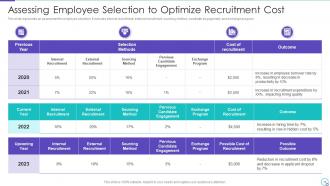
Slide 16: This slide represents Assessing Employee Selection to Optimize Recruitment Cost.
Slide 17: This slide showcases Onboarding Checklist for Effective Orientation of New Employees.
Slide 18: This slide highlights title for topics that are to be covered next in the template.
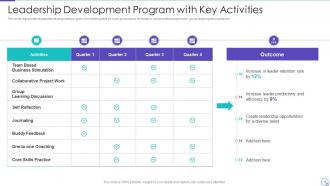
Slide 19: This slide shows Leadership Development Program with Key Activities.
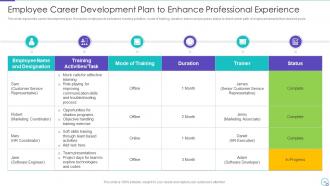
Slide 20: This slide presents Employee Career Development Plan to Enhance Professional Experience.
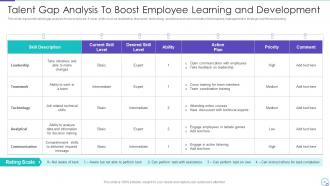
Slide 21: This slide displays Talent Gap Analysis To Boost Employee Learning and Development.
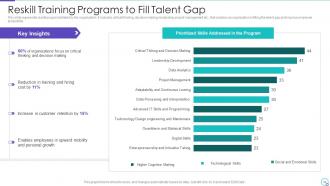
Slide 22: This slide represents Reskill Training Programs to Fill Talent Gap.
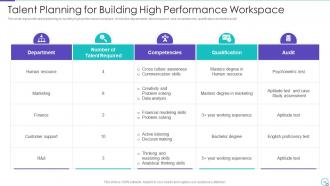
Slide 23: This slide showcases Talent Planning for Building High Performance Workspace.
Slide 24: This slide highlights title for topics that are to be covered next in the template.
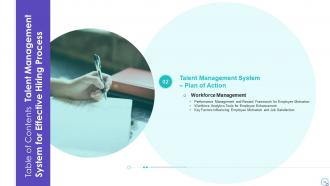
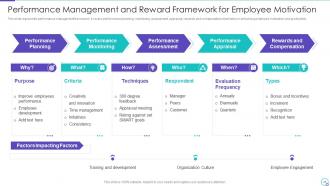
Slide 25: This slide shows Performance Management and Reward Framework for Employee Motivation.
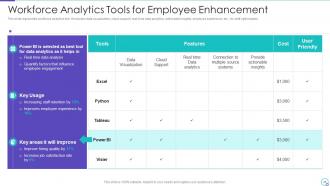
Slide 26: This slide presents Workforce Analytics Tools for Employee Enhancement.
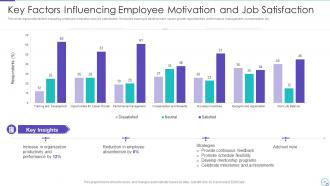
Slide 27: This slide displays Key Factors Influencing Employee Motivation and Job Satisfaction.
Slide 28: This slide highlights title for topics that are to be covered next in the template.
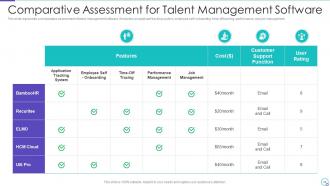
Slide 29: This slide represents Comparative Assessment for Talent Management Software.
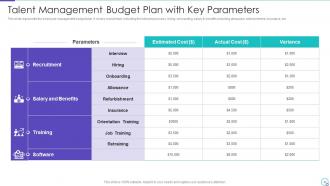
Slide 30: This slide showcases Talent Management Budget Plan with Key Parameters.
Slide 31: This slide highlights title for topics that are to be covered next in the template.
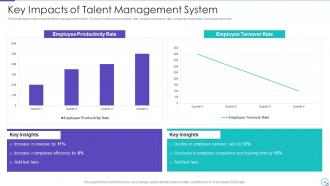
Slide 32: This slide shows Key Impacts of Talent Management System.
Slide 33: This slide highlights title for topics that are to be covered next in the template.
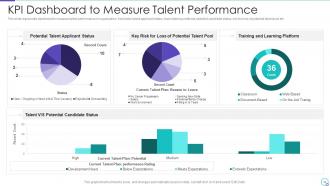
Slide 34: This slide presents KPI Dashboard to Measure Talent Performance.
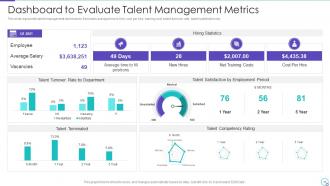
Slide 35: This slide displays Dashboard to Evaluate Talent Management Metrics.
Slide 36: This slide showcases Icons for Talent Management System for Effective Hiring Process.
Slide 37: This slide is titled as Additional Slides for moving forward.
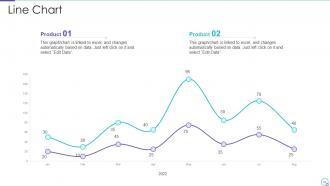
Slide 38: This slide describes Line chart with two products comparison.
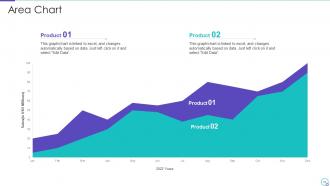
Slide 39: This slide depicts Area chart with two products comparison.
Slide 40: This is Our Goal slide. State your firm's goals here.
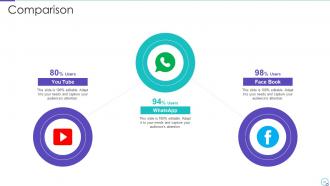
Slide 41: This is a Comparison slide to state comparison between commodities, entities etc.
Slide 42: This slide provides 30 60 90 Days Plan with text boxes.
Slide 43: This slide shows Post It Notes. Post your important notes here.
Slide 44: This slide depicts Venn diagram with text boxes.
Slide 45: This slide contains Puzzle with related icons and text.
Slide 46: This is a Timeline slide. Show data related to time intervals here.
Slide 47: This is a Thank You slide with address, contact numbers and email address.
Talent Management System for Effective Hiring Process complete deck with all 52 slides:
Use our Talent Management System for Effective Hiring Process complete deck to effectively help you save your valuable time. They are readymade to fit into any presentation structure.






FAQs for Talent Management System for Effective Hiring
Key features include applicant tracking, performance management, learning and development modules, succession planning, and compensation management capabilities. These systems streamline recruitment processes, enhance employee development tracking, and enable strategic workforce planning, with many organizations finding that integrated platforms deliver improved retention rates, faster hiring cycles, and better alignment between talent strategies and business objectives.
A Talent Management System enhances employee engagement by providing personalized career development paths, continuous feedback mechanisms, and recognition programs that align individual goals with organizational objectives. Through automated performance tracking and skill gap analysis, employees receive targeted learning opportunities and clear advancement visibility, ultimately fostering greater job satisfaction and retention across teams.
Talent analytics improves recruitment strategies by identifying top-performing candidate sources, predicting hiring success through data patterns, optimizing job descriptions based on successful placements, and reducing time-to-hire through process insights. These data-driven approaches enable organizations to target quality candidates more effectively, minimize recruitment costs, and enhance candidate experiences, ultimately delivering faster placements and improved retention rates.
A Talent Management System plays a crucial role in succession planning by identifying high-potential employees, tracking skill development, mapping career pathways, and creating leadership pipelines across organizational levels. These systems enable companies to proactively assess talent gaps, accelerate development programs, and ensure business continuity, with many organizations finding that strategic succession planning reduces hiring costs while strengthening internal mobility.
Organizations measure TMS ROI by tracking reduced recruitment costs, decreased turnover rates, improved time-to-hire metrics, and enhanced employee productivity scores. Through comprehensive analytics, companies can quantify savings from streamlined processes, better talent retention, and accelerated development programs, with many finding that strategic talent management delivers measurable competitive advantages and operational efficiency gains.
Implementation challenges include system integration complexities, employee resistance to change, data migration issues, inadequate training programs, and budget overruns. Organizations often struggle with aligning existing processes with new workflows, ensuring user adoption across departments, and maintaining data accuracy, while many companies find that phased rollouts and comprehensive change management strategies significantly improve implementation success rates.
A Talent Management System fosters learning culture by identifying skill gaps, delivering personalized development paths, tracking learning progress, and connecting performance outcomes to growth opportunities. Through integrated learning modules and competency mapping, organizations streamline employee development, enhance knowledge sharing, and create continuous improvement frameworks, ultimately delivering higher engagement and competitive advantage through strategic talent development.
Essential security measures for talent management systems include multi-factor authentication, role-based access controls, data encryption, regular security audits, and compliance frameworks like GDPR or HIPAA. These protections safeguard sensitive employee data through encrypted storage, secure transmission protocols, and automated backup systems, with many organizations finding that comprehensive security ultimately enhances employee trust while ensuring regulatory compliance.
Automation within Talent Management Systems streamlines HR processes by digitizing candidate screening, automating interview scheduling, and eliminating manual data entry across recruitment workflows. Through AI-powered matching and workflow automation, organizations reduce hiring time by 40-50%, minimize administrative overhead, and enable HR teams to focus on strategic talent development, ultimately delivering faster placements and enhanced candidate experiences.
Mobile accessibility significantly enhances Talent Management Systems by enabling real-time performance tracking, streamlined recruitment processes, and flexible employee development access. Through mobile platforms, organizations deliver faster feedback cycles, seamless onboarding experiences, and continuous learning opportunities, with many companies finding that mobile-enabled systems increase employee engagement and reduce administrative overhead while providing competitive advantage in talent retention.
A Talent Management System supports diversity and inclusion by providing unbiased recruitment tools, tracking demographic analytics across hiring and promotions, and ensuring equitable performance evaluations through standardized processes. These systems enable organizations to identify gaps in representation, monitor progress toward inclusion goals, and create transparent career pathways, with many companies finding that data-driven approaches significantly enhance workplace equity and retention.
Current trends in Talent Management Systems include AI-powered recruitment, predictive analytics for retention, employee experience platforms, skills-based talent mapping, and integrated performance management tools. These technologies streamline hiring processes, enhance workforce planning, and deliver personalized development pathways, with many organizations finding that strategic talent systems ultimately reduce turnover while accelerating organizational growth and competitive advantage.
Integration capabilities with other HR software enhance a Talent Management System by creating seamless data flow, eliminating duplicate entries, and providing comprehensive employee insights across all HR functions. Through connected payroll, recruiting, and performance platforms, organizations streamline workflows, reduce administrative overhead, and deliver unified employee experiences, with many companies finding that integrated systems significantly improve decision-making accuracy and operational efficiency.
Organizations can ensure user adoption through comprehensive training programs, clear communication of benefits, involving key stakeholders in implementation planning, and providing ongoing technical support. Successful adoption typically requires leadership endorsement, gradual rollout phases, and regular feedback collection, with many companies finding that demonstrating immediate value through streamlined processes and improved employee experiences accelerates acceptance across all organizational levels.
Feedback mechanisms in Talent Management Systems drive employee development by providing real-time performance insights, identifying skill gaps, and creating personalized development pathways through continuous coaching conversations. These systems enable managers to deliver targeted guidance while tracking progress systematically, with organizations finding that regular feedback cycles significantly enhance employee engagement, accelerate career growth, and ultimately improve retention rates.
-
The designs are super attractive. Me and my team love using SlideTeam’s presentations.
-
The templates are the best in class. Very clear and innovative graphics! I am excited to explore and download more presentations.