

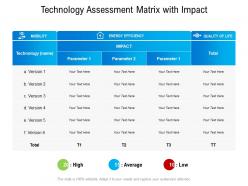
Technology assessment matrix with impact





Try Before you Buy Download Free Sample Product
 Impress Your
 Audience
 100%
100% Editable
 Save Hours
 of Time


Encourage folks to give every assistance to the disabled with our Technology Assessment Matrix With Impact. It helps conduct an effective campaign.
People who downloaded this PowerPoint presentation also viewed the following :
Technology assessment matrix with impact with all 2 slides:
The impact of our Technology Assessment Matrix With Impact can be enormous. It helps develop the driving force.
FAQs for Technology assessment
Key components of a technology assessment matrix include evaluation criteria, scoring methodologies, risk assessments, cost-benefit analyses, and implementation timelines. These components streamline decision-making by enabling organizations to systematically compare technologies across multiple dimensions, with many enterprises finding that this structured approach reduces evaluation time, minimizes implementation risks, and ultimately delivers more strategic technology investments.
Organizations effectively prioritize technologies using a technology assessment matrix by evaluating criteria like strategic alignment, implementation complexity, cost-benefit ratios, risk factors, and competitive impact across multiple dimensions. This structured approach enables companies to systematically compare emerging technologies, allocate resources efficiently, and make data-driven decisions, with many enterprises finding that comprehensive matrices streamline technology adoption and minimize costly misalignments.
A technology assessment matrix should include technical feasibility, scalability potential, integration complexity, implementation costs, security requirements, and competitive advantage potential. These criteria enable organizations to systematically evaluate emerging technologies by analyzing risk-to-benefit ratios, resource allocation needs, and strategic alignment, with many enterprises finding that comprehensive assessment frameworks ultimately streamline decision-making and minimize costly technology investments.
Technology assessment matrices evaluate tech options through structured criteria like cost, scalability, implementation complexity, and strategic alignment, while SWOT analysis focuses on broader strengths, weaknesses, opportunities, and threats. These matrices enable organizations to compare multiple technologies systematically with weighted scoring systems, ultimately delivering more objective decision-making than SWOT's qualitative approach, with many enterprises finding quantified assessments streamline vendor selection processes.
Stakeholder input ensures technology assessment matrices address real operational needs, user requirements, and strategic priorities across different organizational levels. Through interviews, surveys, and workshops, stakeholders from IT, operations, finance, and end-users provide crucial insights on feasibility, implementation challenges, and success metrics, ultimately delivering more accurate evaluations and stronger organizational buy-in.
A technology assessment matrix facilitates better alignment by systematically evaluating initiatives against strategic objectives, business impact, resource requirements, and implementation feasibility. This structured approach enables organizations to prioritize investments that deliver maximum value, streamline resource allocation across departments, and ensure technology decisions support core business outcomes, with many companies finding that matrices reduce misaligned spending while accelerating strategic growth.
Best practices for updating technology assessment matrices include establishing regular review cycles, incorporating real-time market intelligence, engaging cross-functional stakeholder input, adjusting evaluation criteria based on emerging trends, and maintaining version control documentation. These practices enable organizations to capture evolving vendor capabilities, shifting regulatory requirements, and new competitive threats, with many enterprises finding that quarterly assessments deliver optimal strategic alignment.
Organizations use a technology assessment matrix to identify potential risks by evaluating criteria like security vulnerabilities, integration complexity, scalability limitations, compliance requirements, and implementation costs across multiple technological options. This systematic approach enables companies to compare risk profiles side-by-side, with many financial services and healthcare institutions finding that structured assessment helps minimize operational disruptions while maximizing strategic technology investments.
Visualization tools enhance technology assessment matrices by transforming complex data into interactive dashboards, heat maps, radar charts, and comparative graphs that simplify decision-making processes. These visual representations enable stakeholders to quickly identify technology gaps, benchmark performance across multiple criteria, and communicate findings more effectively to executives, ultimately accelerating strategic technology investments and improving organizational buy-in.
The technology assessment matrix adapts across industries by customizing evaluation criteria, risk factors, and compliance requirements specific to each sector's operational demands and regulatory landscape. In healthcare, matrices prioritize patient safety, HIPAA compliance, and clinical workflow integration, while financial services focus on fraud prevention, regulatory adherence, and transaction security, with organizations finding that industry-specific customization delivers more accurate technology selections and strategic alignment.
Common pitfalls include inadequate stakeholder involvement, unrealistic scoring criteria, focusing solely on technical features while ignoring business alignment, insufficient data collection, and failing to regularly update assessment parameters. Many organizations also struggle with bias toward familiar technologies, lack of cross-departmental input, and neglecting long-term scalability considerations, ultimately compromising strategic decision-making and technology investments.
Organizations integrate quantitative and qualitative data in their technology assessment matrices by combining measurable metrics like cost, performance benchmarks, and ROI calculations with subjective evaluations such as user experience, strategic alignment, and implementation complexity. This balanced approach enables comprehensive decision-making, with many enterprises finding that weighting both data types delivers more accurate technology selections and ultimately enhances competitive advantage.
Tools for creating technology assessment matrices include Microsoft Excel, Google Sheets, specialized software like DecisionLens, SmartDraw, and enterprise platforms such as ServiceNow IT Business Management. These solutions streamline evaluation by automating scoring calculations, enabling collaborative input from multiple stakeholders, and generating visual dashboards, with many organizations finding that dedicated matrix software significantly enhances decision accuracy and reduces assessment time.
Case studies demonstrate technology assessment matrices by showcasing structured evaluation processes, comparative scoring methodologies, stakeholder alignment strategies, and risk mitigation frameworks across diverse implementation scenarios. Through documented examples from sectors like healthcare system upgrades, manufacturing automation decisions, and financial services digital transformations, organizations can observe how systematic assessment matrices streamline technology selection, reduce implementation risks, and ultimately deliver measurable ROI improvements.
Organizations should consider artificial intelligence integration, cloud-native architectures, cybersecurity resilience, sustainability metrics, and regulatory compliance when developing their technology assessment matrices. These emerging trends enable companies to evaluate solutions that streamline operations, enhance data security, and reduce environmental impact, with many finding that forward-looking matrices ultimately deliver competitive advantage in increasingly dynamic markets.
No Reviews