


Telesales Lead Generation Conversion Funnel




Try Before you Buy Download Free Sample Product
 Impress Your
 Audience
 100%
100% Editable
 Save Hours
 of Time


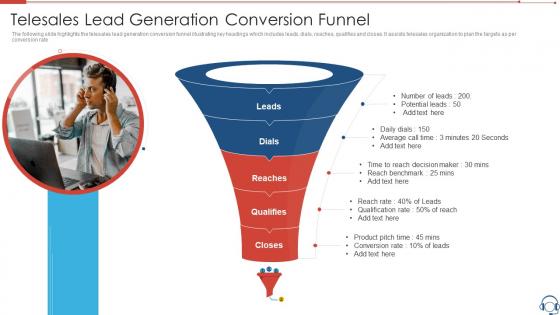
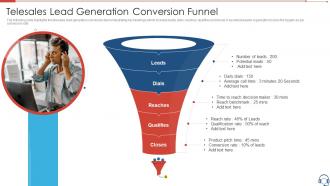
The following slide highlights the telesales lead generation conversion funnel illustrating key headings which includes leads, dials, reaches, qualifies and closes. It assists telesales organization to plan the targets as per conversion rate.
People who downloaded this PowerPoint presentation also viewed the following :
Telesales Lead Generation Conversion Funnel with all 6 slides:
Use our Telesales Lead Generation Conversion Funnel to effectively help you save your valuable time. They are readymade to fit into any presentation structure.





FAQs for Telesales Lead
The key stages of a telesales conversion funnel include lead generation, initial contact and qualification, needs assessment, product presentation, objection handling, and closing. These stages streamline the sales process by systematically nurturing prospects through targeted conversations, personalized solutions, and strategic follow-ups, with many organizations finding that structured funnels significantly enhance conversion rates and revenue growth.
Understanding customer personas enhances telesales funnels by enabling precise targeting, personalized messaging, tailored objection handling, and strategic timing throughout each conversion stage. These detailed customer profiles streamline lead qualification, improve script customization, and optimize follow-up sequences, with many sales organizations finding that persona-driven approaches significantly increase conversion rates and reduce sales cycle length.
Common telesales pitfalls include inadequate lead qualification, generic scripting without personalization, poor follow-up timing, insufficient product knowledge, and failure to address objections effectively. These challenges often result from rushed prospecting, lack of CRM integration, and insufficient training, with many sales teams finding that addressing these systematically through better processes, targeted coaching, and data-driven insights significantly improves conversion rates and revenue outcomes.
Script refinement significantly impacts telesales conversion rates by improving message clarity, addressing common objections proactively, and creating more natural conversation flows that build rapport with prospects. Through systematic testing and optimization, sales teams streamline their pitch delivery, enhance customer engagement, and ultimately boost conversion rates, with many organizations finding that refined scripts increase their closing ratios by 15-25%.
Key metrics for analyzing telesales conversion funnel performance include call-to-lead conversion rates, lead qualification rates, appointment setting ratios, proposal conversion percentages, and overall sales velocity through each stage. These metrics enable sales organizations to identify bottlenecks, optimize agent performance, and streamline processes, with many companies finding that tracking stage-specific conversion rates ultimately delivers improved forecasting accuracy and revenue growth.
Lead qualification significantly enhances telesales efficiency by enabling representatives to focus resources on prospects with genuine buying intent, budget authority, and decision-making timelines. Through systematic qualification processes, sales teams reduce time spent on unviable leads, accelerate conversion rates, and improve overall productivity, with many organizations finding that qualified leads convert at rates 3-5 times higher than unqualified prospects.
Follow-up plays a crucial role in telesales conversion by nurturing prospects through multiple touchpoints, addressing objections, and building trust over time. Through strategic follow-up sequences, sales teams can increase conversion rates by 35-50%, particularly in industries like insurance and financial services, ultimately turning initial interest into closed deals.
Storytelling techniques can be integrated into telesales conversations through customer success narratives, problem-solution scenarios, relatable case studies, and outcome-focused examples that demonstrate value. These approaches enable sales representatives to build emotional connections, overcome objections naturally, and illustrate tangible benefits, with many organizations finding that structured storytelling increases conversion rates significantly.
Technologies that optimize telesales conversion include CRM systems, predictive dialers, call analytics software, lead scoring platforms, and AI-powered conversation intelligence tools. These solutions streamline operations by automating lead prioritization, optimizing call timing, and providing real-time coaching insights, with many sales organizations finding that strategic technology integration delivers higher conversion rates and improved agent performance.
Telesales teams should manage objections through active listening, empathetic acknowledgment, and prepared response frameworks that address common concerns like pricing, timing, and product fit. By training representatives to view objections as buying signals rather than rejections, companies across retail, software, and financial services find significantly higher conversion rates, with successful teams ultimately transforming resistance into trust-building opportunities.
Best practices for training new telesales representatives include product knowledge mastery, objection handling techniques, active listening skills, CRM system proficiency, and structured call scripting frameworks. These comprehensive training approaches streamline onboarding by building confidence, enhancing communication effectiveness, and establishing consistent sales methodologies, with many organizations finding that well-trained representatives achieve higher conversion rates and deliver improved customer experiences.
Personalization in telesales enhances engagement by tailoring conversations to individual customer needs, preferences, purchase history, and behavioral patterns, creating meaningful connections that resonate beyond generic pitches. This strategic approach enables sales teams to address specific pain points, recommend relevant solutions, and build trust more effectively, with many organizations finding that personalized calls deliver significantly higher conversion rates and stronger customer relationships.
Timing significantly impacts conversion rates by ensuring prospects receive relevant information when they're most receptive to making purchasing decisions, whether during initial awareness or final consideration stages. Strategic outreach timing, particularly within hours of prospect inquiries or specific behavioral triggers, enables sales teams to capitalize on peak interest moments, with many organizations finding that well-timed follow-ups increase conversion rates substantially.
Data analytics informs telesales conversion strategies by identifying bottlenecks at each funnel stage, analyzing customer behavior patterns, and revealing optimal timing for calls. Through predictive modeling and performance metrics, sales teams can personalize approaches, prioritize high-value prospects, and refine scripts, with many organizations finding that data-driven insights increase conversion rates while reducing customer acquisition costs.
Team collaboration significantly enhances telesales campaign success by improving lead qualification, streamlining follow-up processes, and enabling real-time knowledge sharing across representatives. Through coordinated efforts, sales teams can leverage collective expertise, reduce prospect response times, and maintain consistent messaging, with many organizations finding that collaborative approaches increase conversion rates by 25-40% while delivering enhanced customer experiences.
-
Informative presentations that are easily editable.
-
Appreciate the research and its presentable format.