


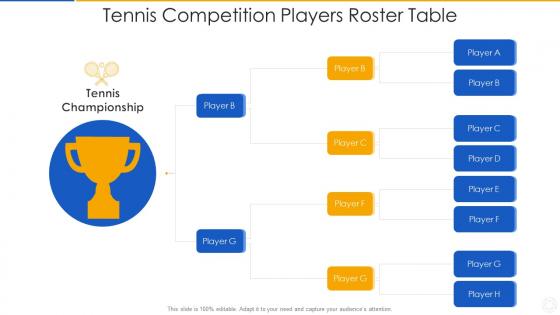
Tennis competition players roster table




Try Before you Buy Download Free Sample Product
 Impress Your
 Audience
 100%
100% Editable
 Save Hours
 of Time


Our Tennis Competition Players Roster Table are topically designed to provide an attractive backdrop to any subject. Use them to look like a presentation pro.
People who downloaded this PowerPoint presentation also viewed the following :
Tennis competition players roster table with all 2 slides:
Use our Tennis Competition Players Roster Table to effectively help you save your valuable time. They are readymade to fit into any presentation structure.

FAQs for Tennis competition
**INPUT**: What are the key elements to include in a tennis roster presentation? **OUTPUT**: Tennis roster presentations should include player profiles with rankings and statistics, match schedules and tournament calendars, team formation strategies, performance analytics, and coaching staff credentials. These elements streamline team management by enhancing strategic planning, facilitating performance tracking, and improving communication with stakeholders, ultimately delivering better competitive outcomes and organizational efficiency.
Effective design improves tennis roster templates by enhancing readability through clear typography, strategic color coding for different player categories, and intuitive layouts that highlight key information like rankings and match schedules. Well-designed templates streamline coach decision-making, facilitate quick player identification during tournaments, and improve communication with team members, ultimately delivering better organizational efficiency and enhanced team management across recreational leagues, school programs, and professional tennis organizations.
When selecting players for a tennis roster, consider skill level consistency, match performance under pressure, physical fitness and injury history, strategic versatility across playing styles, and team chemistry dynamics. These factors work together to build competitive depth, with many coaches finding that balancing proven performers with developing talent creates roster flexibility, ultimately delivering stronger match outcomes and sustained program success.
Data visualization enhances tennis roster presentations by transforming player statistics, performance metrics, match histories, and team comparisons into clear, interactive charts and infographics. Through strategic visual elements like heat maps, performance dashboards, and comparative graphics, coaches and analysts can communicate player strengths, seasonal trends, and tactical insights more effectively, ultimately enabling faster strategic decisions and enhanced audience engagement.
Player statistics serve as the foundation for tennis roster development, guiding coaches in evaluating serve percentages, win-loss records, tournament performance, ranking trajectories, and head-to-head matchups against specific opponents. These metrics enable teams to strategically assess player strengths, identify improvement areas, and make informed decisions about roster composition, ultimately delivering competitive advantages through data-driven player selection and development strategies.
A tennis roster template accommodates varying team sizes through flexible player slots, adjustable lineup sections, and scalable formatting that expands or contracts based on roster needs. These templates streamline team management by enabling coaches to efficiently organize players across singles, doubles, and mixed categories, while maintaining clear tournament brackets and match scheduling, ultimately delivering enhanced organizational efficiency and seamless competition coordination.
Common mistakes when creating a tennis roster include inadequate skill assessment, poor court scheduling, ignoring player availability patterns, failing to balance competitive levels, and overlooking partnership chemistry. These oversights can lead to mismatched games, underutilized court time, and frustrated participants, with many tennis facilities finding that strategic roster planning enhances member satisfaction while maximizing operational efficiency.
Technology enables real-time tennis roster updates through cloud-based management systems, mobile applications, automated scheduling platforms, and instant notification tools. These solutions streamline communication by automatically syncing player availability, match results, and lineup changes across all devices, with many tennis clubs and tournaments finding that digital integration significantly reduces administrative overhead while enhancing player coordination and tournament efficiency.
Best practices for presenting a tennis roster to stakeholders include clear player hierarchies, comprehensive performance metrics, injury status updates, strategic positioning explanations, and transparent selection criteria. These presentation methods enhance stakeholder understanding by streamlining communication, delivering actionable insights, and facilitating informed decision-making, with many sports organizations finding that structured roster presentations ultimately improve strategic planning and competitive positioning.
Coaches use tennis rosters to analyze player strengths, weaknesses, match histories, and current form rankings, enabling strategic lineup decisions and position assignments. Through comprehensive roster data, coaches can identify optimal player matchups, anticipate opponent strategies, and maximize competitive advantages, with many tennis programs finding that data-driven roster management significantly enhances match outcomes and team performance.
**INPUT**: What visual elements are most effective in showcasing player profiles on a roster? **OUTPUT**: Effective roster visual elements include high-quality headshots, consistent formatting, key statistics displays, position indicators, and color-coded performance metrics. These design components enhance viewer engagement by streamlining information accessibility, creating professional presentation standards, and enabling quick player comparisons, with many sports organizations finding that strategic visual hierarchy ultimately delivers improved fan experiences and stronger team branding.
A well-structured tennis roster contributes to team chemistry by balancing complementary playing styles, ensuring clear role definitions, and fostering healthy competition among players. Through strategic player positioning and consistent communication protocols, teams enhance collaboration during doubles matches, build mutual support systems, and ultimately deliver stronger performance outcomes, with many tennis programs finding that structured rosters significantly improve both individual development and collective team dynamics.
Including historical data in tennis roster presentations delivers enhanced player evaluation, performance trend analysis, strategic planning insights, injury pattern recognition, and recruitment decision support. These comprehensive datasets enable coaches and management to identify emerging talent, predict performance trajectories, and make data-driven roster decisions, while providing stakeholders with compelling narratives that demonstrate player development and team strategic evolution.
A tennis roster template caters to both levels through flexible age categories, skill level classifications, tournament tracking sections, and customizable player information fields. Professional applications include rankings, sponsorship details, and career statistics, while junior versions emphasize development milestones, parent contact information, and age group divisions, ultimately enabling coaches and administrators to streamline player management across competitive levels.
Legal and ethical considerations include privacy compliance, consent requirements, data protection regulations, accuracy verification, and age-appropriate disclosure protocols. These frameworks ensure player information remains secure while maintaining transparency, with many sports organizations finding that clear consent processes, regular data audits, and selective information sharing ultimately deliver regulatory compliance and enhanced trust from players and families.
-
Amazing product with appealing content and design.
-
It saves your time and decrease your efforts in half.
-
Informative design.
-
Qualitative and comprehensive slides.
-
Really like the color and design of the presentation.