


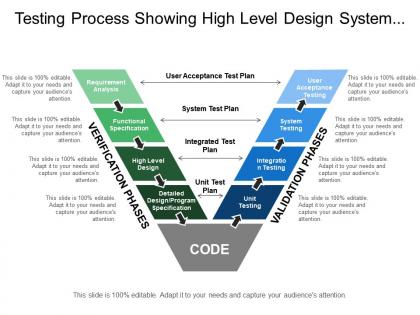
Testing process showing high level design system testing




Try Before you Buy Download Free Sample Product
 Impress Your
 Audience
 100%
100% Editable
 Save Hours
 of Time


Acquire global exposure with our Testing Process Showing High Level Design System Testing. Your thoughts will get carried to all corners of the earth.
People who downloaded this PowerPoint presentation also viewed the following :
Testing process showing high level design system testing with all 5 slides:
Declare your belief in female empowerment with our Testing Process Showing High Level Design System Testing. It is essential for our future.
FAQs for Testing process showing high level
The key objectives of high-level design system testing include validating system architecture, verifying component integration, ensuring performance scalability, confirming security protocols, and testing user interface functionality. These comprehensive assessments enable organizations to identify structural weaknesses early, streamline deployment processes, and minimize costly post-launch failures, with many technology companies finding that thorough high-level testing ultimately delivers faster time-to-market and enhanced user experiences.
High-level design testing evaluates entire system architecture and end-to-end workflows, while unit testing focuses on individual components and integration testing examines component interactions. This comprehensive approach validates business processes, user journeys, and system performance across multiple modules, with many organizations finding that it reveals critical issues like scalability bottlenecks and workflow gaps that smaller-scope testing methods cannot detect.
Critical components include test scope definition, system architecture validation, integration testing strategies, performance benchmarks, security assessments, and failure recovery procedures. These elements work together by ensuring comprehensive coverage of system interactions, validating scalability requirements, and identifying potential bottlenecks, with many organizations finding that structured high-level testing ultimately delivers more reliable deployments and reduced production issues.
High-level design system testing mitigates software development risks by identifying architectural flaws, integration issues, and scalability bottlenecks before implementation, while validating system-wide requirements and performance expectations. Through comprehensive testing frameworks, development teams streamline debugging processes, minimize costly post-deployment fixes, and enhance system reliability, ultimately delivering more robust applications with reduced time-to-market and improved stakeholder confidence.
Stakeholder feedback provides crucial validation during high-level design testing, ensuring solutions align with business requirements, user expectations, and technical constraints across different organizational levels. This input helps identify potential issues early, refines design decisions, and validates functionality against real-world scenarios, with many development teams finding that incorporating diverse stakeholder perspectives significantly reduces costly revisions and accelerates project delivery.
Effective methodologies include end-to-end testing, integration testing, performance testing, user acceptance testing, and system validation testing. These approaches streamline quality assurance by validating complete workflows, identifying integration issues, and ensuring scalability, with many software organizations finding that combining automated and manual testing delivers faster deployment cycles, reduced post-launch defects, and enhanced user experiences.
**INPUT**: How do you ensure that high-level design tests align with business requirements? **OUTPUT**: Ensuring alignment requires creating traceability matrices linking each test case to specific business objectives, conducting stakeholder reviews during test planning, and validating acceptance criteria against user stories. This systematic approach enables organizations to verify that testing scenarios reflect real-world business processes, ultimately delivering solutions that meet operational needs and strategic goals.
Tools that facilitate high-level design system testing include Storybook for component documentation, Chromatic for visual regression testing, Jest for unit testing, Cypress for end-to-end testing, and Figma for design validation. These technologies streamline testing workflows by automating visual consistency checks, validating component behavior, and ensuring cross-platform compatibility, ultimately delivering faster development cycles and enhanced user experiences.
Performance and scalability during high-level design tests are evaluated through load testing, stress testing, capacity planning, response time analysis, and resource utilization monitoring. These methodologies enable organizations to identify bottlenecks, optimize system architecture, and ensure seamless user experiences under varying demand levels, with many enterprises finding that early performance validation significantly reduces deployment risks and enhances competitive advantage.
Common challenges in high-level design system testing include integration complexity across multiple components, maintaining consistency in distributed teams, version control conflicts, performance bottlenecks at scale, and inadequate testing environments that don't mirror production systems. These challenges often result in delayed releases, inconsistent user experiences, and increased maintenance costs, with many organizations finding that implementing automated testing frameworks and cross-functional collaboration protocols significantly streamlines validation processes and enhances system reliability.
Regulatory requirements significantly shape high-level design testing strategies by mandating comprehensive documentation, traceability protocols, validation frameworks, and compliance checkpoints throughout development cycles. Industries like healthcare, finance, and aerospace must integrate specific regulatory standards into their testing approaches, with many organizations finding that proactive compliance testing streamlines audit processes while ensuring product reliability and market readiness.
Success metrics for high-level design testing include system performance benchmarks, integration effectiveness scores, scalability measurements, user experience indicators, and defect detection rates. These comprehensive metrics enable organizations to evaluate architectural robustness, identify bottlenecks, and ensure seamless component interactions, with many enterprises finding that balanced measurement approaches ultimately deliver faster deployment cycles and enhanced system reliability.
Documentation serves as the foundation for high-level design system testing by establishing clear testing criteria, component specifications, usage guidelines, and expected behaviors across different scenarios. It enables testing teams to validate design consistency, accessibility standards, and component interactions systematically, while providing developers and designers with shared references for maintaining quality, ultimately streamlining the testing process and ensuring cohesive user experiences.
Best practices for high-level design system testing include establishing comprehensive test scenarios, implementing automated regression testing, maintaining clear documentation standards, conducting cross-platform validation, and ensuring stakeholder alignment throughout the process. These approaches streamline quality assurance by reducing manual overhead, accelerating feedback cycles, and maintaining design consistency, with many organizations finding that systematic testing protocols ultimately deliver faster deployment timelines and enhanced user experiences across their digital products.
High-level design testing improves collaboration by establishing shared understanding through unified documentation, standardized testing protocols, and clear communication channels across development teams. Through comprehensive system validation, teams can identify integration issues early, streamline cross-functional workflows, and maintain consistent quality standards, ultimately delivering faster development cycles and reduced conflicts between frontend, backend, and QA teams.
-
Attractive design and informative presentation.
-
Wonderful templates design to use in business meetings.