

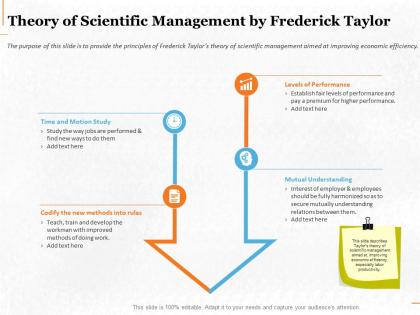
Theory of scientific management by frederick taylor ppt powerpoint format ideas




Try Before you Buy Download Free Sample Product
 Impress Your
 Audience
 100%
100% Editable
 Save Hours
 of Time


Establish conditions that create growth with our Theory Of Scientific Management By Frederick Taylor Ppt Powerpoint Format Ideas. They help analyze the dynamics.
People who downloaded this PowerPoint presentation also viewed the following :
Theory of scientific management by frederick taylor ppt powerpoint format ideas with all 2 slides:
Display the appetite for a challenge with our Theory Of Scientific Management By Frederick Taylor Ppt Powerpoint Format Ideas. Demonstrate the guts to face anything in the future.

FAQs for Theory of scientific management by frederick taylor ppt
So Taylor's Scientific Management has four main principles. Replace gut-feeling work methods with ones that are actually studied scientifically. Scientifically pick and train your workers instead of letting them figure it out themselves. Work with employees to make sure they're following the scientific methods. Then split the work evenly - managers handle planning and supervising, workers do the actual execution. Honestly, it's pretty much how modern industrial efficiency got started, though it's way too rigid for today's workplace culture. These principles still pop up everywhere in operations management if you squint hard enough.
So basically, Scientific Management is all about the tiny details - like Taylor timing workers with those stopwatches to find the "perfect" way to do each little task. Pretty intense if you ask me. Classical management cares more about the big picture stuff: who reports to who, how departments are set up, that whole chain of command thing. One's micro-focused, the other's macro. If you want better efficiency, Scientific Management gives you actual tools for breaking down tasks. But classical helps you figure out your overall structure and authority. Both useful, just different levels.
Yeah, you'll still find Taylor's stuff everywhere! Amazon warehouses are basically his wet dream - all that time-and-motion optimization cranked up to 11. Companies break jobs into tiny pieces, track everything with metrics, and separate the thinking from the doing. But here's the thing - smart managers now realize you can't just treat people like robots. Sure, use the process improvement ideas, standardized procedures work great. Just don't be that boss who forgets humans aren't machines. The data-driven decision making part? Gold. The treating workers like cogs part? Not so much.
So time and motion studies are basically how Taylor figured out the "one best way" to do stuff. You literally break every job into tiny steps, time each one, then cut out wasted movements. It's like workplace choreography - kinda nerdy but cool to watch honestly. These studies let him set performance standards and redesign workflows for max productivity. Without this detailed timing and observation, Scientific Management would've just been random guessing. The studies give you actual hard data to optimize your processes instead of winging it.
So Taylor's whole thing was paying workers based on output - more pieces made = more money earned. He figured everyone's just motivated by cash, which is pretty cynical if you ask me. The method breaks down jobs into super efficient steps, kind of like perfecting an assembly line. It actually worked for boosting productivity back in the day. You'd set clear metrics and tie pay directly to performance. But honestly? People get burned out when you treat them like robots. Money helps short-term, but workers need other stuff too - recognition, variety, whatever. Still, the basic principle isn't terrible for certain situations.
Yeah so the biggest issue is it basically turns people into robots - totally dehumanizing. Workers get super demotivated when they're treated like machines instead of actual humans. Plus it assumes there's always one "perfect" way to do any job, which is obviously BS in real complex situations. Social stuff gets completely ignored too - like teamwork, individual personalities, what actually motivates people beyond just a paycheck. I mean, money's important but it's not everything, right? The efficiency gains can be solid, but you gotta mix that with keeping employees actually engaged and having some flexibility in how things work.
Yeah totally! Just don't let Taylor's stuff turn into micromanaging hell - that'll kill agile real quick. What works is keeping your sprints and standups but also tracking your workflows with actual data. Like, still be flexible with your team but use that systematic analysis to spot where things get stuck. I'd probably start small though - pick one annoying bottleneck and apply some scientific method to it while everything else stays normal. It's basically data-driven agile if you think about it. The measurement part actually helps refine your processes without being all rigid about it.
So here's the thing - Scientific Management totally assumes all workers react the same way to efficiency stuff and money rewards. That works fine in places like the US where people are more individualistic. But throw it into a collectivist culture? You're gonna hit major resistance because it messes with team dynamics and how they've always done things. Power structures matter too - some cultures expect bosses to call all the shots while others want everyone involved. Taylor obviously didn't think about any of this back then (shocker, right?). Check your team's cultural vibe first before implementing anything.
Honestly, once you know what to look for, Scientific Management is literally everywhere. McDonald's breaks down every single task into timed steps - any worker can jump in and follow them perfectly. UPS drivers? Their routes are mapped out with exact step counts. Toyota took Taylor's old ideas and cranked them up to eleven with their production lines. Amazon warehouses are basically giant time-and-motion studies in action. What's wild is this theory is over 100 years old, but breaking complex jobs into simple, measurable tasks still works. Most industries still run on these principles today.
Look, training and standardization are basically what make Scientific Management actually function. You standardize processes so everyone's doing tasks the "one best way" - no more guessing or random approaches. Think of it like everyone using the same recipe instead of just improvising. Workers know exactly what's expected, which means predictable results and faster completion times. Fewer mistakes too. But here's the thing - your training has to be solid enough that people can actually stick to those standardized methods consistently. Otherwise you'll just end up with nice-looking procedures that nobody bothers following.
Dude, Taylor's old stopwatch methods have gotten a crazy upgrade. AI now handles those time-and-motion studies that used to need whole teams with clipboards. Real-time workflow optimization, automatic productivity tracking, bottleneck predictions - the tech does it all now. Honestly, the speed difference is wild compared to manual analysis. The basic idea hasn't changed though. Still about maximizing efficiency and standardizing stuff. But instead of doing everything by hand like it's 1911, you've got these incredibly powerful software tools. Whatever process improvements you're working on, definitely use the tech that's available rather than going old school.
Look, the trick is making sure your workers actually benefit from getting more efficient, not just the bosses. Start with fair pay and bonuses tied to those productivity gains. Taylor's old methods were way too rigid - you've gotta listen to what your team thinks about improving workflows. Give them proper training first, don't just time everything and demand they work faster. That's honestly just asking for trouble. Test it with one team before going all-out company-wide. Workers need to feel like partners in this, not lab rats being studied.
Dude, Scientific Management just doesn't work for creative stuff. You can't time how long a good idea takes - sometimes it's instant, other times you're stuck for weeks. Manufacturing? Sure, measure everything. But trying to standardize innovation is like... why would you even do that? Creative people need room to think, not rigid schedules that kill their flow. My advice? Keep some basic efficiency stuff (definitely cut those pointless meetings), but don't force creative work into factory-style boxes. It'll backfire every time.
So you know how Frederick Taylor figured out that timing every little step could make factories way more efficient? Pick any repetitive task your crew does and actually time it with a stopwatch. Break it down into tiny pieces and find the fastest method. Then teach everyone that exact same way - no more guessing or doing things however they feel like it. Honestly, most places I've seen have tons of wasted motion they don't even notice. You'll probably find 15-20% improvements just lying around. The key is training people properly and paying them fairly so they actually buy into your new system.
Honestly, Taylor's old-school efficiency stuff is weirdly making a comeback. With AI everywhere, we're back to obsessing over human-machine workflows - just with fancier algorithms instead of stopwatches. Remote work has managers tracking metrics like crazy, and gig work is all about measurable tasks anyway. But here's the thing - you can't just copy-paste the rigid micromanagement part. People will quit faster than you can say "productivity optimization." Borrow the systematic approach for sure, but ditch anything that makes your team feel like robots. Focus on streamlining processes without being creepy about it.
No Reviews