

Three Lines Of Defense Model For Cyber Security




Try Before you Buy Download Free Sample Product
 Impress Your
 Audience
 100%
100% Editable
 Save Hours
 of Time


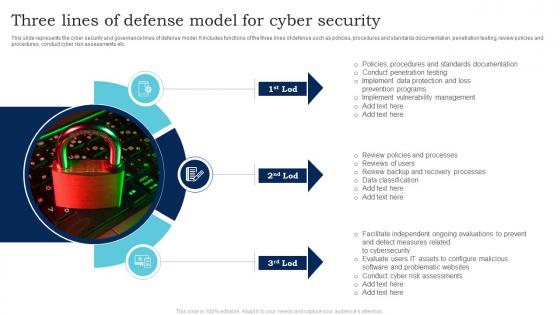
This slide represents the cyber security and governance lines of defense model. It includes functions of the three lines of defense such as policies, procedures and standards documentation, penetration testing, review policies and procedures, conduct cyber risk assessments etc.
People who downloaded this PowerPoint presentation also viewed the following :
Three Lines Of Defense Model For Cyber Security with all 6 slides:
Use our Three Lines Of Defense Model For Cyber Security to effectively help you save your valuable time. They are readymade to fit into any presentation structure.






FAQs for Three Lines Of Defense Model
The Three Lines of Defense model in cybersecurity includes operational management controls, independent risk oversight functions, and internal audit capabilities. These components work together by establishing preventive security measures at the operational level, providing continuous monitoring and compliance validation through risk teams, and delivering independent assurance assessments, ultimately creating layered protection that enables organizations to detect threats faster and respond more effectively.
The first line of defense strengthens cybersecurity posture by embedding security responsibilities directly into daily business operations, enabling real-time risk identification, incident prevention, and immediate threat response at the operational level. Through proactive monitoring, employee training, and integrated security protocols, business units can detect vulnerabilities early, minimize exposure windows, and create organizational resilience, ultimately delivering faster threat mitigation and enhanced security awareness across departments.
Frontline employees serve as the primary detection and prevention layer by identifying suspicious emails, reporting unusual system behavior, following security protocols, and maintaining awareness of emerging threats. Through proper training and clear reporting procedures, these employees enable organizations to catch potential breaches early, reduce response times, and strengthen overall security posture, with many companies finding that engaged frontline staff significantly minimize successful cyber attacks.
Organizations can effectively empower their first line of defense through comprehensive cybersecurity awareness programs, role-specific training modules, regular phishing simulations, clear incident reporting protocols, and continuous education updates. By integrating security training into daily workflows, companies across sectors like banking and healthcare find that employees become proactive threat detectors, ultimately reducing security incidents while strengthening organizational resilience.
The second line of defense encompasses risk management, security oversight, compliance monitoring, policy development, and threat assessment functions. These specialized teams streamline cyber governance by establishing security frameworks, conducting regular audits, and ensuring regulatory compliance, while providing independent oversight of first-line controls, ultimately delivering enhanced risk visibility and strategic security guidance across organizations.
Compliance and risk management teams enhance the second line of defense by establishing comprehensive cybersecurity policies, conducting regular risk assessments, monitoring regulatory compliance, and implementing governance frameworks that oversee security controls. These teams streamline organizational resilience by creating audit trails, facilitating cross-departmental communication, and ensuring continuous monitoring protocols, ultimately delivering enhanced threat visibility and regulatory adherence across enterprise operations.
The second line of defense enhances the first line by providing oversight, policy frameworks, and risk assessment guidance, while monitoring compliance and effectiveness of frontline security controls. Through continuous collaboration, security teams receive specialized expertise from risk management functions, enabling proactive threat identification, streamlined incident response, and ultimately stronger organizational resilience against evolving cyber threats.
**INPUT**: What technologies are typically employed by the second line of defense? **OUTPUT**: Second line of defense technologies include security information and event management (SIEM) systems, vulnerability assessment tools, compliance monitoring platforms, risk management software, and automated policy enforcement solutions. These technologies streamline oversight by centralizing threat detection, automating compliance reporting, and enabling continuous risk assessment, with many organizations finding that this strategic combination enhances operational efficiency while delivering comprehensive security governance. [Word count: 60 words]
The third line of defense provides independent assurance and validation of cyber security controls through internal audit functions, risk assessments, and compliance evaluations. This critical layer enables organizations to identify control gaps, verify security effectiveness, and maintain regulatory compliance, with many financial institutions and healthcare organizations finding that independent oversight ultimately delivers enhanced risk management and stakeholder confidence.
The third line of defense provides independent assurance through internal audit functions that objectively evaluate and validate the effectiveness of the first two lines, while the first line owns and manages risks directly, and the second line monitors and oversees risk management activities. This independent verification approach enables organizations to identify gaps in cybersecurity controls, assess compliance with established policies, and deliver comprehensive risk insights that enhance overall security posture and regulatory confidence.
The third line of defense employs independent audit methodologies including risk-based assessments, control testing, vulnerability assessments, penetration testing, and compliance reviews to evaluate cybersecurity effectiveness. Through systematic auditing frameworks, organizations can identify gaps in operational controls and management oversight, ultimately delivering objective insights that enhance security posture and regulatory compliance across financial services, healthcare, and manufacturing sectors.
Organizations ensure alignment between all three lines of defense through integrated governance frameworks, regular cross-functional communication protocols, and unified risk assessment methodologies that create shared understanding of cybersecurity objectives. Through collaborative incident response exercises, synchronized reporting mechanisms, and joint training programs, financial institutions and healthcare organizations streamline coordination between operational teams, risk management, and internal audit functions, ultimately delivering comprehensive threat protection and regulatory compliance.
Common implementation challenges include organizational resistance to change, unclear role definitions between defense lines, insufficient cybersecurity expertise, budget constraints, and complex legacy system integrations. Many organizations find that while the model enhances security governance and accountability, it requires significant cultural shifts, comprehensive staff training, and strategic resource allocation to deliver effective risk management and operational resilience.
Organizations measure Three Lines of Defense effectiveness through key performance indicators like incident response times, control deficiency rates, audit findings frequency, and security awareness training completion rates. Through regular assessments and cross-functional reviews, companies can evaluate coordination between operational teams, risk management, and internal audit functions, ultimately identifying gaps and strengthening their overall cybersecurity posture.
Continuous monitoring enables real-time threat detection and response across operational controls, risk management oversight, and independent auditing functions. Through automated security tools and analytics, organizations can identify vulnerabilities in first-line defenses, validate second-line risk assessments, and provide third-line auditors with comprehensive security postures, ultimately delivering proactive cyber resilience.
-
SlideTeam was so customer-centric and quick service-provider that I doubted the amount I was paying and literally re-checked the transaction.
-
Unique research projects to present in meeting.