


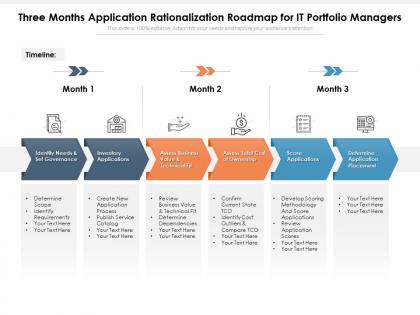
Three months application rationalization roadmap for it portfolio managers




Try Before you Buy Download Free Sample Product
 Impress Your
 Audience
 100%
100% Editable
 Save Hours
 of Time


Utilize our pre build Three Months Application Rationalization Roadmap For IT Portfolio Managers to present your plan of action in the most effective way. Reduce the paperwork and showcase how different activities are linked to each other by incorporating this attention grabbing PowerPoint theme. This completely editable roadmap PPT layout is suitable to fit all your needs and to have a structured outline of the entire process flow using color coding. Provide guidelines to your teammates about the progression process by employing our PPT theme. Team members can easily be designated into teams by accessing the work milestones to be accomplished within the timeframe. You can easily modify the PowerPoint slide according to real time situations. Download our stunning Three Months Application Rationalization Roadmap For IT Portfolio Managers, and you are good to go to prove your expertise in strategic planning.
People who downloaded this PowerPoint presentation also viewed the following :
Three months application rationalization roadmap for it portfolio managers with all 2 slides:
Give your audience a fulfilling experience. They will find our Three Months Application Rationalization Roadmap For IT Portfolio Managers elevating.

FAQs for Three months application rationalization roadmap for
Application rationalization offers several key benefits for organizations, including reduced IT complexity, streamlined operations, and optimized resource allocation. By consolidating and eliminating redundant or outdated applications, businesses can minimize maintenance costs, improve security posture, and enhance user experience. Many enterprises, particularly in the financial services sector, find that application rationalization leads to significant cost savings and increased agility in responding to market changes.
Application rationalization involves identifying and eliminating redundant applications within an organization's IT portfolio. This process can be achieved by conducting a thorough inventory of all existing applications, analyzing their functionalities, usage patterns, and dependencies, and comparing them against business needs and strategic goals. Through tools like application portfolio management software, organizations can gain insights into overlapping functionalities, outdated systems, and underutilized applications, ultimately streamlining operations and reducing IT costs while enhancing efficiency.
Evaluating application effectiveness involves considering factors like user adoption rates, operational efficiency gains, cost savings, and alignment with strategic goals. Organizations should analyze how well applications streamline workflows, reduce redundancies, and deliver tangible business value across departments, with many finding that applications that integrate seamlessly with existing systems and offer robust reporting capabilities drive the most significant improvements in efficiency and productivity.
Application rationalization contributes to cost savings in IT budgets by streamlining processes, minimizing redundancies, and optimizing resource allocation. By identifying and eliminating outdated or underutilized applications, organizations can reduce licensing fees, maintenance costs, and infrastructure requirements. For example, financial institutions often rationalize legacy banking systems, consolidating functionalities to lower hardware and software expenses while enhancing security and customer experiences.
Cloud computing plays a pivotal role in application rationalization by enabling organizations to consolidate, modernize, and optimize their software portfolio. It facilitates the migration of legacy applications to the cloud, reducing infrastructure costs and enhancing scalability. With cloud-based solutions, businesses can streamline their application landscape by retiring redundant or outdated systems, ultimately improving operational efficiency and delivering a more agile and cost-effective IT infrastructure.
Application rationalization requires stakeholder buy-in to succeed, as it often involves consolidating or retiring existing applications. Businesses can ensure this buy-in by clearly communicating the strategic rationale behind the process, emphasizing the benefits such as cost reduction, improved efficiency, and enhanced user experience. For example, by demonstrating how application rationalization can streamline workflows and reduce redundant tasks for employees in sectors like finance or healthcare, businesses can garner support. Ultimately, transparency, clear communication, and a focus on tangible benefits are key to securing stakeholder buy-in and driving successful application rationalization.
Application rationalization involves streamlining software usage by consolidating, retiring, or replacing redundant or inefficient applications. Effective tools include application portfolio management (APM) software, which provides centralized visibility and analysis of applications, and cloud migration platforms, enabling the consolidation of applications onto fewer, more efficient servers. Many organizations find that these technologies, combined with a structured methodology like the TOGAF framework, deliver significant cost savings and operational efficiency by reducing IT complexity and optimizing resource allocation.
Application rationalization streamlines user experience and boosts productivity by eliminating redundant or inefficient software. It achieves this by consolidating applications, simplifying workflows, and reducing the time users spend navigating multiple platforms, ultimately leading to faster task completion and enhanced focus. With fewer applications to manage, employees in sectors like finance or healthcare can dedicate more time to core responsibilities, leading to increased efficiency and improved customer experiences.
Application rationalization presents both challenges and opportunities for organizations. Key hurdles include identifying redundant or obsolete applications, which can be buried within complex IT landscapes, as well as managing user resistance to change, especially when familiar systems are being phased out. This process also requires careful planning to ensure seamless data migration and minimize disruption to business operations, particularly in sectors like finance or healthcare where system downtime can be costly.
Application rationalization leads to enhanced security and compliance by streamlining the software landscape and reducing attack surfaces. By consolidating redundant or outdated applications, organizations minimize vulnerabilities, simplify patching processes, and improve visibility into data flows, ultimately strengthening their security posture and facilitating adherence to regulatory requirements. Many financial institutions, for example, have found that application rationalization significantly reduces the risk of data breaches and streamlines compliance audits.
Organizations should track key metrics like process cycle time, resource utilization, and customer satisfaction post-rationalization. These technologies streamline workflows by minimizing redundancies and optimizing resource allocation, ultimately leading to faster service delivery, reduced operational costs, and enhanced customer experiences.
Legacy application transition during rationalization involves a strategic blend of modernization, migration, and decommissioning. Organizations can streamline this process by leveraging cloud-based platforms, adopting microservices architectures, and implementing robust data migration strategies. Financial institutions, for example, are increasingly utilizing these approaches to modernize core banking systems, enhancing operational efficiency and reducing infrastructure costs while ensuring seamless customer experiences.
Application rationalization involves streamlining applications, consolidating redundancies, and aligning them with business goals, presenting both challenges and opportunities for enterprise architecture. It enables organizations to minimize operational costs by reducing infrastructure and maintenance burdens, while simultaneously enhancing agility by creating a more streamlined and efficient application landscape. Many enterprises find that rationalization leads to improved security posture and better alignment of IT investments with strategic objectives.
Application rationalization supports digital transformation by streamlining operations and optimizing resource allocation. It identifies redundant or outdated applications, consolidating them into more efficient platforms, while also enabling organizations to invest in modern, cloud-based solutions that foster agility and scalability. This consolidation process minimizes IT costs, enhances security, and allows businesses to focus on innovative digital strategies, ultimately accelerating their digital transformation journey.
Application rationalization planning should consider emerging technologies like artificial intelligence (AI), cloud computing, and blockchain. These technologies can streamline operations, automate processes, and enhance security, enabling organizations to optimize resource allocation and minimize costs. For example, AI-powered analytics can identify redundant applications, while cloud migration can consolidate infrastructure and reduce IT overhead, ultimately delivering significant efficiency gains and a competitive advantage.
No Reviews