


Timeline Implementing Transaction Monitoring System Building AML And Transaction




Try Before you Buy Download Free Sample Product
 Impress Your
 Audience
 100%
100% Editable
 Save Hours
 of Time


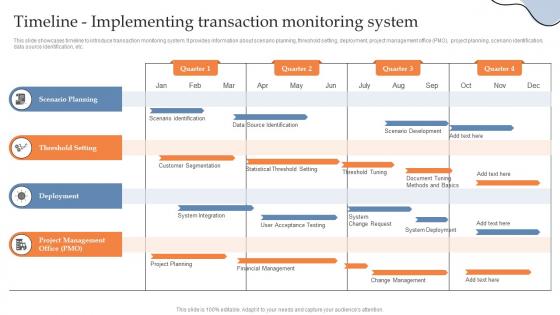
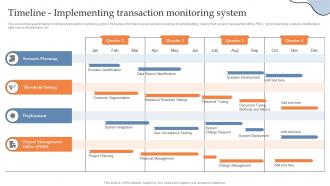
This slide showcases timeline to introduce transaction monitoring system. It provides information about scenario planning, threshold setting, deployment, project management office PMO, project planning, scenario identification, data source identification, etc.
People who downloaded this PowerPoint presentation also viewed the following :
Timeline Implementing Transaction Monitoring System Building AML And Transaction with all 6 slides:
Use our Timeline Implementing Transaction Monitoring System Building AML And Transaction to effectively help you save your valuable time. They are readymade to fit into any presentation structure.





FAQs for Timeline Implementing Transaction Monitoring System Building
Key components include real-time data processing engines, advanced analytics algorithms, rule-based screening mechanisms, machine learning capabilities, and comprehensive reporting dashboards. These technologies work together by analyzing transaction patterns, detecting anomalies, and flagging suspicious activities, with financial institutions finding that integrated systems significantly enhance compliance efficiency while reducing false positives and operational costs.
Artificial intelligence enhances transaction monitoring by analyzing vast datasets in real-time, identifying complex fraud patterns, and reducing false positives through machine learning algorithms. Banks and financial institutions leverage AI-powered systems to detect suspicious activities faster, automate compliance reporting, and improve customer experiences, while significantly reducing operational costs and enhancing regulatory compliance in increasingly complex financial environments.
Organizations should consider Anti-Money Laundering (AML) regulations, Know Your Customer (KYC) requirements, Bank Secrecy Act compliance, GDPR data protection standards, and industry-specific mandates like PCI DSS for payment processors. These regulatory frameworks work together to ensure comprehensive oversight, with financial institutions finding that proactive compliance through robust monitoring systems ultimately delivers reduced regulatory risk and enhanced operational credibility.
Machine learning algorithms enhance transaction detection accuracy by analyzing vast datasets, identifying subtle patterns, and adapting to evolving fraud techniques in real-time. These systems continuously learn from historical transactions, reducing false positives while catching sophisticated schemes, with banks and financial institutions finding significantly improved detection rates and streamlined compliance operations.
Organizations face integration challenges including data format inconsistencies, legacy system compatibility issues, real-time processing requirements, regulatory compliance alignment, and workflow disruptions during implementation. While these present complexity, many financial institutions and retail companies find that strategic phased approaches, API-based integrations, and comprehensive staff training ultimately streamline operations and enhance fraud detection capabilities.
Transaction monitoring systems mitigate financial crime risk by analyzing transaction patterns, flagging suspicious activities, detecting unusual behaviors, implementing real-time alerts, and maintaining comprehensive audit trails. These systems enable banks and financial institutions to identify money laundering, fraud, and terrorist financing more effectively, while ensuring regulatory compliance and ultimately protecting institutional reputation and customer assets.
Data quality serves as the foundation for effective transaction monitoring, directly impacting accuracy of fraud detection, reducing false positives, and ensuring regulatory compliance through clean, complete, and timely data feeds. Poor data quality can undermine even sophisticated monitoring systems, with many financial institutions finding that investing in data governance and validation processes significantly enhances their ability to detect suspicious patterns while minimizing operational disruptions.
Transaction monitoring systems adapt to evolving fraud patterns through machine learning algorithms, real-time data analysis, behavioral pattern recognition, and continuous model updates. These technologies enhance detection capabilities by analyzing transaction histories, identifying anomalous behaviors, and automatically adjusting risk parameters, with many financial institutions finding that adaptive systems reduce false positives while improving fraud detection rates significantly.
Organizations should track false positive rates, alert resolution times, detection accuracy, compliance adherence rates, and operational efficiency metrics to measure transaction monitoring success. These metrics enable financial institutions to optimize system performance, reduce investigative workloads, enhance regulatory compliance, and improve customer experiences, with many banks finding that balanced scorecards ultimately deliver stronger fraud prevention and streamlined operations.
Transaction monitoring systems ensure AML compliance by automatically screening transactions against regulatory watchlists, detecting suspicious patterns through behavioral analytics, and generating comprehensive audit trails for regulatory reporting. These systems streamline compliance operations by flagging high-risk activities, automating case management workflows, and maintaining detailed documentation, ultimately enabling financial institutions to meet stringent regulatory requirements while minimizing operational costs and compliance risks.
Best practices for setting thresholds include analyzing historical transaction patterns, implementing risk-based scoring, establishing multiple threshold levels, regularly reviewing performance metrics, and incorporating behavioral analytics. Financial institutions enhance their monitoring by calibrating thresholds based on customer segments, transaction types, and geographic regions, ultimately delivering reduced false positives while maintaining robust fraud detection capabilities.
Blockchain significantly enhances transaction monitoring by providing immutable audit trails, real-time visibility, and automated compliance through smart contracts. Financial institutions and supply chain companies increasingly leverage distributed ledger technology to streamline regulatory reporting, reduce fraud detection costs, and accelerate suspicious activity investigations, ultimately delivering greater transparency and operational efficiency.
Essential skills include regulatory compliance knowledge, data analysis capabilities, financial crime detection techniques, system administration expertise, and investigative research abilities. These professionals increasingly require proficiency in machine learning tools, pattern recognition methodologies, and cross-border transaction protocols, with many financial institutions finding that continuous education in emerging fraud schemes and evolving regulatory requirements ultimately delivers more effective monitoring and reduced compliance risks.
Organizations leverage transaction monitoring data for predictive analytics by analyzing historical patterns, customer behaviors, spending trends, and seasonal fluctuations to forecast future activities. Through machine learning algorithms, banks and financial institutions can predict potential fraud, anticipate customer needs, optimize resource allocation, and enhance risk management strategies, ultimately delivering proactive services and competitive advantage.
Major banks like JPMorgan Chase and HSBC demonstrate transaction monitoring effectiveness through significantly reduced false positives, faster compliance reporting, and enhanced fraud detection capabilities. These institutions achieved 40-60% reductions in manual review workloads while improving regulatory compliance accuracy, ultimately delivering cost savings exceeding millions annually and strengthening customer trust through seamless transaction experiences.
-
Easy to use and customize templates. Helped me give a last minute presentation.
-
Informative presentations that are easily editable.