


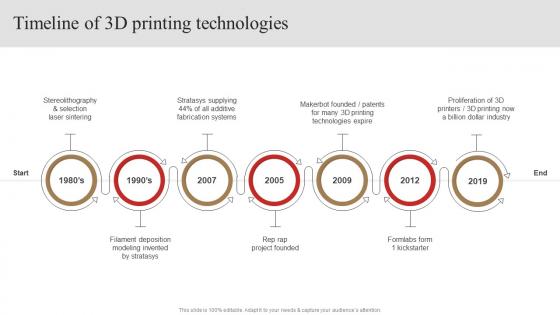
Timeline Of 3d Printing Technologies 3d Printing In Manufacturing




Try Before you Buy Download Free Sample Product
 Impress Your
 Audience
 100%
100% Editable
 Save Hours
 of Time


Our Timeline Of 3d Printing Technologies 3d Printing In Manufacturing are topically designed to provide an attractive backdrop to any subject. Use them to look like a presentation pro.
People who downloaded this PowerPoint presentation also viewed the following :
Timeline Of 3d Printing Technologies 3d Printing In Manufacturing with all 6 slides:
Use our Timeline Of 3d Printing Technologies 3d Printing In Manufacturing to effectively help you save your valuable time. They are readymade to fit into any presentation structure.





FAQs for Timeline Of 3d Printing Technologies 3d
Primary 3D printing technologies include Fused Deposition Modeling (FDM), Stereolithography (SLA), Selective Laser Sintering (SLS), Digital Light Processing (DLP), and Multi Jet Fusion (MJF). These technologies streamline manufacturing by enabling rapid prototyping, customized production, and reduced material waste, with sectors like aerospace, healthcare, and automotive increasingly leveraging these capabilities for competitive advantage.
FDM extrudes heated thermoplastic filaments layer by layer through a moving nozzle, while SLA uses ultraviolet lasers to cure liquid photopolymer resins into solid structures. FDM delivers cost-effective prototyping and functional parts for manufacturing and automotive applications, whereas SLA enables high-precision medical devices and jewelry production, with many organizations finding strategic value in combining both technologies.
**INPUT**: What applications of 3D printing have the greatest impact on industries like healthcare and aerospace? **OUTPUT**: Healthcare applications include patient-specific prosthetics, surgical guides, dental implants, and bioprinting tissue scaffolds, while aerospace leverages lightweight engine components and rapid prototyping. These technologies streamline production timelines, reduce material waste, and enable mass customization, with many organizations finding that 3D printing delivers significant cost reductions and enhanced operational efficiency. [Word count: 54 words]
3D printing has revolutionized prototyping by enabling rapid iteration, reducing development timelines from weeks to days, and significantly lowering costs compared to traditional manufacturing methods. Through additive manufacturing, companies in automotive, aerospace, and medical device sectors can test multiple design variations quickly, enhance product functionality, and accelerate time-to-market, ultimately delivering competitive advantages in increasingly fast-paced markets.
Common 3D printing materials include PLA, ABS, PETG, nylon, resin, and metal filaments, each delivering distinct properties like flexibility, durability, heat resistance, and surface finish quality. These material choices significantly impact final product strength, appearance, and functionality, with manufacturers in aerospace, healthcare, and automotive sectors finding that strategic material selection enables enhanced performance, reduced weight, and ultimately delivers competitive advantages in their specific applications.
Digital Light Processing (DLP) significantly advances 3D printing by delivering faster print speeds, superior surface finishes, and enhanced precision through its projector-based curing system. This technology enables manufacturers in aerospace, automotive, and medical device sectors to produce intricate components with smooth surfaces and fine details, ultimately streamlining prototyping processes while reducing post-processing requirements.
Software advancements significantly enhance 3D printing effectiveness by improving design precision, optimizing print parameters, reducing material waste, and enabling complex geometries previously impossible to manufacture. These innovations streamline workflows through automated support generation, predictive maintenance algorithms, and real-time monitoring systems, with aerospace and automotive industries finding that advanced software reduces production time while delivering superior part quality and cost efficiency.
3D printing technologies present both environmental challenges and opportunities, including reduced material waste through precise manufacturing, lower transportation emissions via localized production, energy-intensive printing processes, and plastic waste from failed prints or supports. While traditional manufacturing often requires significant resource extraction and shipping, 3D printing enables on-demand production that minimizes inventory waste, with many manufacturers finding that strategic implementation ultimately delivers operational efficiency and reduced carbon footprints.
3D printing in construction enables automated building of walls, foundations, structural components, and architectural elements using concrete, polymers, and composite materials. Through large-scale printers and robotic systems, construction companies streamline project timelines, reduce labor costs, and minimize material waste, while enabling complex geometric designs, with many firms finding faster construction cycles and enhanced design flexibility.
Companies face material limitations, high equipment costs, quality consistency issues, workforce training requirements, and regulatory compliance challenges when integrating 3D printing into manufacturing. While these obstacles present initial hurdles, organizations in aerospace, automotive, and medical device sectors find that strategic implementation ultimately delivers reduced inventory costs, faster prototyping, and enhanced customization capabilities.
Post-processing techniques enhance 3D printed parts by removing support materials, smoothing surface finishes, improving dimensional accuracy, and strengthening mechanical properties through methods like sanding, chemical treatment, and heat curing. These processes enable manufacturers in aerospace, medical devices, and automotive sectors to achieve production-grade quality standards, ultimately delivering parts with superior functionality and professional aesthetics for commercial applications.
Emerging bioprinting innovations include multi-material printers, living cell bioinks, vascularization techniques, organ-on-chip platforms, and personalized tissue scaffolds. These technologies revolutionize healthcare by enabling custom prosthetics, drug testing models, and regenerative treatments, with pharmaceutical companies and research hospitals finding that bioprinted tissues accelerate clinical trials while reducing costs.
3D printing enables distributed manufacturing by decentralizing production closer to consumers, reducing transportation costs, and allowing on-demand creation of customized products across multiple locations. This approach streamlines supply chains, minimizes inventory requirements, and enhances responsiveness to local market demands, with manufacturers in automotive, healthcare, and aerospace sectors increasingly leveraging distributed networks to deliver faster, more cost-effective solutions.
Industrial 3D printing safety considerations include proper ventilation systems, personal protective equipment, material handling protocols, fire suppression systems, and regular equipment maintenance. These safety measures streamline operations by minimizing workplace hazards, reducing liability risks, and ensuring regulatory compliance, with many manufacturing facilities finding that comprehensive safety protocols ultimately enhance productivity while protecting workers from harmful emissions and mechanical risks.
3D printing enables custom consumer products by allowing on-demand manufacturing of personalized items like jewelry, footwear, phone cases, and medical devices tailored to individual specifications. Companies in fashion, healthcare, and electronics increasingly leverage this technology to deliver unique customer experiences, reduce inventory costs, and accelerate product development, ultimately creating competitive advantages through mass customization capabilities.
-
A fantastic collection of templates. I'll likely use this as my go-to resource for future templates and support.
-
Illustrative design with editable content. Exceptional value for money. Highly pleased with the product.