


Total quality management outline powerpoint presentation slides




Try Before you Buy Download Free Sample Product
 Impress Your
 Audience
 100%
100% Editable
 Save Hours
 of Time


Achieve long-term business success by using the content ready Total Quality Management Outline PowerPoint Presentation Slides. With the aid of the quality management presentation template, you can outline the numerous determinants of product and service quality. You can increase customer satisfaction and improve the internal process of your business with the help of total quality management PPT slideshow. Employ the TQM PowerPoint graphic and contribute to long-term revenue and profitability. Take the assistance of this professionally designed quality assurance PPT theme to showcase the different principles like customer focus, leadership, process approach, and continual improvement. There are various high-grade icons present in the deck that makes your presentation attention-grabbing and knowledgable. Use quality improvement PPT slide to concentrate on the consistency of performance and dependability of the product. Explain the importance of good quality and liability of products by downloading our ready-to-use quality management system ppt.
People who downloaded this PowerPoint presentation also viewed the following :
Content of this Powerpoint Presentation
Slide 1: This slide introduces Total Quality Management Outline. State Your Company Name and begin.
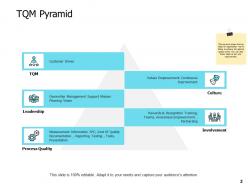
Slide 2: This slide shows TQM Pyramid describing the key steps an organization has to follow to achieve the optimal quality levels.
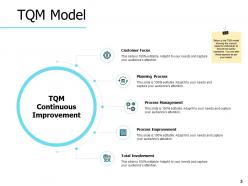
Slide 3: This slide presents TQM Model describing- Customer Focus, Planning Process, Process Improvement, Total Involvement, Process Management.
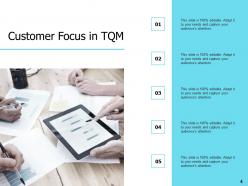
Slide 4: This slide displays Customer Focus In TQM with related imagery and icons.
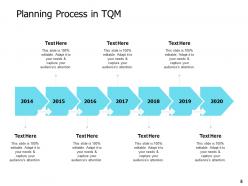
Slide 5: This slide represents Planning Process in TQM with the help of timeline.
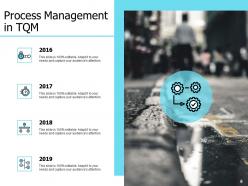
Slide 6: This slide showcases Process Management In TQM with related imagery.
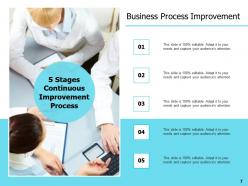
Slide 7: This slide shows Business Process Improvement with a 5 stage circular diagram.
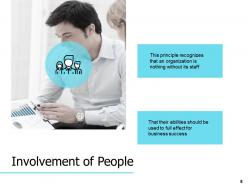
Slide 8: This slide presents Involvement of People with related imagery.
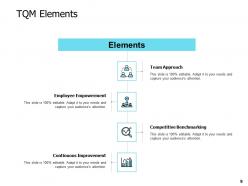
Slide 9: This slide displays TQM Elements as- Team Approach, Employee Empowerment, Continuous Improvement, Competitive Benchmarking.
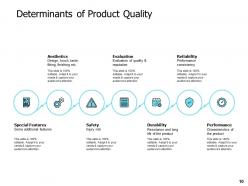
Slide 10: This slide represents Determinants of Product Quality as- Performance, Durability, Safety, Special Features, Reliability, Evaluation, Aesthetics.
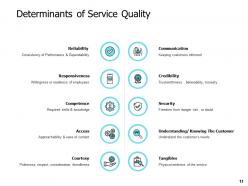
Slide 11: This slide showcases Determinants of Service Quality as- Responsiveness, Credibility, Access, Understanding/ Knowing The Customer, Courtesy, Tangibles, Reliability, Communication, Competence, Security.
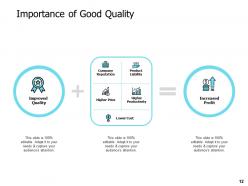
Slide 12: This slide shows Importance of Good Quality.
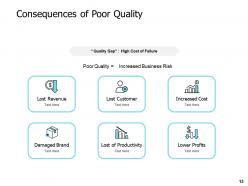
Slide 13: This slide describes Consequences Of Poor Quality as- Lost Revenue, Lost Customers, Increased Cost, Lower Profits, Lost of Productivity, Damaged Brand.
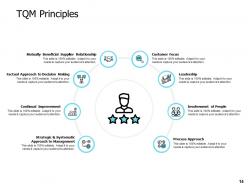
Slide 14: This slide presents TQM Principles as- Mutually Beneficial Supplier Relationship, Factual Approach to Decision Making, Continual Improvement, Strategic & Systematic Approach to Management, Process Approach, Involvement of People, Leadership, Customer Focus.
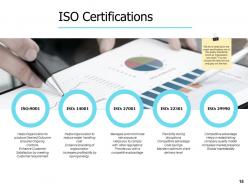
Slide 15: This slide showcases ISO Certifications wrt to the quality standards which an organization can attain.
Slide 16: This slide displays Total Quality Management Outline Icons.
Slide 17: This slide is titled as Additional Slides for moving forward.
Slide 18: This is Our Mission slide with related imagery and text.
Slide 19: This is Our Team slide with names and designation.
Slide 20: This is About Us slide to show company specifications etc.
Slide 21: This is a Bulb or Idea slide to state a new idea or highlight information, specifications etc.
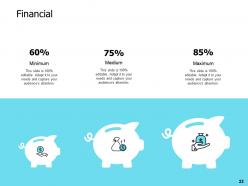
Slide 22: This is a Financial slide. Show your finance related stuff here.
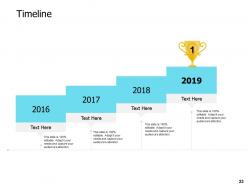
Slide 23: This is a Timeline slide to show information related with time period.
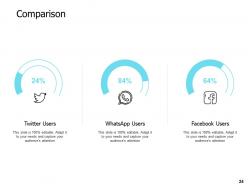
Slide 24: This is a Comparison slide to state comparison between commodities, entities etc.
Slide 25: This is a Thank You slide with address, contact numbers and email address.
Total quality management outline powerpoint presentation slides with all 25 slides:
Use our Total Quality Management Outline Powerpoint Presentation Slides to effectively help you save your valuable time. They are readymade to fit into any presentation structure.




FAQs for Total quality management outline
Total Quality Management's core principles include customer focus, continuous improvement, employee empowerment, process optimization, and data-driven decision making. These principles work together by streamlining operations, reducing defects, and enhancing customer satisfaction, with many organizations finding that systematic TQM implementation delivers competitive advantage, operational efficiency, and sustained growth across manufacturing, healthcare, and service industries.
TQM integrates effectively across sectors through standardized processes, employee training, customer feedback systems, and continuous improvement methodologies tailored to specific operational needs. Manufacturing companies implement statistical process control and defect reduction protocols, while service organizations focus on customer satisfaction metrics and response time optimization, ultimately delivering enhanced operational efficiency and competitive advantage.
Leadership plays a pivotal role in TQM implementation by establishing quality vision, allocating necessary resources, fostering cultural transformation, and demonstrating unwavering commitment to continuous improvement. Through strategic communication and employee empowerment, leaders in manufacturing, healthcare, and service industries streamline operations, enhance customer satisfaction, and drive organizational excellence, ultimately delivering competitive advantage and sustainable growth.
Organizations measure TQM effectiveness through customer satisfaction surveys, defect rates, employee engagement scores, process cycle times, and return on investment metrics. These measurements enable companies to track quality improvements across manufacturing, healthcare, and service sectors, while identifying areas needing attention, ultimately delivering enhanced operational efficiency and competitive advantage in increasingly quality-focused markets.
Common TQM adoption challenges include resistance to cultural change, inadequate leadership commitment, insufficient employee training, lack of customer focus, and poor communication across departments. Organizations overcome these by securing executive sponsorship, implementing comprehensive training programs, establishing clear quality metrics, and fostering cross-functional collaboration, with many manufacturing and healthcare institutions finding that gradual implementation ultimately delivers sustained operational excellence and competitive advantage.
Employee involvement and empowerment enhance TQM by fostering ownership, encouraging continuous improvement suggestions, and enabling faster problem-solving at operational levels. Through empowered teams and participatory decision-making, organizations streamline quality processes, reduce defects, and accelerate response times, with many manufacturing and service companies finding that engaged employees ultimately deliver superior customer experiences and sustainable competitive advantage.
Common TQM tools include statistical process control, flowcharts, fishbone diagrams, Pareto analysis, control charts, and Six Sigma methodologies. These techniques streamline operations by identifying bottlenecks, reducing defects, and enhancing workflow efficiency, with many manufacturing and service organizations finding that systematic application ultimately delivers improved customer satisfaction and significant cost reduction.
TQM significantly enhances customer satisfaction and loyalty by systematically improving product quality, reducing defects, and streamlining service delivery processes. Through continuous improvement initiatives, organizations consistently exceed customer expectations, deliver more reliable products, and provide faster response times, with many companies in manufacturing and hospitality finding that TQM-driven quality improvements ultimately strengthen customer relationships and increase repeat business rates.
Technology supports TQM through data analytics platforms, automated quality monitoring systems, digital workflow management tools, real-time performance dashboards, and integrated customer feedback systems. These solutions streamline quality processes by enabling continuous monitoring, predictive issue identification, and instant corrective actions, with manufacturing and healthcare organizations finding that automated systems significantly reduce defects while enhancing operational efficiency.
A continuous improvement culture aligns with TQM principles through employee empowerment, regular training programs, cross-functional collaboration, and systematic feedback mechanisms that encourage innovation at all organizational levels. Companies like Toyota and General Electric have successfully implemented these approaches by establishing quality circles, rewarding improvement suggestions, and integrating customer feedback loops, ultimately delivering enhanced operational efficiency and sustained competitive advantage.
Data-driven decision-making in TQM eliminates guesswork by using statistical analysis, performance metrics, customer feedback, and process measurements to guide quality improvements. This approach enables organizations to identify root causes systematically, track progress objectively, and optimize resources strategically, with many manufacturing and service companies finding that evidence-based quality management delivers sustained competitive advantage.
TQM serves as a foundational philosophy that integrates seamlessly with Six Sigma's data-driven problem-solving methodologies and ISO 9001's systematic documentation standards, creating a comprehensive quality ecosystem. Organizations increasingly combine these frameworks, with manufacturing companies, healthcare institutions, and financial services finding that TQM's cultural focus enhances Six Sigma's statistical rigor while supporting ISO certification requirements.
Organizations ensure TQM sustainability by embedding quality principles into organizational culture, establishing continuous monitoring systems, investing in ongoing employee training, and maintaining leadership commitment across management transitions. Through regular performance reviews, feedback loops, and adaptive improvement processes, companies like Toyota and Motorola have sustained quality excellence for decades, ultimately delivering consistent competitive advantage and operational efficiency.
Toyota's Production System revolutionized automotive manufacturing through continuous improvement, employee empowerment, and waste elimination, while Motorola's Six Sigma approach dramatically reduced defects and enhanced customer satisfaction. These implementations demonstrate that successful TQM requires long-term leadership commitment, comprehensive employee training, and systematic process improvement, with organizations finding that sustained cultural transformation ultimately delivers competitive advantage, operational excellence, and measurable business results across all departments.
Training and development programs supporting TQM initiatives should emphasize continuous improvement methodologies, quality measurement techniques, customer-focused service delivery, cross-functional collaboration skills, and problem-solving frameworks. These comprehensive programs enhance organizational capabilities by embedding quality principles throughout operations, streamlining processes across departments, and ultimately delivering improved customer satisfaction and competitive advantage in increasingly quality-conscious markets.
-
Thanks for all your great templates they have saved me lots of time and accelerate my presentations. Great product, keep them up!
-
Editable templates with innovative design and color combination.
-
Very unique, user-friendly presentation interface.
-
Really like the color and design of the presentation.