


Toxicology applied pharmacology ppt powerpoint presentation summary slides




Try Before you Buy Download Free Sample Product
 Impress Your
 Audience
 100%
100% Editable
 Save Hours
 of Time


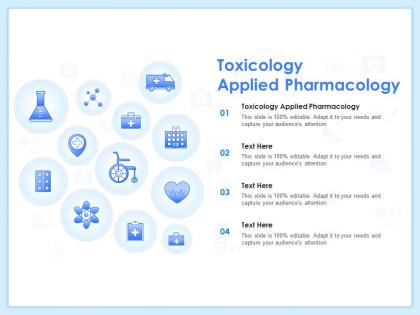
The following is a completely editable Medical Powerpoint Template Slide that discusses the topic Toxicology Applied Pharmacology. It is designed for medical professionals to discuss Toxicology Applied Pharmacology and can be completely customized to suit their needs. Add more items to this list and include this in your deck to impress your audience.
People who downloaded this PowerPoint presentation also viewed the following :
Toxicology applied pharmacology ppt powerpoint presentation summary slides with all 2 slides:
Use our Toxicology Applied Pharmacology Ppt Powerpoint Presentation Summary Slides to effectively help you save your valuable time. They are readymade to fit into any presentation structure.

FAQs for Toxicology applied pharmacology ppt powerpoint
Toxicology's primary branches include clinical toxicology, environmental toxicology, forensic toxicology, regulatory toxicology, and occupational toxicology, each addressing distinct exposure scenarios and safety concerns. These specialized disciplines enhance public health protection by focusing on patient treatment, environmental impact assessment, legal investigations, regulatory compliance, and workplace safety respectively, with many healthcare institutions, regulatory agencies, and corporations finding that this targeted approach streamlines risk management and delivers more effective safety protocols.
Dose-response relationships reveal how toxic effects intensify with increasing exposure levels, establishing threshold doses, identifying safe exposure limits, and determining lethal concentrations for risk assessment. Through systematic analysis, regulatory agencies, pharmaceutical companies, and environmental scientists establish safety standards, guide drug development protocols, and create workplace exposure guidelines, ultimately delivering evidence-based protection measures and informed public health policies.
Pharmacokinetics determines how toxins are absorbed, distributed, metabolized, and eliminated by the body, directly influencing their toxic effects and duration of exposure. This process enables toxicologists to predict dose-response relationships, establish safety thresholds, and develop targeted treatment protocols, with pharmaceutical companies and regulatory agencies increasingly leveraging these insights to enhance drug safety assessments and minimize adverse reactions.
Toxicology findings influence public health policies by establishing safety standards, informing regulatory decisions, and guiding exposure limits for chemicals, pharmaceuticals, and environmental contaminants. Through comprehensive risk assessments, regulatory agencies develop protective guidelines for air quality, water safety, and food standards, ultimately enabling communities to minimize health risks while supporting evidence-based policy frameworks that enhance population safety.
Common toxicological testing methods include in vitro cell cultures, animal models, biochemical assays, chromatography-mass spectrometry, and computational modeling. These approaches streamline safety assessment by evaluating cellular responses, metabolic pathways, and chemical interactions, with pharmaceutical companies and regulatory agencies finding that strategic combinations deliver faster drug approvals, enhanced safety profiles, and reduced development costs.
Environmental factors in urban settings contribute to toxic exposure through air pollution from vehicle emissions and industrial activities, contaminated soil from legacy pollutants, compromised water quality from runoff, and heat island effects that concentrate airborne toxins. These combined exposures particularly affect densely populated areas like manufacturing districts and high-traffic corridors, with many urban communities finding that cumulative environmental stressors significantly impact public health outcomes and require comprehensive monitoring strategies.
Biomonitoring provides critical insights into actual chemical exposures and biological responses in human populations, enabling researchers to assess real-world toxicity levels, identify exposure patterns, and validate laboratory findings. Through blood, urine, and tissue analyses, toxicologists can track contaminant absorption across diverse environments like industrial workplaces and residential areas, ultimately delivering more accurate risk assessments and targeted public health interventions.
Emerging contaminants present complex toxicological challenges through unknown exposure pathways, limited toxicity data, and unpredictable bioaccumulation patterns. These substances, including pharmaceuticals, microplastics, and industrial chemicals, require advanced analytical methods and comprehensive risk assessment frameworks, with regulatory agencies increasingly adopting innovative testing protocols to enhance environmental protection and public health outcomes.
Workplace hazardous material safety involves comprehensive risk assessments, proper storage protocols, personal protective equipment requirements, employee training programs, and emergency response procedures. Through these systematic approaches, organizations in manufacturing, pharmaceuticals, and chemical processing streamline compliance while minimizing exposure risks, ultimately delivering safer work environments and reduced liability, with many companies finding that proactive safety measures enhance both operational efficiency and regulatory adherence.
Regulatory toxicology focuses on establishing safety standards and compliance requirements for product approval, while academic research explores fundamental mechanisms and theoretical understanding. Through standardized protocols, regulatory studies deliver definitive safety assessments for pharmaceuticals, chemicals, and consumer products, whereas academic institutions pursue broader scientific questions, with many organizations finding that combining both approaches enhances comprehensive risk evaluation.
Notable forensic toxicology case studies include the Napoleon Bonaparte arsenic poisoning investigation, the Alexander Litvinenko polonium-210 case, Anna Nicole Smith's prescription drug death, and the Tylenol cyanide murders of 1982. These landmark cases revolutionized forensic methodologies by advancing detection techniques, establishing legal precedents, and enhancing investigative protocols, ultimately delivering more accurate determinations and faster case resolutions for law enforcement agencies worldwide.
Toxins significantly impact reproductive health by disrupting hormone production, reducing fertility rates, causing developmental abnormalities, and affecting sperm and egg quality through endocrine interference. These exposures create multigenerational health risks, with healthcare systems and fertility clinics increasingly recognizing that early intervention and comprehensive screening programs enhance treatment outcomes, ultimately delivering improved reproductive success rates and healthier developmental patterns for future populations.
Advances in technology enhance toxicology through AI-powered analytical systems, biosensors, mass spectrometry improvements, automated screening platforms, and real-time monitoring devices. These innovations streamline detection by reducing analysis time, increasing sensitivity levels, and enabling simultaneous multi-toxin identification, with laboratories and regulatory agencies finding faster, more accurate results that ultimately enhance public safety protocols.
Toxicology research presents ethical considerations including informed consent protocols, minimizing harm to study participants, ensuring equitable subject selection, maintaining data privacy, and balancing scientific benefits against potential risks. These ethical frameworks streamline research integrity by establishing clear guidelines, protecting vulnerable populations, and enhancing public trust, with many research institutions finding that robust ethical oversight ultimately delivers more credible findings and regulatory acceptance.
Public awareness and education reduce toxic exposure risks by promoting safer product choices, encouraging protective behaviors, and improving emergency response knowledge. Through targeted campaigns, communities learn to identify hazardous materials, implement proper disposal methods, and recognize exposure symptoms, with many schools, healthcare systems, and workplaces finding that informed populations significantly minimize accidental poisonings and environmental contamination.
No Reviews