


Transformer Neural Network Architecture Of ChatGPT V2




Try Before you Buy Download Free Sample Product
 Impress Your
 Audience
 100%
100% Editable
 Save Hours
 of Time


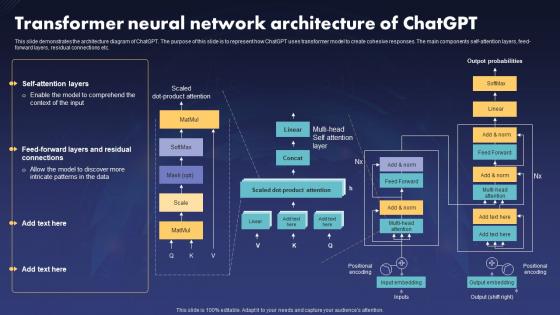
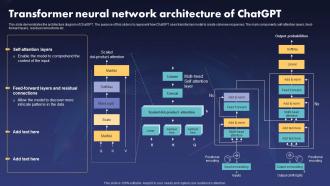
This slide demonstrates the architecture diagram of ChatGPT. The purpose of this slide is to represent how ChatGPT uses transformer model to create cohesive responses. The main components self-attention layers, feed-forward layers, residual connections etc.
People who downloaded this PowerPoint presentation also viewed the following :
Transformer Neural Network Architecture Of ChatGPT V2 with all 9 slides:
Use our Transformer Neural Network Architecture Of ChatGPT V2 to effectively help you save your valuable time. They are readymade to fit into any presentation structure.
-
Transformer Neural Network Architecture Of ChatGPT V2
-

Transformer Neural Network Architecture Of ChatGPT V2
-

Transformer Neural Network Architecture Of ChatGPT V2
-

Transformer Neural Network Architecture Of ChatGPT V2
-

Transformer Neural Network Architecture Of ChatGPT V2
-

Transformer Neural Network Architecture Of ChatGPT V2
-

Transformer Neural Network Architecture Of ChatGPT V2
-

Transformer Neural Network Architecture Of ChatGPT V2
-

Transformer Neural Network Architecture Of ChatGPT V2
FAQs for Transformer Neural Network Architecture
So transformers have this encoder-decoder setup with multi-head attention as the core piece. Honestly, the attention mechanism is wild - it lets the model look at different parts of your input sequence all at once instead of going step by step. Feed-forward networks and positional encoding are in there too. The encoder handles your input, decoder spits out results one token at a time. Oh and there's residual connections everywhere (probably overkill but whatever works I guess). Layer norm keeps training from going haywire. If you're gonna build one, definitely wrap your head around attention first since that's where all the magic happens.
So self-attention is basically like giving each word x-ray vision to see every other word at once. Your transformer doesn't have to trudge through words one by one like RNNs do - it just instantly spots that "bank" connects to "river" even if they're 40+ words apart. The whole thing runs in parallel too, which is why these models are so much faster. No more losing context through that telephone game effect. Honestly, the attention visualization maps are pretty wild when you actually look at them - shows you exactly what the model's "thinking" about.
Honestly, the biggest thing is Transformers don't process sequences word by word like RNNs - they look at everything at once. Makes training way faster since there's no waiting around. CNNs are stuck with their fixed filter sizes, but Transformers can connect any two parts of your sequence directly through self-attention. Pretty clever if you ask me. RNNs also get that annoying vanishing gradient issue with longer sequences, which Transformers just... don't have. Oh, and if you're dealing with long text or sequences, you'll probably see better results with Transformers anyway.
So basically, Transformers process everything at once - they have zero clue about word order without help. That's where positional encodings come in. They're like little ID tags that get added to your input embeddings, telling the model "hey, this word is first, this one's second," etc. Otherwise "cat sat mat" and "mat sat cat" would be completely identical to the model, which is... not great. You can either use the classic sine/cosine patterns or train your own embeddings. Honestly, don't even think about skipping this step if you're building one - learned that the hard way!
Oh man, transformers are just way better at this stuff! So with RNNs, they process things step by step and basically forget earlier info as they go. CNNs can only "see" a limited window at once. But transformers? They use this self-attention thing where every word can directly connect to every other word in the sequence - doesn't matter if they're right next to each other or 1000 tokens apart. It's honestly pretty cool when you visualize the attention weights and see what connections the model makes. No more forgetting important details from way back in the text.
So multi-head attention is basically like having several different spotlights instead of one big floodlight. Each "head" gets really good at picking up on different patterns - one might focus on syntax while another catches semantic relationships. Way more efficient than trying to do everything with single attention. The cool part is how they work in parallel, so you're capturing both nearby connections and long-range dependencies at the same time. Honestly, it's kind of genius because you end up with much richer representations of your input. Each head specializes in its own thing, then they all combine to give you this comprehensive understanding that single-head just can't match.
So fine-tuning is basically taking models like BERT or GPT that already get language and teaching them your specific problem. Way smarter than starting from zero. You're using their pre-trained weights as a head start, then just tweaking the final layers for whatever you need - sentiment analysis, entity recognition, etc. Performance boost is honestly pretty dramatic compared to generic models. Oh, and pick something close to your domain if you can find it. Makes the whole process smoother since you won't be fighting the model's existing biases as much.
Honestly, the biggest pain is just how expensive these things are to run. Transformers eat up resources like crazy, and it gets worse with longer text since the attention mechanism scales quadratically - which is annoying. Most models also cap out at a few thousand tokens, so forget about processing entire documents in one go. Training them? You'll need massive datasets and serious compute power. They're also black boxes half the time, so good luck figuring out why they made weird decisions. If you're working with tight resources, maybe look into distilled models or some hybrid setup instead.
So basically, your pre-training approach totally changes what your model ends up being good at. BERT-style masked language modeling? Perfect for understanding context and doing classification stuff. GPT's autoregressive training kills it for generation tasks though. There's also these hybrid approaches like prefix LM trying to do both - jury's still out on those tbh. I always just match the pre-training to whatever I'm actually gonna use it for later. Classification work = go masked. Need text generation? Autoregressive all the way. Makes way more sense than trying to force square pegs into round holes, you know?
BERT's your go-to for classification stuff - it reads text bidirectionally which is pretty smart. GPT models are the text generation kings, and honestly their scaling ability caught everyone off guard. T5 does this cool thing where it treats every task as text-to-text conversion. RoBERTa basically took BERT and fixed the training issues, while ELECTRA found a way more efficient pre-training method (which I think is underrated). For your projects: BERT-family when you need understanding, GPT-style when you're generating text. Pretty straightforward once you get the hang of it.
Think of attention weights as your model's internal spotlight - they show which input parts get focused on during decisions. You can actually visualize these patterns to see what words or tokens matter most for different tasks. Honestly, it's pretty neat stuff. Just don't get too carried away though. High attention doesn't always equal high importance for the final output. They're more like a starting point for understanding what's happening under the hood. The causality picture is way more complex than what these weights reveal, but they'll give you some decent insight into your model's behavior patterns.
Honestly, the resource requirements are brutal - these things eat up memory and compute like crazy. Training gets messy with vanishing gradients, especially when you go deeper. The attention mechanism? Super finicky at first. Overfitting hits hard too since there's just so many parameters to tune. Hyperparameter sensitivity is probably the most annoying part though - tiny changes break everything. I'd start with gradient clipping right away, plus learning rate scheduling. Dropout and layer norm are must-haves from day one. Oh, and maybe grab some coffee because debugging these things takes forever.
Honestly? Skip them if you've got tiny datasets - like a few hundred samples. Transformers are super data-hungry and you'll probably get better results with SVMs or basic neural nets instead. Real-time stuff is another dealbreaker since the computational cost can be pretty rough, especially on edge devices. For computer vision, CNNs still win most of the time unless you actually need that global attention stuff. Oh and latency requirements - if you need things fast, Transformers aren't your friend. Check your data size and compute limits first before diving in.
So basically you train a bunch of different Transformer models - mess with the architectures, tweak hyperparameters, maybe use different data splits. Then combine their predictions by voting or averaging them out. Each model catches different stuff, like one might be great with long sequences while another nails the local details. I swear this trick works way better than it should! Usually bumps accuracy up 2-5%, especially on tricky tasks like translation. Oh and start simple - just grab 3-5 models and average what they spit out. You can get all fancy with stacking techniques later if you want.
So basically everyone's trying to fix how attention scales terribly with longer sequences. Linformer and Performer do smart approximations instead of the full quadratic mess. There's also window-based stuff where tokens only look at nearby context - makes sense for most tasks anyway. FlashAttention's cool because it tackles the memory problem from a different angle. Honestly though, I keep forgetting half these paper names lol. The real trick is figuring out if you actually need every token talking to every other token. Most of the time you don't, so why waste the compute?
-
“Excellent service from the customer support team when I wanted a slide that was a bit different from those on their standard menu. Super helpful.”
-
Innovative and attractive designs.