Working Mechanism Of Chatgpt Language Model Chatgpt Ai Powered Architecture Explained ChatGPT SS
Try Before you Buy Download Free Sample Product
Audience
Editable
of Time
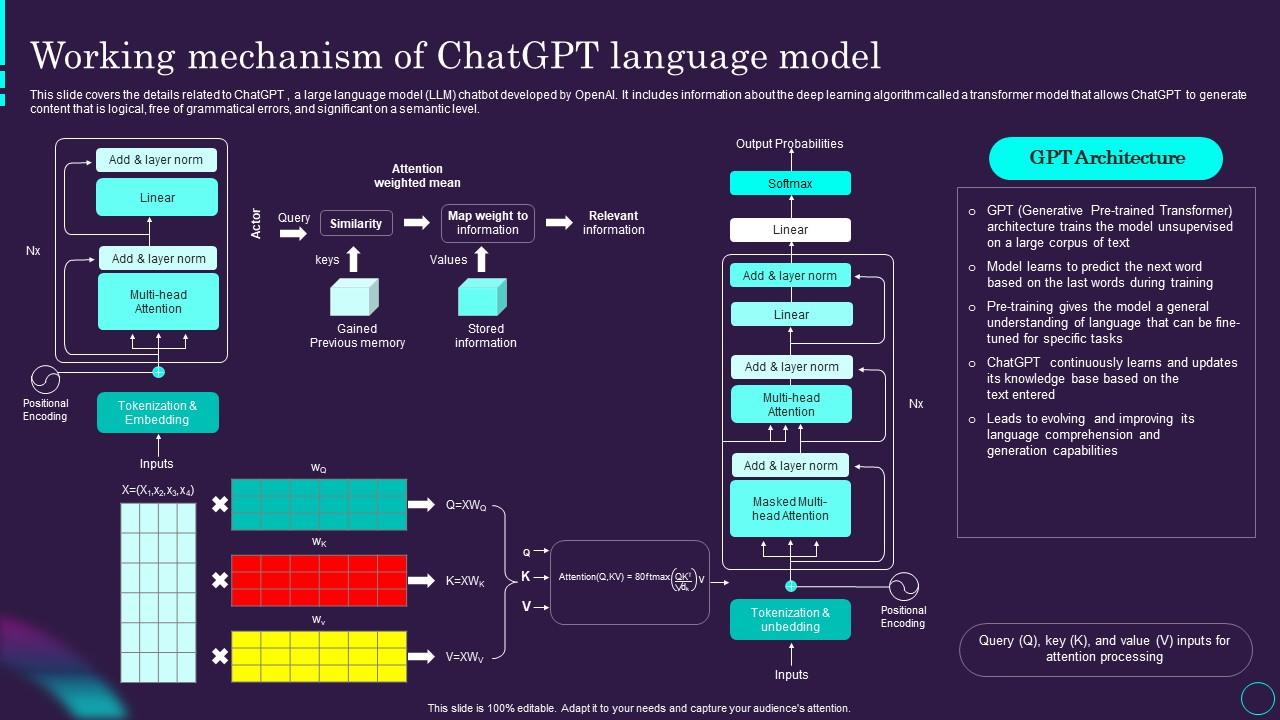
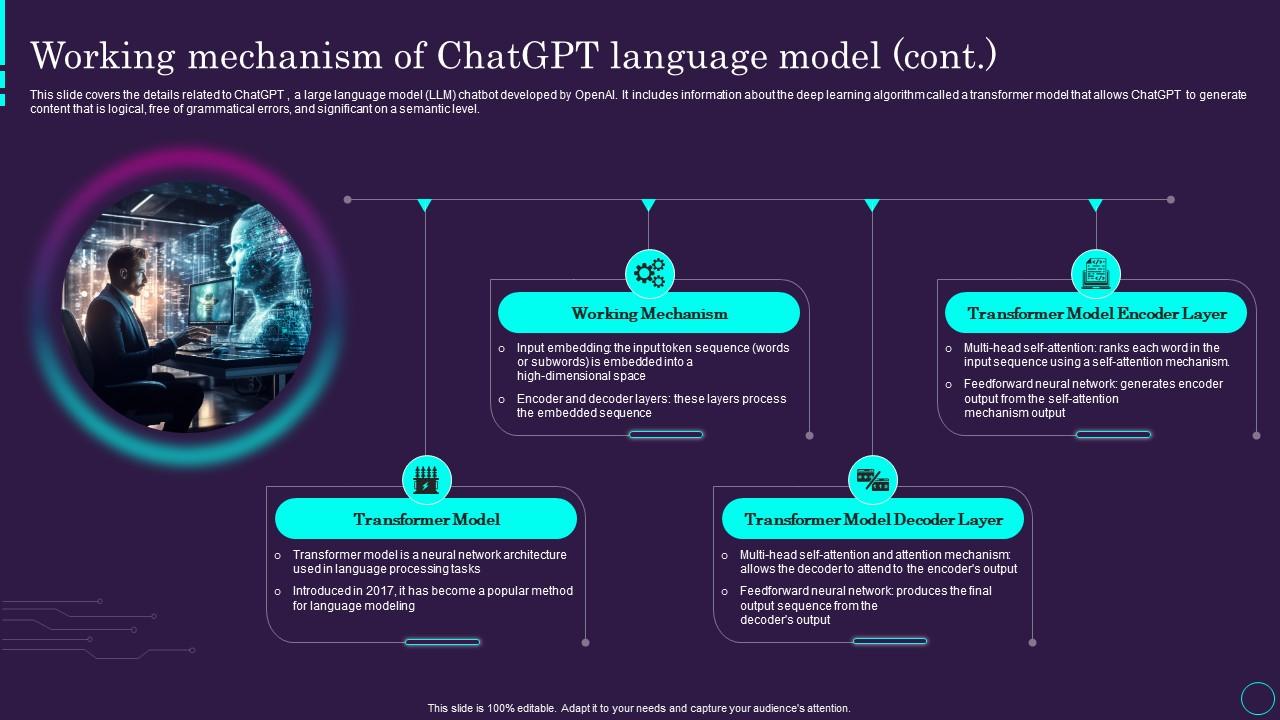
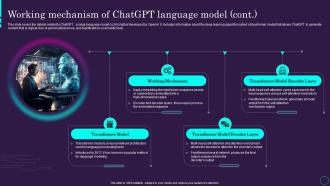
This slide covers the details related to ChatGPT , a large language model LLM chatbot developed by OpenAI. It includes information about the deep learning algorithm called a transformer model that allows ChatGPT to generate content that is logical, free of grammatical errors, and significant on a semantic level.
People who downloaded this PowerPoint presentation also viewed the following :
Working Mechanism Of Chatgpt Language Model Chatgpt Ai Powered Architecture Explained ChatGPT SS with all 10 slides:
Use our Working Mechanism Of Chatgpt Language Model Chatgpt Ai Powered Architecture Explained ChatGPT SS to effectively help you save your valuable time. They are readymade to fit into any presentation structure.
FAQs for Working Mechanism Of Chatgpt Language Model Chatgpt Ai Powered Architecture
The core components of ChatGPT architecture include transformer neural networks, attention mechanisms, tokenization systems, embedding layers, and multi-head self-attention blocks. These components work together by processing sequential data through parallel attention computations, enabling contextual understanding and coherent response generation, with many organizations finding that this architecture delivers faster natural language processing, enhanced customer interactions, and scalable conversational AI capabilities.
The attention mechanism enables ChatGPT to weigh the importance of different words when processing text, creating connections between relevant terms regardless of their position in the sequence. Through multi-head attention layers, the model simultaneously focuses on various aspects like context, grammar, and meaning, ultimately delivering more coherent responses and enabling applications in customer service, content generation, and automated analysis across industries.
The transformer architecture enhances natural language processing through self-attention mechanisms, parallel processing capabilities, contextual understanding, positional encoding, and multi-head attention layers. These innovations enable organizations to deploy more accurate language models for customer service automation, content generation, and document analysis, with many businesses finding that transformer-based systems deliver significantly faster processing speeds and improved comprehension across complex linguistic tasks.
ChatGPT maintains conversational coherence through attention mechanisms, context windows, and transformer architecture that processes entire conversation history simultaneously. These systems enable understanding of references, topic shifts, and nuanced dialogue patterns, with many customer service platforms and educational institutions finding that this contextual awareness delivers more natural interactions, reduces misunderstandings, and ultimately enhances user engagement across extended conversations.
Pre-training enables ChatGPT to develop foundational language understanding by learning patterns, grammar, and contextual relationships from massive text datasets before fine-tuning begins. This comprehensive knowledge base allows the model to generate coherent responses across diverse topics, from technical documentation to customer service interactions, with organizations finding that pre-trained models require significantly less specialized training while delivering more accurate and contextually appropriate communications.
Fine-tuning improves ChatGPT's performance by adapting the model's parameters to specific datasets, domains, and use cases through targeted training on specialized content. This process enables organizations to enhance accuracy for industry-specific applications like legal document analysis, medical diagnostics, or customer service interactions, ultimately delivering more precise responses and reducing errors while maintaining the model's broad conversational abilities.
ChatGPT uses neural networks and machine learning to understand context and generate human-like responses, while traditional rule-based systems rely on pre-programmed scripts and keyword matching. Through transformer architecture, ChatGPT delivers more natural conversations, handles complex queries, and adapts to various contexts, with many organizations finding that this flexibility significantly enhances customer experiences and operational efficiency.
Tokenization significantly impacts ChatGPT's language understanding by breaking text into manageable subword units, enabling pattern recognition across vocabulary, syntax, and semantic relationships. This process allows the model to handle rare words, multiple languages, and contextual nuances more effectively, with organizations in customer service, content creation, and technical documentation finding that proper tokenization delivers more accurate responses, better multilingual support, and enhanced comprehension of specialized terminology.
ChatGPT faces challenges including training data bias, potential harmful content generation, privacy concerns, and ensuring fair representation across demographics. These issues require ongoing monitoring, diverse training datasets, robust content filtering, and transparent governance frameworks, with many organizations finding that proactive ethical guidelines and continuous model refinement help deliver more responsible AI implementations.
ChatGPT's architecture demonstrates strong scalability through distributed training across multiple GPUs, data parallelism, and model parallelism techniques that enable processing of massive datasets efficiently. Through cloud-based infrastructure and optimized transformer architectures, organizations across financial services, healthcare, and retail can handle billions of parameters and terabytes of data, ultimately delivering faster processing speeds and enhanced performance capabilities.
Using large language models like ChatGPT in real-world applications presents both transformative opportunities and important considerations, including enhanced customer service automation, content generation capabilities, data privacy concerns, computational costs, and potential accuracy limitations. These models enable organizations across healthcare, finance, and retail to streamline operations, reduce response times, and improve user experiences, while requiring careful implementation strategies to address bias mitigation and regulatory compliance requirements.
ChatGPT leverages transfer learning by pre-training on vast text datasets to learn language patterns, then fine-tuning on conversational data to enhance dialogue capabilities. This approach enables organizations across finance, healthcare, and customer service to deploy sophisticated chatbots with minimal training data, ultimately delivering faster implementation and more natural interactions than traditional language models.
ChatGPT employs reinforcement learning from human feedback (RLHF), content filtering systems, safety classifiers, adversarial testing, and continuous monitoring to ensure reliable responses. These methods work together by training the model on human preferences, detecting harmful content, and implementing real-time safety checks, with many organizations finding that these layered approaches significantly enhance trustworthiness and reduce risks in customer-facing applications.
Developers can customize ChatGPT through fine-tuning with industry-specific datasets, prompt engineering for specialized workflows, API integration with existing systems, and custom training on domain knowledge. Through these approaches, organizations in healthcare, finance, and legal services enhance patient interactions, automate compliance reporting, and streamline document analysis, ultimately delivering faster services and competitive advantage.
ChatGPT's architecture accommodates multilingual capabilities through its transformer-based neural network trained on diverse, multilingual datasets, cross-lingual embeddings, and attention mechanisms that capture linguistic patterns across languages. This enables seamless translation, code-switching, and contextual understanding in multiple languages simultaneously, with organizations increasingly leveraging these capabilities for global customer support, international content creation, and cross-border communication strategies.
-
You guys are life-saver when it comes to presentations. Honestly I cannot do much without your services. Thank you!!!
-
Great product with highly impressive and engaging designs.