


Understanding Open AI Organization Structure How ChatGPT Actually Work ChatGPT SS V




Try Before you Buy Download Free Sample Product
 Impress Your
 Audience
 100%
100% Editable
 Save Hours
 of Time


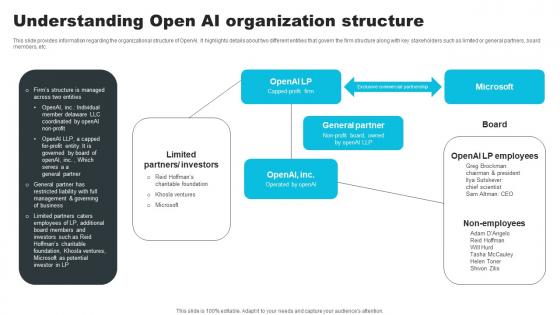
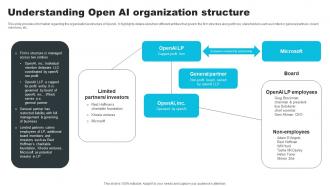
This slide provides information regarding the organizational structure of OpenAI. It highlights details about two different entities that govern the firm structure along with key stakeholders such as limited or general partners, board members, etc.
People who downloaded this PowerPoint presentation also viewed the following :
Understanding Open AI Organization Structure How ChatGPT Actually Work ChatGPT SS V with all 9 slides:
Use our Understanding Open AI Organization Structure How ChatGPT Actually Work ChatGPT SS V to effectively help you save your valuable time. They are readymade to fit into any presentation structure.








FAQs for Understanding Open AI Organization Structure How ChatGPT Actually Work
OpenAI's organizational structure includes a nonprofit parent organization, a capped-profit subsidiary, specialized research divisions, safety and alignment teams, and strategic partnerships with technology companies. These components enable balanced decision-making between mission-driven goals and commercial viability, with many technology organizations finding that hybrid structures facilitate innovation while maintaining ethical oversight and sustainable growth.
OpenAI ensures cross-departmental collaboration through integrated project teams, shared research initiatives, and regular cross-functional meetings that align safety, research, and product development goals. This collaborative structure enables seamless knowledge transfer between AI researchers, safety teams, and engineering departments, while fostering innovation through diverse perspectives, ultimately delivering more robust AI solutions and maintaining organizational coherence across complex technical challenges.
OpenAI's leadership model significantly influences its research agenda through strategic governance structures, balanced commercial-academic priorities, and mission-driven decision-making frameworks that align AI development with safety objectives. This hybrid approach enables the organization to pursue breakthrough innovations while maintaining ethical oversight, with research directions shaped by both market demands and long-term societal impact considerations, ultimately delivering commercially viable yet responsible AI advancement.
Ethics and safety are embedded throughout OpenAI's organizational hierarchy through dedicated safety teams, research oversight committees, and executive-level governance structures that guide AI development decisions. These functions operate across technical development, policy creation, and strategic planning, with many AI organizations finding that integrated safety frameworks enable responsible innovation while maintaining competitive advancement in increasingly complex AI landscapes.
OpenAI's substantial scale enables operational efficiency through specialized teams, distributed computing resources, and streamlined research-to-deployment pipelines across multiple AI domains. However, this size also presents coordination challenges, with many large tech organizations finding that strategic resource allocation and cross-functional collaboration ultimately deliver faster innovation cycles and competitive advantage in the AI landscape.
OpenAI employs research partnerships, developer API programs, safety collaboration initiatives, academic alliances, and policy engagement frameworks to connect with external stakeholders. Through these structured approaches, technology companies, research institutions, and government agencies collaborate on AI development, safety protocols, and ethical guidelines, while developers integrate OpenAI's capabilities into diverse applications, ultimately advancing responsible AI innovation across industries.
OpenAI balances open research and proprietary projects through its hybrid structure, combining a nonprofit research arm with a capped-profit subsidiary that enables commercial development. While the nonprofit focuses on safety research and public knowledge sharing, the for-profit entity develops proprietary technologies like GPT models, ultimately delivering strategic funding for research while maintaining competitive advantage in increasingly commercial AI markets.
Interdisciplinary teams at OpenAI combine expertise from computer science, neuroscience, policy, safety research, and ethics to tackle AI's complex challenges comprehensively. This strategic collaboration enables breakthrough innovations like GPT models while addressing safety concerns, regulatory compliance, and societal impacts, with organizations increasingly recognizing that diverse expertise accelerates responsible AI development and competitive advantage.
Talent acquisition and retention significantly shapes OpenAI's organizational dynamics by attracting top-tier AI researchers, engineers, and strategists who drive innovation velocity and competitive positioning. These efforts create knowledge-intensive teams that accelerate breakthrough development, foster collaborative research cultures, and maintain technical leadership, with many AI organizations finding that retaining specialized talent ultimately delivers sustained innovation capacity and market advantage.
OpenAI's structure adapts through flexible research teams, cross-functional collaboration, and rapid prototyping cycles that enable quick pivots between projects and priorities. This organizational agility allows them to reallocate resources strategically, integrate breakthrough discoveries across departments, and maintain competitive positioning in an increasingly dynamic AI landscape, ultimately delivering faster innovation cycles and technological leadership.
OpenAI incorporates feedback through collaborative research partnerships, open publication policies, peer review processes, and community engagement initiatives that directly inform strategic decisions. These mechanisms enable the organization to adapt its governance structures, research priorities, and safety protocols based on external insights, while fostering transparency and academic collaboration that ultimately enhances innovation and responsible AI development.
Diversity and inclusion at OpenAI enhances innovation by bringing varied perspectives, experiences, and problem-solving approaches to AI development, research methodologies, and ethical considerations. This strategic combination enables more comprehensive solutions, reduces algorithmic bias, and strengthens decision-making processes, with diverse teams consistently delivering better outcomes in complex technical challenges while ensuring AI systems serve broader global communities effectively.
OpenAI manages project timelines and resource allocation through cross-functional teams, agile development methodologies, strategic priority frameworks, and centralized resource planning systems. These approaches enable streamlined coordination between research, engineering, and product teams, while ensuring optimal talent distribution across initiatives like GPT development, safety research, and API services, ultimately delivering faster innovation cycles and more efficient project execution.
OpenAI implements governance mechanisms including an independent board of directors, safety committees, external audits, and staged deployment protocols for AI releases. These frameworks enhance accountability through systematic oversight, transparent research publication, and responsible scaling practices, with many AI organizations finding that structured governance ultimately delivers stakeholder confidence and sustainable innovation in an increasingly regulated landscape.
OpenAI's organizational structure combines a nonprofit foundation with a capped-profit subsidiary, enabling mission-driven research while attracting investment capital for scaling operations. This dual structure balances innovation incentives with safety oversight through independent boards, safety committees, and staged deployment protocols, with many tech organizations finding that hybrid governance models deliver both breakthrough capabilities and responsible development practices.
-
My team has been relying on SlideTeam’s professional PPT designs for a while now. It has greatly sped up quality work at my organization. So thanks!
-
It makes easy work of my work presentations. I’ve never had to be nervous about my presentations for meetings.