


Transformer Neural Network Architecture Of Chatgpt Open Ai Language Model It




Try Before you Buy Download Free Sample Product
 Impress Your
 Audience
 100%
100% Editable
 Save Hours
 of Time


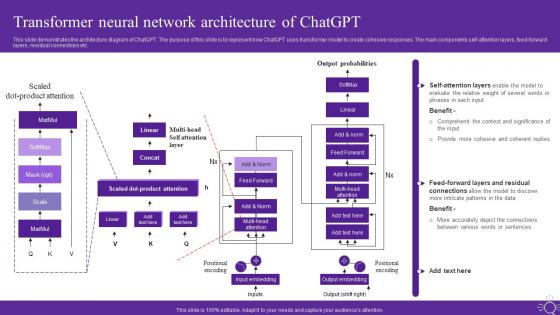
This slide demonstrates the architecture diagram of ChatGPT. The purpose of this slide is to represent how ChatGPT uses transformer model to create cohesive responses. The main components self-attention layers, feed-forward layers, residual connections etc.
People who downloaded this PowerPoint presentation also viewed the following :
Transformer Neural Network Architecture Of Chatgpt Open Ai Language Model It with all 6 slides:
Use our Transformer Neural Network Architecture Of Chatgpt Open Ai Language Model It to effectively help you save your valuable time. They are readymade to fit into any presentation structure.





FAQs for Transformer Neural Network Architecture Of Chatgpt Open Ai
Transformer architecture includes self-attention mechanisms, multi-head attention layers, positional encoding, encoder-decoder stacks, and feed-forward networks, eliminating the need for recurrent connections entirely. These components enable organizations to process sequential data in parallel rather than sequentially, with financial services and healthcare institutions finding significantly faster training times, enhanced scalability for large datasets, and improved performance on complex language tasks.
The self-attention mechanism enables Transformers to analyze relationships between all sequence elements simultaneously, weighing relevance and capturing long-range dependencies that traditional models miss. This parallel processing approach significantly enhances machine translation, document analysis, and conversational AI applications, with many organizations finding that self-attention delivers more accurate context interpretation and faster processing speeds.
Positional encodings provide Transformers with crucial sequence order information, since the architecture processes all tokens simultaneously rather than sequentially, enabling the model to understand word relationships and context within sentences. These mathematical representations help distinguish between identical words in different positions, with many natural language processing applications finding that positional encodings significantly enhance translation accuracy, text generation quality, and semantic understanding across various industries.
Multi-head attention enables transformer networks to simultaneously focus on different aspects of input sequences, such as syntactic relationships, semantic meanings, and positional dependencies. This parallel processing approach enhances pattern recognition across various representation subspaces, with applications in language translation, document analysis, and financial text processing ultimately delivering more accurate contextual understanding and improved model performance.
The Transformer model handles long-range dependencies through self-attention mechanisms that directly connect all sequence positions, enabling each token to attend to every other token regardless of distance. Unlike recurrent models that process sequences step-by-step, this parallel attention approach allows organizations in natural language processing and machine translation to achieve significantly faster training times, better context understanding, and more accurate results for complex tasks like document analysis and multilingual communication systems.
Transformers offer superior parallel processing, better long-range dependency capture, faster training times, and enhanced scalability compared to RNNs or CNNs. These advantages enable organizations in financial services, healthcare, and customer support to deploy more accurate language models, process larger datasets efficiently, and deliver real-time conversational AI, ultimately streamlining operations while reducing computational costs.
Transformer architecture adapts to image and audio tasks through vision transformers that process image patches as sequences, audio transformers for speech recognition and music analysis, and multimodal approaches combining visual and auditory data. These adaptations enable organizations in healthcare, entertainment, and retail to streamline pattern recognition, automate content analysis, and enhance customer experiences, ultimately delivering faster processing and competitive advantages across industries.
Training Transformer models presents challenges including computational intensity, vanishing gradients, overfitting, and memory constraints that require strategic mitigation approaches. Through techniques like gradient clipping, dropout regularization, learning rate scheduling, and model parallelization, organizations in healthcare, finance, and technology streamline training processes, ultimately delivering more efficient AI implementations and competitive advantages in automated decision-making systems.
BERT uses only the encoder stack for bidirectional context understanding, making it ideal for tasks like sentiment analysis and question answering, while GPT employs only the decoder stack for autoregressive text generation. These architectural variations enable different applications, with BERT excelling in language understanding for search engines and customer service automation, and GPT powering content creation and conversational AI, ultimately delivering specialized capabilities for diverse business needs.
Transformers revolutionize transfer learning by enabling massive pre-trained models like BERT and GPT to capture universal language patterns, significantly reducing training time and data requirements for specific tasks. Organizations across healthcare, finance, and customer service leverage these pre-trained models to rapidly deploy sophisticated AI applications, ultimately delivering faster implementation cycles and enhanced performance with minimal computational overhead.
Transformer architecture enables scalability through parallel processing of sequences, eliminating recurrent dependencies that bottleneck traditional models, and supporting distributed training across multiple GPUs or TPUs. While this delivers faster training times and handles larger datasets efficiently, it significantly increases memory and computational requirements, with many organizations finding that strategic resource allocation ultimately provides competitive advantages in processing complex language tasks.
Transformer architecture limitations include high computational complexity for long sequences, extensive memory requirements, significant training data needs, quadratic scaling attention mechanisms, and substantial energy consumption during processing. While these challenges impact resource allocation and training timelines, many organizations find that strategic implementation with optimized hardware and efficient fine-tuning approaches ultimately delivers enhanced performance and competitive advantage in AI applications.
Layer Normalization and Dropout enhance Transformer performance by stabilizing training, preventing overfitting, and improving model generalization across diverse datasets. These techniques streamline gradient flow, reduce internal covariate shift, and enable more robust feature learning, with many organizations in natural language processing and computer vision finding that these optimizations deliver faster convergence and significantly better accuracy.
Transformer architectures will increasingly integrate with quantum computing, neuromorphic chips, and multimodal AI systems, enabling more efficient processing and broader applications. These evolving combinations streamline natural language processing, computer vision, and real-time decision-making across healthcare, finance, and manufacturing sectors, ultimately delivering faster automation and competitive advantages for organizations scaling AI operations.
Recent Transformer innovations include sparse attention mechanisms, mixture-of-experts architectures, rotary position embeddings, efficient attention patterns, and multi-scale processing capabilities. These advancements streamline computational efficiency, enhance scalability, and deliver superior performance across natural language processing and computer vision applications, with organizations in finance, healthcare, and technology finding that these optimized architectures significantly reduce operational costs while accelerating deployment timelines.
-
No second thoughts when I’m looking for excellent templates. SlideTeam is definitely my go-to website for well-designed slides.
-
I discovered some really original and instructive business slides here. I found that they suited me well.