


Chatgpt IT History And Evolution Of Openai Research Organization




Try Before you Buy Download Free Sample Product
 Impress Your
 Audience
 100%
100% Editable
 Save Hours
 of Time


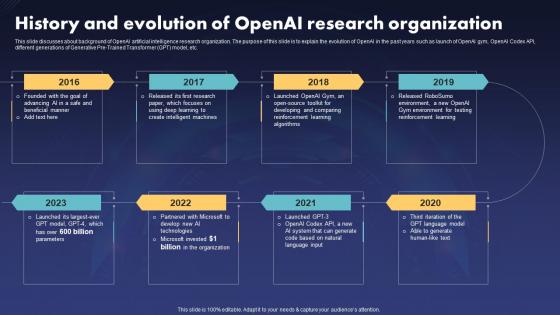
This slide discusses about background of OpenAI artificial intelligence research organization. The purpose of this slide is to explain the evolution of OpenAI in the past years such as launch of OpenAI gym, OpenAI Codex API, different generations of Generative Pre Trained Transformer GPT model, etc.
People who downloaded this PowerPoint presentation also viewed the following :
Chatgpt IT History And Evolution Of Openai Research Organization with all 6 slides:
Use our Chatgpt IT History And Evolution Of Openai Research Organization to effectively help you save your valuable time. They are readymade to fit into any presentation structure.





FAQs for Chatgpt IT History And Evolution Of
OpenAI's evolution includes GPT-1's foundational language modeling, GPT-2's improved text generation, GPT-3's breakthrough in conversational AI, ChatGPT's user-friendly interface launch, and GPT-4's multimodal capabilities. These milestones have enabled organizations across healthcare, finance, and education to streamline customer interactions, automate content creation, and enhance decision-making processes, ultimately delivering competitive advantages through scalable AI integration.
ChatGPT's architecture has evolved through significant improvements in model size, training methodologies, reinforcement learning from human feedback, and multimodal capabilities across GPT-3.5 to GPT-4 iterations. These enhancements have delivered more accurate responses, better contextual understanding, and expanded functionality, with many organizations finding that newer versions streamline customer service, content creation, and automated workflows more effectively.
Reinforcement learning enhances ChatGPT's capabilities by enabling continuous improvement through human feedback, optimizing response quality, and refining conversational accuracy. This approach allows the model to learn from user interactions, adapt to context-specific requirements, and deliver more relevant responses, with many organizations finding that these refinements significantly improve customer service automation and content generation efficiency.
OpenAI addresses ethical concerns through rigorous safety testing, content filtering systems, bias mitigation protocols, and transparent research practices that guide ChatGPT's development. These measures help organizations deploy AI responsibly by reducing harmful outputs, ensuring fairness across diverse user interactions, and maintaining accountability standards, ultimately enabling businesses to leverage conversational AI while building stakeholder trust.
ChatGPT's most significant applications include customer service automation, content creation and marketing, code development and debugging, educational tutoring and training, and healthcare documentation assistance. Across industries like financial services, retail, and healthcare, organizations are leveraging these capabilities to streamline operations, reduce costs, and enhance customer experiences, with many finding that strategic AI integration delivers substantial competitive advantages.
User feedback has fundamentally shaped ChatGPT's development through iterative training processes, safety improvements, response accuracy enhancements, and capability expansions based on real-world interactions. OpenAI continuously integrates user insights to refine conversational quality, reduce harmful outputs, and optimize performance across diverse applications, with organizations in education, healthcare, and customer service finding increasingly reliable and contextually appropriate responses that enhance operational efficiency and user experiences.
ChatGPT differentiates itself through advanced natural language processing, extensive training data, contextual conversation retention, and superior response coherence compared to traditional chatbots. While many conversational agents struggle with complex queries, ChatGPT's transformer architecture enables nuanced understanding and human-like interactions, with businesses in customer service, content creation, and technical support finding significantly enhanced user engagement and operational efficiency.
ChatGPT updates enhance performance through improved training datasets, refined algorithms, better contextual understanding, reduced hallucinations, and enhanced safety measures. These iterations enable more accurate responses, faster processing, and improved reliability across diverse applications, with businesses finding that newer versions deliver significantly better customer service automation, content generation, and decision-support capabilities.
Common misconceptions include believing ChatGPT has real-time internet access, can learn from conversations, provides always-accurate information, understands context like humans, and operates without biases. While ChatGPT streamlines content creation, research assistance, and customer interactions across industries, organizations increasingly find that understanding these limitations enables more strategic implementation, ultimately delivering better outcomes through appropriate use cases and human oversight.
Businesses can effectively integrate ChatGPT into customer service by implementing it for initial inquiry handling, FAQ responses, ticket routing, and 24/7 support availability, while maintaining human oversight for complex issues. This strategic combination enables companies to reduce response times, lower operational costs, and enhance customer experiences, with many organizations in retail, banking, and telecommunications finding that hybrid AI-human models ultimately deliver scalable efficiency and improved satisfaction rates.
Key advancements include transformer architecture, attention mechanisms, unsupervised pre-training, reinforcement learning from human feedback, and massive parameter scaling. These innovations enable ChatGPT to understand context, generate coherent responses, and engage in nuanced conversations, with organizations across finance, healthcare, and customer service finding that these capabilities streamline operations and enhance user experiences.
OpenAI employs reinforcement learning from human feedback (RLHF), constitutional AI training, extensive red team testing, and iterative safety evaluations to align ChatGPT with user intentions. Through continuous monitoring, bias detection systems, and phased deployment strategies, organizations integrating ChatGPT benefit from enhanced reliability, reduced harmful outputs, and improved user experiences, ultimately delivering safer AI interactions while maintaining competitive advantage in an increasingly AI-driven business landscape.
ChatGPT's limitations include occasional factual inaccuracies, knowledge cutoff dates, difficulty with real-time information, context length restrictions, and potential bias in responses. OpenAI addresses these through enhanced training methodologies, expanded knowledge bases, improved reasoning capabilities, and better safety measures, with organizations in healthcare, finance, and education finding that newer iterations deliver more reliable outputs, reduced hallucinations, and enhanced contextual understanding for critical business applications.
Training data significantly influences ChatGPT's conversational abilities by providing diverse language patterns, contextual relationships, and communication styles from millions of text sources. This extensive dataset enables the model to understand nuances, generate contextually appropriate responses, and adapt tone across different scenarios, with many organizations finding that higher-quality training data ultimately delivers more natural interactions and enhanced user experiences.
Future conversational AI trends include enhanced multimodal capabilities, specialized industry applications, improved reasoning abilities, real-time learning, and seamless integration with business workflows. These advancements enable organizations across healthcare, finance, and customer service to deliver more personalized experiences, automate complex decision-making, and streamline operations, ultimately creating competitive advantages through intelligent automation.
-
Nice and innovative design.
-
Eye-catching PPT designs, outstanding team, and best customer service. I’m a super satisfied customer here!