


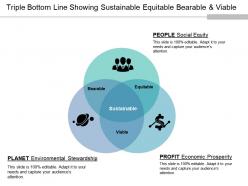
Triple bottom line showing sustainable equitable bearable and viable





Try Before you Buy Download Free Sample Product
 Impress Your
Audience
 100%
Editable
 Save Hours
of Time


Identify causes of infection with our Triple Bottom Line Showing Sustainable Equitable Bearable And Viable. Empower folks to fight bacteria.
People who downloaded this PowerPoint presentation also viewed the following :
Triple bottom line showing sustainable equitable bearable and viable with all 5 slides:
Be certain our Triple Bottom Line Showing Sustainable Equitable Bearable And Viable are aesthetically designed. They are created with great care and attention.


FAQs for Triple bottom line showing sustainable equitable
The three pillars of the Triple Bottom Line framework are people, planet, and profit, representing social responsibility, environmental sustainability, and economic viability respectively. This strategic approach enables organizations across industries like manufacturing, retail, and financial services to measure comprehensive performance beyond traditional metrics, ultimately delivering balanced stakeholder value and sustainable competitive advantage.
Businesses can measure social impact through employee satisfaction surveys, community investment tracking, diversity metrics, stakeholder engagement assessments, and social return on investment calculations alongside traditional financial KPIs. Many organizations integrate these measurements into balanced scorecards and sustainability reports, enabling comprehensive performance evaluation that demonstrates value to investors, customers, and communities while driving competitive advantage.
Organizations can enhance environmental sustainability through renewable energy adoption, waste reduction programs, sustainable supply chain management, water conservation initiatives, and carbon footprint monitoring systems. These strategies streamline operations by lowering energy costs, minimizing resource waste, and improving regulatory compliance, with many companies in manufacturing and retail finding that sustainable practices ultimately deliver competitive advantages and enhanced brand reputation.
The Triple Bottom Line influences corporate governance by integrating people, planet, and profit considerations into strategic decision-making, board oversight, and stakeholder accountability frameworks. This approach enables organizations to establish comprehensive governance structures that balance financial performance with social impact and environmental sustainability, with many companies finding that triple bottom line governance enhances long-term value creation and stakeholder trust.
Stakeholders significantly influence Triple Bottom Line strategies through investment decisions, consumer preferences, regulatory requirements, employee expectations, and community engagement initiatives. Through ESG investing, sustainability-focused purchasing, environmental regulations, and social responsibility demands, stakeholders drive companies to balance profit with environmental stewardship and social impact, ultimately delivering long-term value and competitive advantage.
Small businesses can adopt Triple Bottom Line principles by integrating social and environmental considerations into core operations, starting with energy-efficient practices, local sourcing, and community partnerships. These strategic combinations enable smaller enterprises to reduce operational costs, enhance brand reputation, and attract conscious consumers, with many local retailers and service providers finding that sustainable practices ultimately deliver competitive advantages while building stronger community connections.
Successful Triple Bottom Line implementations include Patagonia's environmental activism and supply chain transparency, Ben & Jerry's social justice initiatives and sustainable sourcing, and Interface Inc.'s Mission Zero carbon-neutral manufacturing. These companies demonstrate how strategic integration of people, planet, and profit considerations enhances brand loyalty, operational efficiency, and long-term financial performance, with many organizations finding that comprehensive sustainability approaches ultimately deliver competitive advantage and stakeholder value.
The Triple Bottom Line framework drives innovation by compelling organizations to develop solutions that simultaneously address social, environmental, and financial challenges, fostering creative problem-solving and resource efficiency. Companies increasingly find that this approach generates breakthrough products, operational improvements, and market opportunities, while attracting talent and customers who value sustainability, ultimately delivering competitive advantage.
Companies face challenges including measuring non-financial impacts, managing increased operational costs, aligning stakeholder expectations, navigating regulatory complexities, and balancing short-term pressures with long-term sustainability goals. While implementing triple bottom line frameworks requires significant resource allocation and cultural shifts, organizations increasingly find that integrating social and environmental considerations ultimately delivers enhanced brand reputation, operational efficiency, and competitive advantage in today's conscious marketplace.
Non-profits can leverage the Triple Bottom Line by integrating people, planet, and profit metrics into their mission strategies, ensuring social programs create measurable community impact while maintaining environmental sustainability and financial viability. This approach enables organizations like habitat restoration groups and educational foundations to demonstrate comprehensive value to donors, secure sustainable funding streams, and ultimately deliver greater long-term impact across all stakeholder communities.
Triple Bottom Line metrics include financial indicators like revenue and ROI, social measures such as employee satisfaction and community investment, and environmental KPIs including carbon footprint and waste reduction. These comprehensive assessments enable organizations to track sustainability progress across all three dimensions, with many companies finding that integrated reporting enhances stakeholder transparency and competitive positioning.
Consumer preferences significantly drive Triple Bottom Line adoption as businesses respond to growing demand for sustainable, ethical products and transparent corporate practices. Companies in retail, food service, and consumer goods increasingly integrate social and environmental considerations alongside profit metrics, with many finding that Triple Bottom Line approaches enhance brand loyalty, attract conscious consumers, and deliver competitive advantage in sustainability-focused markets.
Triple Bottom Line contributes to long-term financial sustainability by reducing operational costs through resource efficiency, attracting socially conscious investors and customers, and mitigating regulatory risks. Companies implementing comprehensive people, planet, and profit strategies often experience enhanced brand loyalty, improved employee retention, and access to sustainable financing opportunities, ultimately delivering competitive advantage in an increasingly ESG-focused marketplace.
Organizations communicate their Triple Bottom Line efforts through sustainability reports, social media campaigns, customer testimonials, community engagement events, and transparent supply chain documentation. These comprehensive approaches enable businesses to showcase their environmental initiatives, social responsibility programs, and financial performance simultaneously, with many companies finding that authentic storytelling about measurable impacts builds stronger customer loyalty and stakeholder trust.
Emerging trends include stakeholder capitalism prioritization, ESG integration into core operations, circular economy adoption, impact measurement standardization, and supply chain transparency enhancement. Through advanced analytics and reporting frameworks, organizations across manufacturing, retail, and financial services are demonstrating measurable social and environmental returns alongside profits, ultimately delivering competitive advantage in an increasingly purpose-driven marketplace.
-
Good research work and creative work done on every template.
-
Great quality slides in rapid time.