

Understanding How Digital Payment Wallets Works Digital Transformation In Banking DT SS




Try Before you Buy Download Free Sample Product
 Impress Your
 Audience
 100%
100% Editable
 Save Hours
 of Time


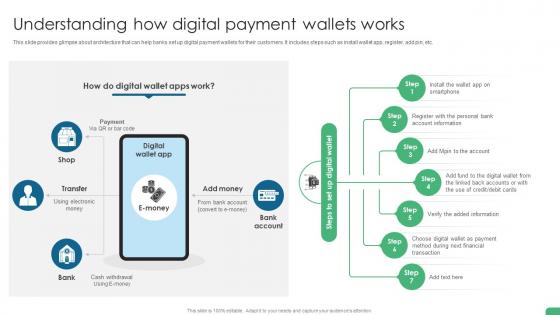
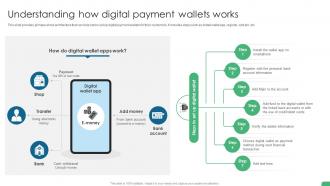
This slide provides glimpse about architecture that can help banks set up digital payment wallets for their customers. It includes steps such as install wallet app, register, add pin, etc.
People who downloaded this PowerPoint presentation also viewed the following :
Understanding How Digital Payment Wallets Works Digital Transformation In Banking DT SS with all 9 slides:
Use our Understanding How Digital Payment Wallets Works Digital Transformation In Banking DT SS to effectively help you save your valuable time. They are readymade to fit into any presentation structure.








FAQs for Understanding How Digital Payment Wallets Works Digital Transformation In
Digital payment wallets offer instant transactions, enhanced security through encryption and biometric authentication, contactless payments, loyalty program integration, and comprehensive transaction tracking. These features streamline financial interactions by eliminating physical card requirements, reducing transaction times, and providing real-time spending insights, with many retailers and financial institutions finding that wallet adoption significantly enhances customer convenience while reducing operational costs.
Digital payment wallets ensure security through multi-layered encryption, tokenization, biometric authentication, fraud detection algorithms, and secure cloud storage systems. These technologies work by replacing sensitive card data with encrypted tokens, monitoring transactions for suspicious patterns, and requiring fingerprint or facial recognition, ultimately delivering faster, safer payment experiences while minimizing fraud risks for consumers and merchants.
**INPUT**: What are the most popular digital payment wallet services available today, and what sets them apart? **OUTPUT**: Popular digital payment wallets include PayPal, Apple Pay, Google Pay, Samsung Pay, and Venmo, each offering distinct advantages through different integration approaches, security features, and user experiences. PayPal dominates online transactions with broad merchant acceptance, while Apple Pay and Google Pay leverage biometric authentication and seamless device integration, ultimately delivering faster checkout experiences and enhanced security for increasingly mobile-focused consumers.
Digital wallets facilitate international transactions by enabling instant cross-border transfers, supporting multiple currencies, offering competitive exchange rates, and reducing traditional banking fees through blockchain and fintech integrations. While these platforms streamline global commerce for businesses and consumers, they face regulatory compliance complexities, varying international standards, and security concerns, with many financial institutions finding that strategic partnerships ultimately deliver enhanced customer experiences and operational efficiency.
Digital payment wallets accelerate e-commerce growth by streamlining checkout processes, reducing cart abandonment, enhancing mobile shopping experiences, and enabling faster transaction processing. Through secure one-click payments and stored payment methods, retailers experience increased conversion rates, improved customer retention, and expanded global reach, with many online businesses finding that wallet integration ultimately delivers higher sales volumes and enhanced customer satisfaction.
User demographics significantly influence digital payment wallet adoption through age preferences, income levels, technological familiarity, and geographic accessibility factors. Younger consumers and urban professionals typically embrace mobile payments faster, while older demographics often prefer traditional methods, though financial institutions increasingly find that targeted education and simplified interfaces can bridge these gaps, ultimately expanding market reach across diverse user segments.
Digital payment wallets enable brick-and-mortar businesses to streamline transactions, reduce cash handling costs, and enhance customer experiences through faster checkout processes. These technologies deliver operational efficiency by minimizing payment processing times, improving transaction security, and providing valuable customer data insights, with many retailers finding that wallet integration ultimately drives customer loyalty and competitive advantage in an increasingly digital marketplace.
Digital payment wallets integrate with loyalty programs through APIs, point accumulation systems, personalized offers, and real-time reward tracking capabilities. These integrations enable retailers to deliver targeted promotions directly through wallet interfaces, automatically apply discounts at checkout, and provide seamless point redemption experiences, ultimately enhancing customer engagement while driving repeat purchases and brand loyalty.
Technological advancements shaping digital payment wallets include biometric authentication, blockchain integration, artificial intelligence for fraud detection, contactless NFC technology, and cryptocurrency support. These innovations enhance security, streamline transactions, and enable seamless cross-border payments, with financial institutions and retailers increasingly finding that advanced wallet features deliver faster customer experiences and significant operational efficiency gains.
Regulatory frameworks significantly impact digital payment wallet operations through licensing requirements, data protection mandates, transaction limits, anti-money laundering compliance, and cross-border payment restrictions. These regulations vary substantially across countries, with banks in Europe navigating GDPR compliance while financial institutions in Asia face different KYC requirements, ultimately creating operational complexity but enhancing consumer trust and security.
Main challenges include security concerns about financial data, learning new interfaces and features, ensuring merchant acceptance, managing multiple wallet platforms, and maintaining reliable internet connectivity. While these hurdles initially seem daunting, many users find that digital wallets ultimately streamline transactions, enhance payment security, and deliver faster checkout experiences, with financial institutions increasingly offering comprehensive support and education during the transition process.
Digital wallets significantly enhance financial inclusion by enabling unbanked populations to access essential financial services through smartphones, bypassing traditional banking infrastructure requirements. Mobile payment platforms like M-Pesa in Kenya and bKash in Bangladesh demonstrate how these technologies facilitate money transfers, bill payments, and micro-savings, ultimately delivering greater economic participation and financial empowerment.
Emerging trends in developing countries include mobile-first wallet designs, integration with government services, cryptocurrency support, QR code standardization, and AI-powered financial insights. These innovations enable financial inclusion for unbanked populations, streamline cross-border remittances, and deliver micro-lending capabilities, with many developing nations finding that digital wallets accelerate economic growth and reduce cash dependency significantly.
Digital payment wallets address fraud and chargeback concerns through advanced encryption, tokenization, biometric authentication, real-time transaction monitoring, and multi-layered security protocols. These technologies streamline dispute resolution by maintaining detailed transaction records, enabling faster chargeback processing, and providing merchants with comprehensive fraud protection tools, ultimately delivering enhanced security and reduced financial losses.
Digital payment wallets significantly reduce environmental impact compared to cash transactions by eliminating paper currency production, coin minting, and physical transportation networks that require substantial energy and raw materials. While digital payments increase data center energy consumption, banks and financial institutions find that electronic transactions ultimately deliver lower carbon footprints, reduced resource consumption, and enhanced operational efficiency across payment ecosystems.
-
The service is fast, and I could access any presentation after buying the subscription. I don’t think I’ll ever have to worry about a presentation in my life.
-
Every time I ask for something out-of-the-box from them and they never fail in delivering that. No words for their excellence!