


Understanding The Bant Model Sales Qualification Scoring Model




Try Before you Buy Download Free Sample Product
 Impress Your
 Audience
 100%
100% Editable
 Save Hours
 of Time


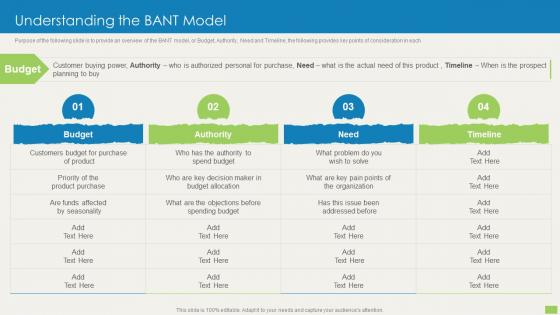
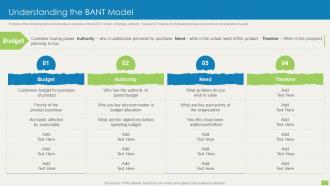
Purpose of the following slide is to provide an overview of the BANT model, or Budget, Authority, Need and Timeline, the following provides key points of consideration in each
People who downloaded this PowerPoint presentation also viewed the following :
Understanding The Bant Model Sales Qualification Scoring Model with all 6 slides:
Use our Understanding The Bant Model Sales Qualification Scoring Model to effectively help you save your valuable time. They are readymade to fit into any presentation structure.





FAQs for Understanding The Bant Model Sales
BANT model components include Budget (financial capacity), Authority (decision-making power), Need (business requirement), and Timeline (purchase timeframe). These elements interrelate strategically, with Authority and Budget determining procurement feasibility, while Need and Timeline drive urgency, enabling sales teams to prioritize qualified prospects and streamline conversion processes effectively.
The BANT model improves lead qualification by systematically evaluating Budget, Authority, Need, and Timeline, enabling sales teams to prioritize high-potential prospects and allocate resources more efficiently. This structured approach streamlines sales processes by identifying decision-makers, confirming purchasing power, and establishing realistic timelines, ultimately delivering faster conversions and higher close rates.
Successful BANT applications include software companies qualifying enterprise clients through budget verification and decision-maker identification, financial services firms assessing loan applicants' authority and timeline requirements, and manufacturing businesses evaluating procurement needs and purchasing timelines. These implementations streamline sales processes by eliminating unqualified prospects early, reducing sales cycle length, and improving conversion rates, with many organizations finding significantly enhanced resource allocation and revenue predictability.
Businesses can effectively train sales teams on BANT through role-playing exercises, real prospect scenarios, and structured questioning frameworks that cover budget, authority, need, and timeline assessment. Through interactive workshops and CRM integration training, sales professionals learn to qualify leads systematically, ultimately reducing sales cycles and improving conversion rates while enhancing overall pipeline quality.
Common pitfalls include treating BANT as a rigid checklist rather than a flexible framework, dismissing prospects who don't meet all criteria immediately, and failing to adapt questions for different industries or sales cycles. Many organizations find that over-qualifying leads, neglecting relationship building while focusing solely on qualification criteria, and applying outdated budget assumptions can significantly reduce conversion rates and miss valuable opportunities.
BANT focuses on budget, authority, need, and timeline for straightforward qualification, while MEDDIC emphasizes decision criteria and processes, and CHAMP prioritizes challenges before authority assessment. Each framework serves different sales contexts, with BANT working well for transactional sales, MEDDIC for complex enterprise deals, and CHAMP for consultative approaches, ultimately enabling sales teams to match qualification strategies with their specific market dynamics and deal complexity.
Technology enhances BANT model implementation through CRM systems, lead scoring algorithms, predictive analytics, marketing automation platforms, and AI-powered chatbots. These tools streamline prospect qualification by automatically tracking budget indicators, identifying decision-maker roles, and monitoring engagement signals, while delivering faster qualification processes, improved lead prioritization, and ultimately higher conversion rates for sales teams.
Companies adapt BANT for digital environments by leveraging marketing automation platforms, CRM analytics, social media insights, and behavioral tracking tools to assess prospects remotely. Through digital touchpoints like webinars, content downloads, and online demos, sales teams can evaluate budget authority through form fields and engagement patterns, assess needs via content consumption behavior, and determine timeline through lead scoring algorithms, ultimately delivering more efficient qualification processes and faster conversion rates in increasingly competitive online markets.
**INPUT**: What specific metrics can be used to measure the effectiveness of the BANT model? **OUTPUT**: BANT model effectiveness metrics include lead conversion rates, sales cycle length, lead scoring accuracy, pipeline velocity, and cost per qualified lead. These measurements enable sales teams to optimize qualification processes, improve forecasting accuracy, and enhance resource allocation, with many organizations finding that tracking these metrics delivers higher close rates and streamlined sales operations. [Word count: 54 words]
BANT integration with CRM systems enables automated lead scoring, customized pipeline stages, and real-time qualification tracking through dedicated fields for budget, authority, need, and timeline assessment. Sales teams can streamline prospect evaluation, prioritize high-quality leads more effectively, and generate comprehensive analytics reports, ultimately delivering faster conversion rates and improved sales forecasting accuracy across organizations.
Customer feedback enables sales teams to refine BANT criteria by revealing which prospects convert most effectively, adjusting budget thresholds, authority identification methods, and timeline expectations based on real outcomes. Through systematic analysis of won and lost deals, organizations enhance their qualification accuracy, streamline resource allocation, and ultimately deliver more targeted sales approaches that align with actual buyer behaviors.
Businesses can leverage the BANT model in marketing by segmenting campaigns based on budget availability, targeting decision-makers with authority-focused content, creating urgency through need-based messaging, and developing timeline-specific nurturing sequences. Marketing teams in sectors like financial services and healthcare use these criteria to optimize resource allocation, personalize customer journeys, and deliver highly targeted campaigns that ultimately enhance conversion rates and marketing ROI.
The BANT model enhances customer relationship management by enabling sales teams to prioritize qualified prospects, personalize engagement strategies, and allocate resources more effectively based on budget, authority, need, and timeline assessments. This strategic approach streamlines customer interactions, reduces acquisition costs, and improves retention rates, with many organizations finding that BANT-qualified leads convert faster and maintain longer-term relationships.
The BANT framework helps startups identify promising prospects by qualifying leads based on Budget, Authority, Need, and Timeline, enabling focused resource allocation on viable opportunities. By systematically evaluating these criteria, early-stage companies can prioritize prospects with genuine purchasing power and immediate requirements, ultimately streamlining their sales process and accelerating customer acquisition in competitive markets.
Enterprise BANT requires deeper stakeholder analysis, longer timeline assessments, and complex budget verification processes, while small business BANT focuses on streamlined decision-maker identification and faster qualification cycles. Large organizations demand multi-layered authority mapping and extensive needs analysis, whereas smaller companies enable direct access to decision-makers, ultimately delivering more agile sales processes and shorter conversion timelines.
-
Based on my personal experience, I would recommend other people to subscribe to SlideTeam. No one can be disappointed here!
-
Editable, diversified, compatible with MS PPT and Google Slides, and on top of that finest graphics!! I mean in the words of the famous Ross Geller, “What more do you want!”