


Understanding The Key Elements Of Healthcare Strategic Planning Functional Areas Of Medical




Try Before you Buy Download Free Sample Product
 Impress Your
 Audience
 100%
100% Editable
 Save Hours
 of Time


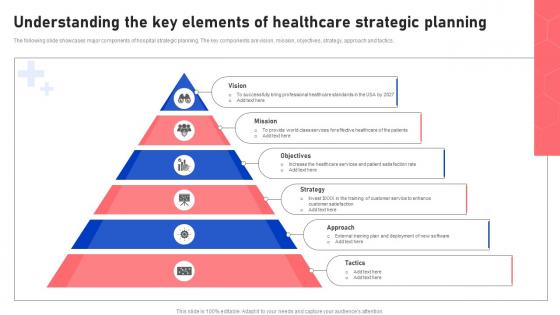
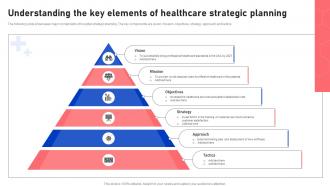
The following slide showcases major components of hospital strategic planning. The key components are vision, mission, objectives, strategy, approach and tactics.
People who downloaded this PowerPoint presentation also viewed the following :
Understanding The Key Elements Of Healthcare Strategic Planning Functional Areas Of Medical with all 6 slides:
Use our Understanding The Key Elements Of Healthcare Strategic Planning Functional Areas Of Medical to effectively help you save your valuable time. They are readymade to fit into any presentation structure.





FAQs for Understanding The Key Elements Of Healthcare Strategic Planning Functional
**INPUT**: What are the key components of an effective healthcare strategic plan? **OUTPUT**: Effective healthcare strategic plans include comprehensive market analysis, operational efficiency frameworks, technology integration roadmaps, financial sustainability models, and regulatory compliance strategies. These components work together by aligning organizational resources with patient care objectives, streamlining service delivery, and enhancing competitive positioning, with many healthcare institutions finding that strategic integration ultimately delivers improved patient outcomes and sustainable growth. [Word count: 60 words]
Healthcare organizations can improve stakeholder engagement through structured forums, regular feedback sessions, transparent communication channels, cross-departmental workshops, and digital collaboration platforms. These approaches streamline input gathering by involving physicians, nurses, administrators, and patients early in planning phases, ultimately delivering more comprehensive strategies and stronger buy-in across all organizational levels.
Healthcare strategic plan success should be measured through patient satisfaction scores, clinical quality indicators, financial performance metrics, operational efficiency measures, and staff engagement levels. These comprehensive metrics enable healthcare organizations to track improvements in patient outcomes, cost reduction, service delivery times, and competitive positioning, with many hospitals finding that balanced scorecards ultimately deliver better resource allocation and sustainable growth.
Emerging technologies significantly reshape healthcare strategic planning by enabling data-driven decision making, predictive analytics, and resource optimization across organizational operations. Healthcare systems increasingly integrate AI for patient flow management, telemedicine for expanded access, and IoT devices for real-time monitoring, ultimately delivering improved patient outcomes, operational efficiency, and competitive positioning in evolving markets.
Data analytics serves as the foundation for evidence-based healthcare strategic planning, enabling organizations to identify patient patterns, predict demand fluctuations, optimize resource allocation, and measure outcomes effectively. Through predictive modeling and real-time insights, hospitals and health systems streamline operations, reduce costs, enhance patient experiences, and ultimately deliver more personalized care while maintaining competitive advantage in an increasingly data-driven healthcare landscape.
Hospitals can align strategic plans with community health needs through comprehensive health assessments, stakeholder engagement, data-driven priority setting, and collaborative partnerships with local organizations. By conducting regular community health surveys, analyzing demographic trends, and partnering with public health agencies, healthcare systems can develop targeted service offerings that address prevalent conditions while ensuring sustainable resource allocation and improved population health outcomes.
Best practices for involving healthcare staff include forming cross-functional planning committees, conducting comprehensive staff surveys and focus groups, hosting department-specific strategy sessions, and implementing regular feedback loops throughout the process. These approaches enhance buy-in by incorporating frontline insights from nurses, physicians, and support staff, while ensuring strategic initiatives address operational realities, ultimately delivering more effective implementation and stronger organizational alignment.
Financial constraints significantly impact healthcare strategic decision-making by limiting technology investments, reducing staff expansion capabilities, and forcing prioritization of essential services over innovative programs. These budget limitations often lead hospitals and health systems to delay equipment upgrades, postpone facility expansions, and focus resources on immediate patient care needs, while many healthcare organizations find that strategic partnerships and phased implementation approaches help maximize limited resources for long-term sustainability.
Healthcare organizations can ensure sustainability through diversified revenue streams, operational efficiency improvements, strategic partnerships, technology integration, and robust financial planning. These strategies enable hospitals and health systems to reduce costs, enhance patient outcomes, and adapt to regulatory changes, with many healthcare institutions finding that combining digital transformation with strategic resource allocation ultimately delivers improved financial performance and competitive advantage in an increasingly complex healthcare landscape.
SWOT analysis in healthcare strategic planning evaluates internal strengths like specialized expertise and weaknesses such as outdated technology, while assessing external opportunities including demographic shifts and threats like regulatory changes. Healthcare organizations use this framework to identify strategic priorities, allocate resources effectively, and develop competitive positioning strategies, ultimately enabling data-driven decisions that enhance patient outcomes and operational efficiency.
Healthcare organizations should consider aging populations, value-based care models, digital health adoption, personalized medicine advances, and regulatory changes when developing strategies. These trends significantly impact resource allocation, technology investments, and service delivery models, with many hospitals and health systems finding that proactive adaptation to these shifts delivers improved patient outcomes, operational efficiency, and competitive positioning in an increasingly complex healthcare landscape.
Healthcare leaders can foster innovation by establishing cross-functional planning teams, implementing pilot programs for emerging technologies, and creating dedicated innovation budgets within strategic frameworks. Through structured brainstorming sessions and partnerships with tech startups, hospitals and health systems encourage creative problem-solving while maintaining operational stability, ultimately delivering enhanced patient care and competitive positioning in an increasingly dynamic healthcare landscape.
Healthcare strategic planning faces challenges including resource constraints, stakeholder resistance, regulatory complexities, technology integration hurdles, and change management difficulties. These obstacles can be overcome through comprehensive stakeholder engagement, phased implementation approaches, robust communication strategies, and flexible planning frameworks, with many healthcare organizations finding that regular monitoring and adaptive adjustments ultimately deliver improved patient outcomes and operational efficiency.
Regulatory changes significantly impact healthcare strategic planning by requiring organizations to reassess compliance frameworks, operational protocols, and resource allocation strategies. These shifts often necessitate updated policies, staff retraining, and technology investments, with many healthcare systems finding that proactive regulatory monitoring ultimately delivers competitive advantage and enhanced patient care standards.
Patient experience serves as a cornerstone of healthcare strategic planning, influencing service delivery models, technology investments, care coordination protocols, and facility design decisions. Healthcare organizations increasingly recognize that superior patient experiences drive loyalty, referrals, and competitive differentiation, with many hospitals and clinics finding that patient-centered strategies ultimately enhance both clinical outcomes and financial performance.
-
“One of the best experiences with SlideTeam for my presentation.Everything on time, communication is efficient and price is reasonable. All good in one place.”
-
I discovered this website through a google search, the services matched my needs perfectly and the pricing was very reasonable. I was thrilled with the product and the customer service. I will definitely use their slides again for my presentations and recommend them to other colleagues.