

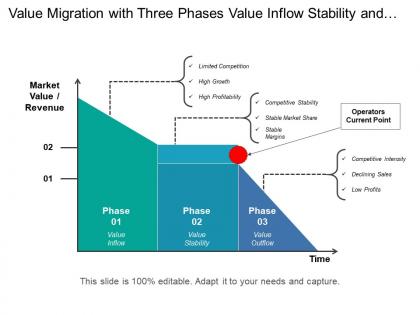
Value migration with three phases value inflow stability and outflow




Try Before you Buy Download Free Sample Product
 Impress Your
 Audience
 100%
100% Editable
 Save Hours
 of Time


Discredit any display of insolence with our Value Migration With Three Phases Value Inflow Stability And Outflow. Encourage folks to be courteous.
People who downloaded this PowerPoint presentation also viewed the following :
Value migration with three phases value inflow stability and outflow with all 5 slides:
Create images that will impress folks for decades to come with our Value Migration With Three Phases Value Inflow Stability And Outflow. It inspires iconic designs



FAQs for Value migration with three phases value inflow
Key factors driving value migration include digital transformation initiatives, changing consumer preferences, regulatory shifts, technological disruption, and evolving market dynamics. These forces accelerate value movement by enabling new business models, streamlining operations, and creating competitive advantages, with many organizations finding that strategic adaptation to these trends ultimately delivers enhanced market positioning and sustainable growth.
Companies can identify value migration by monitoring shifting customer preferences, analyzing competitor performance, tracking technological disruptions, and studying changing regulatory environments within their sectors. Through strategic market research, data analytics, and customer feedback loops, organizations in industries like retail, financial services, and healthcare can pivot their business models, reallocate resources, and develop new value propositions, ultimately maintaining competitive advantage.
Technology serves as the primary catalyst for value migration by enabling disruptive business models, automating processes, enhancing customer experiences, and creating data-driven insights that shift competitive advantages. Through digital platforms, AI-powered analytics, and cloud infrastructure, companies can rapidly scale operations, reduce costs, and deliver superior services, with many traditional industries finding that technology-forward competitors capture significant market share by fundamentally reimagining value delivery.
Value migration can significantly impact customer loyalty by shifting consumer expectations toward brands that deliver superior experiences, innovative solutions, and competitive pricing. When value migrates to new market entrants or reimagined business models, traditional brands often face declining loyalty as customers gravitate toward organizations offering enhanced convenience, personalization, and digital integration, ultimately forcing established companies to transform their value propositions or risk losing market share.
Market disruption accelerates value migration by fundamentally altering customer preferences, competitive dynamics, and industry economics through technological innovation, regulatory changes, and evolving consumer behaviors. When disruptive forces emerge, established players often struggle to adapt, while agile competitors capture shifting value streams, with many organizations finding that embracing disruption enables competitive advantage and sustainable growth.
Businesses can capture value migration opportunities through strategic diversification, digital transformation, ecosystem partnerships, customer-centric innovation, and proactive market monitoring. Companies like Netflix transitioning from DVDs to streaming, or traditional banks developing fintech capabilities, demonstrate how organizations successfully pivot by anticipating shifts, investing in emerging technologies, and reimagining their value propositions to stay competitive.
Startups can leverage value migration by identifying emerging customer needs that established players haven't addressed, focusing on underserved market segments, and adopting new technologies or business models faster than incumbents. By positioning themselves where value is shifting—such as digital-first services, personalized experiences, or sustainable solutions—startups capture market share while larger competitors struggle with legacy constraints.
Organizations should track revenue growth rates, market share changes, customer acquisition and retention costs, profit margin trends, and competitive positioning metrics. These indicators help businesses identify shifting value patterns across sectors, enabling strategic pivots through enhanced resource allocation, targeted innovation investments, and improved customer experience initiatives, ultimately delivering sustainable competitive advantage in increasingly dynamic markets.
Globalization accelerates value migration by enabling rapid capital flows, technology transfers, and market access shifts across borders. Companies can quickly pivot resources from declining markets to emerging opportunities, while digital connectivity allows businesses in developing economies to capture value from traditional Western markets, ultimately reshaping competitive landscapes and forcing strategic repositioning.
Value migration increasingly aligns with corporate sustainability initiatives, as businesses recognize that environmental and social responsibility drives long-term value creation and competitive positioning. Companies implementing comprehensive sustainability programs often experience value migration toward their operations, with stakeholders, investors, and consumers favoring organizations that demonstrate measurable environmental impact, ethical practices, and sustainable innovation, ultimately delivering enhanced brand equity and market differentiation.
Traditional businesses can pivot by embracing digital transformation, developing new customer-centric business models, investing in emerging technologies, and forming strategic partnerships with innovative companies. These approaches enable organizations to capture shifting value pools by streamlining operations, enhancing customer experiences, and accessing new revenue streams, ultimately delivering competitive advantage in an increasingly dynamic marketplace.
Companies that successfully navigated value migration demonstrate the importance of early market signal recognition, strategic business model pivots, customer-centric innovation, and proactive technology adoption. Netflix's shift from DVDs to streaming, Amazon's expansion beyond books, and Microsoft's cloud transformation show that agility, continuous reinvention, and willingness to cannibalize existing revenue streams ultimately deliver sustained competitive advantage.
Consumer behaviors and preferences drive value migration by shifting demand toward companies that better align with evolving expectations, purchasing patterns, and lifestyle changes. When consumers increasingly prioritize sustainability, convenience, or digital experiences, value flows from traditional providers to innovators who deliver these desired attributes, ultimately rewarding businesses that anticipate and adapt to changing consumer priorities.
Ignoring value migration risks include declining market position, reduced profitability, obsolete business models, misallocated resources, and competitive disadvantage. Organizations that fail to adapt increasingly find themselves displaced by more agile competitors, with many traditional retailers and media companies experiencing significant revenue loss while nimble startups capture emerging value pools.
Digital platforms facilitate value migration by creating ecosystems that connect multiple stakeholders, enabling data monetization, and reducing traditional barriers to market entry. Through network effects and platform-based business models, companies like Amazon and Uber have captured value from retail and transportation respectively, while financial services platforms streamline payment processing and customer acquisition, ultimately delivering enhanced user experiences and operational efficiency.
-
Nice and innovative design.
-
Commendable slides with attractive designs. Extremely pleased with the fact that they are easy to modify. Great work!