


Various Sensor Integration In Drone Technology




Try Before you Buy Download Free Sample Product
 Impress Your
 Audience
 100%
100% Editable
 Save Hours
 of Time


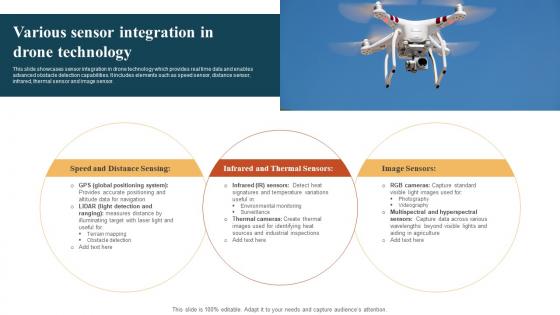
This slide showcases sensor integration in drone technology which provides real time data and enables advanced obstacle detection capabilities. It includes elements such as speed sensor, distance sensor, infrared, thermal sensor and image sensor.
People who downloaded this PowerPoint presentation also viewed the following :
Various Sensor Integration In Drone Technology with all 9 slides:
Use our Various Sensor Integration In Drone Technology to effectively help you save your valuable time. They are readymade to fit into any presentation structure.








FAQs for Various Sensor Integration
Honestly, sensor fusion is a game changer - way more reliable than relying on just one type of sensor. Cameras, lidar, radar, ultrasonic... when you combine all that data, you get this really complete view of what's around the car. It's like having multiple people describe the same scene to you. If your camera can't see through fog, radar's still working fine. Same with bright sunlight messing with one sensor - others pick up the slack. Works in basically any weather or lighting situation, which is huge. Figure out which sensors work best together for whatever you're trying to do first though.
So basically sensor fusion takes data from all your different sensors - cameras, LiDAR, GPS, IMUs - and combines it into one coherent picture. Way better than relying on just one sensor. Like, cameras suck in low light and GPS is useless indoors, right? But when you merge everything together, the strong sensors cover for the weak ones. You'll get way more accurate obstacle detection and positioning. I've found it's a game-changer for navigation in tricky conditions. Figure out which sensor combo works best for what you're trying to do first though.
Basically, sensor fusion makes your fitness tracker way more accurate by mixing data from different sensors. Like your accelerometer + gyroscope + heart rate monitor all working together instead of solo. The step counting gets so much better, and calorie tracking isn't as wonky. Sleep data improves too since the device can spot weird readings and ignore them. Oh, and that's how you get cool stuff like fall detection - needs multiple sensors talking to each other. I'd honestly just look for anything that mentions "multi-sensor" in the specs. Makes a huge difference over those basic single-sensor ones.
For fusion you'll want IMUs first - accelerometers, gyros, magnetometers. They're dirt cheap and give constant motion data, but man do they drift over time (hence why you need fusion lol). Cameras give you all that visual stuff, LiDAR nails precise distances. GPS obviously handles global positioning. Radar's clutch in crappy weather when other sensors struggle. The whole point is mixing sensors that cover each other's blind spots. I'd start by figuring out what your system actually needs to detect, then pick sensors that fill those holes without breaking the bank.
So AI and ML are totally changing sensor fusion - they make it way more adaptive than those old rigid algorithms. Neural networks can actually learn the best fusion strategies from your data automatically. Pretty cool how they improve over time as they process more inputs and different conditions. Machine learning nails the complex pattern recognition stuff and can even handle sensor drift or failures that mess up traditional approaches. Honestly, if you're stuck with noisy or mixed sensor data, ML-based fusion is a game changer. It'll cut down all that tedious manual calibration work you'd normally have to do.
Honestly? Data's gonna be your worst enemy. GPS pings every second but air quality sensors are like once an hour - total mess to sync up. Privacy laws will give you nightmares since it's citizen data. Plus managing thousands of sensors that constantly break or go offline? Ugh. The computational costs for real-time processing are brutal too - learned that one the hard way on a previous project. Different formats, sketchy connection issues, calibration drift... it never ends. Seriously though, pilot test in one neighborhood first. Don't try launching citywide right away or you'll hate your life.
Honestly, sensor fusion is a game changer for safety stuff. You're basically getting backup systems - when one sensor craps out or starts acting weird, the others pick up the slack. It's like having multiple people witness an accident instead of just one guy's story. Different sensors catch different things too, so combining cameras with temperature and proximity sensors gives you way better coverage of what's actually going down. Oh and you'll spot equipment issues before they turn into real problems. I'd say look at where you have the biggest safety gaps first, then figure out what combo of sensors makes sense there.
Dude, sensor fusion is what makes AR/VR actually work. Your headset mixes data from accelerometers, gyroscopes, and cameras to track your head and hand movements in real-time. Without it? You'd get that nasty motion sickness from laggy, jittery tracking. Early VR was brutal for this reason. The algorithms predict where you're moving and cover for each sensor's weak spots. Oh, and magnetometers help sometimes too. If you're building anything in this space, spend time on IMU calibration and sensor timing - honestly, it's the difference between users loving or hating your app.
Honestly, Kalman filters are super accurate but they'll slow you down, especially the extended ones. Particle filters are amazing for non-linear problems - though they're total resource hogs. Simple weighted averaging or basic Bayesian stuff runs way faster but you lose some precision. Neural networks are pretty hot right now and work great once you train them, but the computational cost is all over the place depending on what you build. Oh, and definitely prototype a few different approaches with whatever sensors you're actually using. That's really the only way to figure out what speed/accuracy tradeoff makes sense for your specific situation.
So basically, sensor fusion gives your robots backup ways to see what's happening around them. Instead of just trusting one camera or sensor, you're mixing data from LiDAR, cameras, ultrasonic stuff, IMUs - the whole works. If one craps out or gets weird readings, the others cover for it. Way fewer crashes into things, better navigation, less downtime overall. Honestly though, the tricky part is getting your algorithms to handle it when sensors disagree with each other. Otherwise you're just making everything more complicated for no reason. It's like - redundancy only helps if the system knows how to use it properly.
Cars and healthcare are crushing it with sensor fusion right now. Autonomous driving combines cameras, radar, lidar - basically life or death stuff that has to work perfectly. Medical sensors getting fused together? Game changer for diagnostics. Manufacturing's huge too since you can actually predict when machines will break before they do. Agriculture's gotten weirdly high-tech with drones plus ground sensors for precision farming (who saw that coming?). Look for areas where being more accurate saves serious money or opens up new revenue. Safety-critical stuff pays the most.
Dude, sensor fusion is what makes IoT devices actually useful instead of just fancy paperweights. Raw data from temperature sensors, GPS, cameras etc is pretty messy by itself. Fusion algorithms combine all those inputs to create something meaningful - like your smart thermostat knowing you're actually home versus just detecting random movement from your cat walking by. Industrial stuff uses it to predict when machines might break down. Honestly, if you're building anything IoT-related, plan for fusion algorithms from day one. That's how you turn a bunch of random sensor readings into something that actually works.
Data quality is everything - garbage in, garbage out no matter how fancy your fusion setup is. Get your sensor calibration sorted first, then pick algorithms that actually fit your problem instead of whatever's hot on GitHub right now. I've watched so many projects crash because someone chose the shiniest ML model. Test the hell out of everything in controlled settings before going live. Have backup plans for when things break (they will). Oh, and talk to your actual users early - you'd be amazed how often what engineers think people need isn't what they actually want from the data.
So 5G makes sensor fusion way better - the latency drops to just milliseconds which is crazy important for stuff like self-driving cars. You can actually process tons more sensor data in real-time now. What's cool is the edge computing part - you don't have to send everything back to some distant server anymore. Instead, you can run the fusion processing right where your sensors are located. Honestly the bandwidth increase alone changes everything. Start thinking about redesigning your sensor setups because the possibilities are pretty wild now. My buddy's been working on this and he's obsessed with it.
Okay so the main things you gotta worry about are privacy, consent, and how the data gets used. When you combine all those sensors, you're basically creating these super detailed profiles of people - way more invasive than just one sensor alone. It's like surveillance on steroids, which is cool tech-wise but also kinda scary if you think about it. Did people actually agree to be monitored this deeply? How are you protecting all that combined data? Who's getting access to it? You really need solid data policies from day one. Also be upfront about what you're collecting and why - people hate feeling tricked about this stuff.
-
Extremely professional slides with attractive designs. I especially appreciate how easily they can be modified and come in different colors, shapes, and sizes!
-
SlideTeam just saved my project! Thank you so much. The variety of templates helped me showcase multiple perspectives easily.