


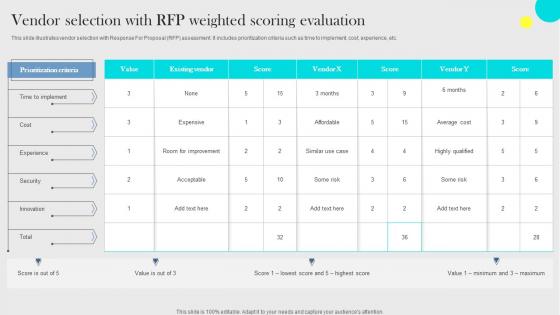
Vendor Selection With RFP Weighted Scoring Evaluation




Try Before you Buy Download Free Sample Product
 Impress Your
 Audience
 100%
100% Editable
 Save Hours
 of Time


This slide illustrates vendor selection with Response For Proposal RFP assessment. It includes prioritization criteria such as time to implement, cost, experience, etc.
People who downloaded this PowerPoint presentation also viewed the following :
Vendor Selection With RFP Weighted Scoring Evaluation with all 6 slides:
Use our Vendor Selection With RFP Weighted Scoring Evaluation to effectively help you save your valuable time. They are readymade to fit into any presentation structure.





FAQs for Vendor Selection With RFP
Businesses should prioritize vendor reliability, cost-effectiveness, technical capabilities, compliance standards, and scalability potential when selecting partners. These criteria enable organizations to evaluate long-term value beyond initial pricing, with many companies finding that vendors offering strong support, proven track records, and flexible solutions ultimately deliver better ROI and strategic advantage.
Companies assess vendor financial stability through credit reports, financial statements, bank references, industry reputation checks, and performance history analysis. These evaluations help organizations identify reliable partners by examining cash flow stability, debt ratios, and operational consistency, with many finding that comprehensive due diligence ultimately delivers stronger partnerships and reduced supply chain risks.
Vendor reputation serves as a critical risk assessment tool, influencing trust, reliability expectations, and long-term partnership viability throughout the selection process. It provides insights into past performance, client satisfaction, and operational stability, with many organizations finding that strong vendor reputations correlate with better project outcomes, reduced implementation risks, and enhanced stakeholder confidence.
Vendor compliance with industry standards and regulations is critical for risk mitigation, legal protection, and operational continuity, ensuring partners meet required security, quality, and regulatory frameworks. Organizations in healthcare, financial services, and manufacturing find that compliant vendors reduce audit burdens, minimize regulatory penalties, and enhance customer trust, ultimately delivering competitive advantage through reliable, standards-based partnerships.
Effective vendor proposal evaluation methods include weighted scoring matrices, cost-benefit analysis, reference checks, technical capability assessments, and risk evaluation frameworks. These approaches streamline decision-making by comparing pricing structures, service levels, and implementation timelines, with many organizations finding that combining multiple evaluation criteria ultimately delivers better vendor partnerships and reduced procurement risks.
Businesses ensure alignment through comprehensive needs assessment, detailed vendor capability evaluation, and pilot project testing before full commitment. Strategic approaches include requesting specific use cases, checking client references in similar industries, and establishing clear performance metrics, with many organizations finding that structured vendor scorecards streamline selection while minimizing implementation risks.
Vendor experience in a specific industry ensures deep understanding of regulatory requirements, operational challenges, and sector-specific best practices that generic providers often lack. This expertise translates into faster implementation, reduced compliance risks, and tailored solutions, with organizations in healthcare, financial services, and manufacturing finding that industry-experienced vendors deliver significantly better outcomes and strategic alignment.
Vendor selection tools include vendor management platforms, RFP automation software, supplier scorecards, risk assessment systems, and contract lifecycle management solutions. These technologies streamline evaluation by automating proposal comparisons, standardizing scoring criteria, and tracking vendor performance metrics, with many organizations finding that integrated platforms reduce selection time while improving decision accuracy and vendor relationships.
Cultural fit and company values significantly influence vendor selection by ensuring alignment in work ethics, communication styles, collaboration approaches, and long-term strategic vision. Organizations increasingly prioritize vendors who share similar values regarding sustainability, innovation, and customer service, with many finding that cultural compatibility enhances project outcomes, reduces conflicts, and ultimately delivers stronger partnerships and operational efficiency.
Key factors include the vendor's ability to handle increased transaction volumes, adapt to changing business requirements, support multiple integration methods, offer modular service additions, and provide geographic expansion capabilities. These scalability elements enable organizations to grow without switching vendors, while flexibility in contract terms, customization options, and technology updates ensures long-term strategic alignment and competitive advantage.
Past performance metrics inform vendor selection by providing quantifiable data on delivery timelines, quality standards, cost management, and customer satisfaction rates from previous contracts. These metrics enable organizations to assess reliability, identify potential risks, and compare vendors objectively, with many procurement teams finding that historical performance data significantly reduces project failures and enhances strategic partnerships.
Common red flags during vendor evaluation include lack of transparency in pricing, poor communication responsiveness, limited references or case studies, unclear contract terms, and inadequate security certifications. These warning signs often indicate potential issues with service delivery, cost overruns, and partnership reliability, with many organizations finding that thorough due diligence during selection prevents costly vendor relationships and operational disruptions.
Geographic location significantly influences vendor selection through shipping costs, delivery timeframes, regulatory compliance requirements, cultural alignment, and communication ease across time zones. Companies in manufacturing and retail increasingly prioritize regional suppliers to minimize logistics expenses and enhance supply chain resilience, while service-based organizations often balance cost advantages with operational efficiency, ultimately delivering faster customer experiences and reduced operational complexity.
Effective vendor contract negotiation strategies include benchmarking market rates, leveraging competitive bidding, establishing clear performance metrics, negotiating flexible terms, and securing volume discounts. Through strategic preparation and relationship building, organizations streamline procurement processes while reducing costs, with many companies finding that collaborative partnerships ultimately deliver better service levels and long-term value.
Technology integration capability plays a crucial role in vendor selection by ensuring seamless compatibility with existing systems, reducing implementation costs, and minimizing operational disruptions. Organizations increasingly prioritize vendors who offer robust APIs, flexible data formats, and scalable platforms, with many companies in healthcare, finance, and retail finding that strong integration capabilities ultimately deliver faster deployment timelines and enhanced operational efficiency.
-
Extremely professional slides with attractive designs. I especially appreciate how easily they can be modified and come in different colors, shapes, and sizes!
-
The design is very attractive, informative, and eye-catching, with bold colors that stand out against all the basic presentation templates.