

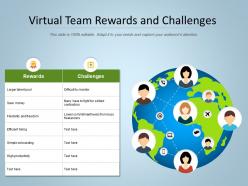
Virtual team rewards and challenges





Try Before you Buy Download Free Sample Product
 Impress Your
 Audience
 100%
100% Editable
 Save Hours
 of Time


Our Virtual Team Rewards And Challenges are explicit and effective. They combine clarity and concise expression.
People who downloaded this PowerPoint presentation also viewed the following :
Virtual team rewards and challenges with all 2 slides:
Give your audience a fulfilling experience. They will find our Virtual Team Rewards And Challenges elevating.
FAQs for Virtual team
Key strategies include establishing clear communication protocols, utilizing collaborative digital platforms, scheduling regular check-ins, creating structured project workflows, and fostering informal team interactions. These approaches enhance virtual collaboration by streamlining information sharing, maintaining team cohesion, and ensuring accountability, with many organizations finding that combining synchronous meetings with asynchronous tools ultimately delivers improved productivity and stronger team relationships.
Effective communication tools improve remote teamwork by enabling real-time collaboration, streamlining project coordination, and maintaining team connectivity across different time zones and locations. These platforms facilitate seamless file sharing, video conferencing, and instant messaging, while many organizations find that integrated communication systems reduce response times, enhance project transparency, and ultimately deliver stronger team cohesion and productivity outcomes.
Virtual teams face challenges including communication barriers, time zone coordination difficulties, technology integration issues, trust-building obstacles, and maintaining team cohesion across distances. These challenges can be overcome through regular video conferences, collaborative digital platforms, structured communication protocols, and virtual team-building activities, with many organizations finding that clear expectations and consistent check-ins ultimately deliver stronger remote collaboration and enhanced productivity.
Cultural diversity in virtual teams presents both challenges and opportunities, including varied communication styles, different time zones, diverse problem-solving approaches, and distinct cultural perspectives on collaboration and hierarchy. Organizations can leverage this diversity by implementing structured communication protocols, providing cultural awareness training, creating inclusive meeting schedules, and establishing clear expectations, ultimately delivering enhanced innovation, broader market insights, and more creative solutions through their multicultural workforce.
Leadership in virtual teams involves establishing clear communication protocols, setting transparent expectations, maintaining regular check-ins, and creating structured collaboration frameworks that bridge physical distance. Effective virtual leaders foster trust through consistent availability, recognize individual contributions across time zones, and leverage digital tools to maintain team cohesion, ultimately delivering enhanced productivity and employee engagement in increasingly distributed work environments.
Virtual team-building activities can be adapted through interactive online games, virtual coffee chats, collaborative project challenges, digital escape rooms, and remote skill-sharing sessions. These approaches enhance team cohesion by fostering personal connections, encouraging creative collaboration, and maintaining social interaction, with many organizations finding that structured virtual engagement ultimately delivers improved communication and stronger workplace relationships.
Best practices for setting clear goals in virtual teams include establishing SMART objectives, documenting expectations in shared platforms, conducting regular check-ins, defining individual roles clearly, and creating measurable milestones with deadlines. These approaches streamline accountability by enhancing transparency, minimizing miscommunication, and enabling consistent progress tracking, with many organizations finding that structured goal-setting frameworks ultimately deliver improved team alignment and productivity outcomes.
Team members manage time zones effectively through strategic scheduling overlap windows, asynchronous communication protocols, rotating meeting times, shared calendar systems, and clear deadline coordination across regions. These approaches streamline international collaboration by establishing consistent communication rhythms, minimizing scheduling conflicts, and ensuring equitable participation, with many global organizations finding that structured time zone management ultimately delivers enhanced productivity and stronger team cohesion.
Psychological effects of remote work isolation include decreased motivation, increased anxiety, reduced sense of belonging, communication barriers, and difficulty maintaining work-life boundaries. Teams can address this through regular video check-ins, virtual coffee breaks, collaborative project management tools, and structured social interactions, with many organizations finding that intentional relationship-building activities significantly enhance employee engagement and overall productivity.
Technology assists virtual teams through project management platforms like Asana and Trello, time tracking tools, real-time collaboration dashboards, automated reporting systems, and performance analytics software. These solutions enable managers to monitor deliverables, track individual contributions, and assess team productivity seamlessly, with many organizations finding that digital tracking tools enhance accountability while providing transparency that ultimately drives better project outcomes and team performance.
**INPUT**: What methods can be employed to ensure accountability among virtual team members? **OUTPUT**: Effective accountability methods include clear goal-setting frameworks, regular check-in protocols, shared project management platforms, peer accountability systems, and transparent progress tracking mechanisms. These approaches streamline virtual collaboration by establishing defined expectations, enabling real-time visibility into deliverables, and fostering team ownership, with many organizations finding that structured accountability ultimately enhances productivity and trust in remote environments. [Word count: 60]
Effective virtual feedback requires structured approaches including scheduled one-on-ones, written summaries, video calls for complex discussions, and collaborative platforms for ongoing dialogue. Through clear communication protocols and regular check-ins, organizations streamline performance management, enhance team alignment, and build stronger relationships, with many remote teams finding that documented feedback processes ultimately deliver greater transparency and accountability than traditional methods.
Project management tools for virtual teams include Asana, Trello, Monday.com, Microsoft Project, and Slack integrations, each offering task tracking, deadline management, and collaborative workflows. These platforms streamline coordination by centralizing communication, automating progress updates, and providing real-time visibility, with many distributed organizations finding that integrated solutions significantly enhance productivity and accountability across time zones.
Virtual teams maintain strong company culture through regular video conferences, virtual team-building activities, shared digital workspaces, consistent communication protocols, and celebrating achievements collectively across time zones. These approaches enable remote employees to build meaningful connections, align with organizational values, and participate in cultural traditions, with many companies finding that intentional virtual engagement actually strengthens team bonds and employee satisfaction.
Virtual teamwork effectiveness metrics include task completion rates, communication frequency, collaboration tool engagement, meeting participation levels, and goal achievement timelines. These measurements enable organizations to assess productivity patterns, identify workflow bottlenecks, and optimize resource allocation, with many companies finding that combining quantitative data with qualitative feedback ultimately delivers enhanced team performance and stronger project outcomes.
No Reviews