


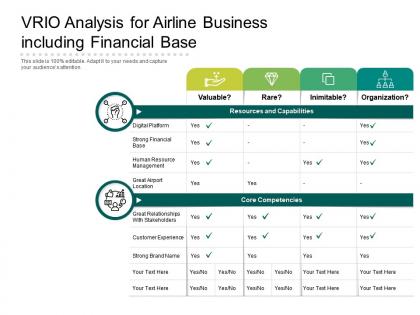
Vrio analysis for airline business including financial base




Try Before you Buy Download Free Sample Product
 Impress Your
 Audience
 100%
100% Editable
 Save Hours
 of Time


Our VRIO Analysis For Airline Business Including Financial Base cater for customisation. Feel free to fashion every detail.
People who downloaded this PowerPoint presentation also viewed the following :
Vrio analysis for airline business including financial base with all 2 slides:
Fashion every detail with our VRIO Analysis For Airline Business Including Financial Base. They allow you to get it customized.
FAQs for Vrio analysis for airline business
Key financial metrics in Vrio analysis for airlines include revenue per available seat mile (RASM), cost per available seat kilometer (CASK), load factors, operating margins, and fuel efficiency ratios. These metrics enable airlines to assess competitive positioning by evaluating route profitability, operational efficiency, and cost management capabilities, with many carriers finding that superior RASM and optimized CASK deliver sustained competitive advantages in increasingly price-sensitive markets.
An airline's resource base influences competitive advantage through strategic assets like route networks, fleet efficiency, brand reputation, operational expertise, and financial strength. Airlines with extensive hub systems, fuel-efficient aircraft, and strong loyalty programs can deliver lower costs, premium experiences, and market access, while robust financial resources enable strategic investments, ultimately creating sustainable differentiation in an increasingly competitive aviation landscape.
Airline financials reflect operational strategy effectiveness through revenue per available seat mile (RASM), operational margins, fuel efficiency ratios, and load factor performance metrics. Strong financials typically indicate successful route optimization, fleet utilization, and cost management strategies, with airlines like Southwest and Delta demonstrating how operational excellence translates into sustained profitability and competitive advantage.
Cost structure analysis helps airlines understand profitability by identifying fixed costs like aircraft leases and maintenance, variable costs including fuel and crew expenses, and operational inefficiencies across routes and services. Through detailed cost breakdowns, airlines can optimize resource allocation, eliminate unprofitable routes, and benchmark against competitors, with many carriers finding that strategic cost management delivers improved margins and sustainable competitive advantage in an increasingly price-sensitive market.
Brand reputation and customer loyalty significantly impact airline financial performance by driving repeat bookings, enabling premium pricing, reducing marketing costs, and creating resilience during crises. Airlines with strong reputations, like Emirates or Singapore Airlines, command higher fares while maintaining occupancy rates, with loyal customers delivering 20-30% higher lifetime value through reduced price sensitivity and positive word-of-mouth marketing.
Airlines can assess regulatory impact through Vrio analysis by evaluating how new regulations affect their valuable resources like route networks, operational capabilities, and compliance systems, determining rarity through competitive positioning analysis, and assessing imitability of adaptive responses. This strategic framework enables airlines to identify which regulatory changes create competitive advantages or disadvantages, ultimately helping them reallocate resources efficiently and maintain profitability in an increasingly regulated aviation landscape.
Airlines require substantial capital reserves, consistent revenue streams, access to credit facilities, government subsidies, and strategic partnerships to fund technology investments. These financial resources enable carriers to modernize fleet management systems, enhance customer experience platforms, and implement predictive maintenance technologies, with many airlines finding that strategic technology investments ultimately deliver operational cost reductions and competitive advantages.
Fleet management and maintenance costs significantly influence airline financial health by representing 15-20% of total operating expenses, directly impacting profitability, cash flow, and competitive positioning. Efficient fleet utilization and predictive maintenance strategies enable airlines to reduce downtime, extend aircraft lifecycles, and optimize fuel consumption, with many carriers finding that strategic fleet renewal and maintenance scheduling delivers lower operational costs and enhanced service reliability.
Partnerships and alliances enhance airline resources by enabling code-sharing agreements, expanding route networks, sharing maintenance facilities, pooling frequent flyer programs, and accessing complementary market expertise. These strategic collaborations allow airlines to leverage shared resources, reduce operational costs, and offer passengers seamless global connectivity, ultimately delivering competitive advantages and enhanced customer experiences that individual carriers struggle to achieve independently.
Market demand fluctuation significantly impacts airline financial stability through revenue volatility, load factor variations, and capacity utilization challenges, creating both operational risks and strategic opportunities. Airlines experience amplified effects due to high fixed costs and perishable inventory, with many carriers finding that diversifying routes, implementing dynamic pricing, and maintaining flexible fleet management ultimately delivers improved resilience and competitive advantage.
Capital investment determines airline viability by enabling fleet modernization, route expansion, technology upgrades, and operational infrastructure development. Strategic investments in fuel-efficient aircraft, digital booking systems, and maintenance facilities deliver competitive advantages through reduced operating costs, enhanced customer experiences, and improved safety records, with many carriers finding that sustained capital allocation ultimately drives market positioning and profitability resilience.
Pricing strategies significantly impact airline revenue streams by enabling dynamic yield management, market segmentation, and competitive positioning, with successful implementation creating valuable revenue optimization capabilities. Airlines leveraging sophisticated pricing algorithms and market intelligence can achieve sustainable competitive advantages through enhanced load factors, premium service differentiation, and strategic route profitability, ultimately delivering improved financial performance in increasingly competitive aviation markets.
Airlines should monitor key financial indicators including operating margin, revenue per available seat mile (RASM), cost per available seat mile (CASM), load factor, and fuel cost ratios. These metrics enable carriers to optimize route profitability, enhance capacity utilization, and streamline operational costs, with many airlines finding that integrated monitoring ultimately delivers competitive advantage and sustainable growth.
Airlines can leverage human resources by investing in comprehensive training programs, implementing performance-based incentive systems, optimizing crew scheduling efficiency, and developing cross-functional skill sets across departments. Strategic workforce management enables reduced operational costs, enhanced customer service quality, and improved safety standards, with many airlines finding that engaged, well-trained employees ultimately deliver higher passenger satisfaction and stronger revenue performance.
External economic factors significantly influence airline financial outlooks through fuel price volatility, currency exchange fluctuations, interest rate changes, GDP growth patterns, and consumer spending levels. These variables directly impact operational costs, revenue streams, and capital investment decisions, with many airlines finding that economic downturns reduce business travel demand while fuel price spikes can eliminate profit margins, ultimately requiring strategic hedging and flexible capacity management to maintain competitive advantage.
No Reviews