


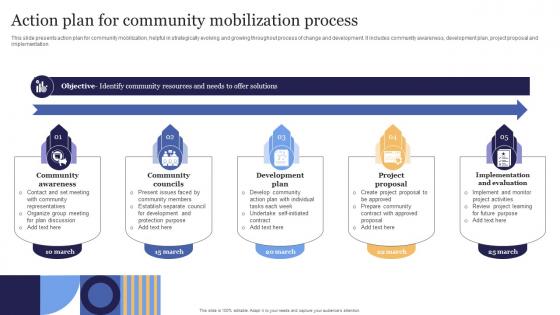
Action Plan For Community Mobilization Process




Try Before you Buy Download Free Sample Product
 Impress Your
 Audience
 100%
100% Editable
 Save Hours
 of Time


This slide presents action plan for community mobilization, helpful in strategically evolving and growing throughout process of change and development. It includes community awareness, development plan, project proposal and implementation.
People who downloaded this PowerPoint presentation also viewed the following :
Action Plan For Community Mobilization Process with all 6 slides:
Use our Action Plan For Community Mobilization Process to effectively help you save your valuable time. They are readymade to fit into any presentation structure.





FAQs for Action Plan For
**INPUT**: What are the key elements that drive effective community mobilization? **OUTPUT**: Effective community mobilization includes strong leadership development, clear communication channels, shared goal identification, resource coordination, and sustained stakeholder engagement. These elements streamline collective action by building trust, enhancing participation rates, and delivering measurable outcomes, with many organizations finding that strategic community partnerships ultimately accelerate project implementation and enhance long-term sustainability.
Technology enhances community mobilization efforts by streamlining communication through social media platforms, mobile apps, and messaging systems, while enabling real-time coordination and broader reach. Through digital tools, community organizations can automate event planning, track volunteer engagement, and analyze participation data, ultimately delivering faster response times and more efficient resource allocation across diverse populations.
Local leaders serve as catalysts, connectors, and credible voices who bridge community needs with actionable solutions, leveraging their established relationships and cultural understanding to build trust and participation. Through grassroots networks, strategic communication, and resource coordination, these leaders transform individual concerns into collective action, with many communities finding that locally-driven initiatives achieve higher engagement and sustainable outcomes than externally-imposed programs.
Strategies include culturally responsive outreach, trusted community leader partnerships, accessible meeting locations and times, multilingual communication materials, and addressing immediate needs alongside broader goals. These approaches enhance participation by removing barriers, building authentic relationships, and demonstrating tangible value, with many organizations finding that early wins and consistent presence ultimately deliver stronger community ownership and sustainable engagement.
Measuring community mobilization success involves tracking participation rates, behavior change indicators, resource mobilization levels, stakeholder engagement metrics, and sustainable outcomes achieved. These assessments help organizations evaluate impact through increased volunteer involvement, enhanced local capacity building, and strengthened community networks, with many nonprofits and development agencies finding that consistent measurement ultimately delivers greater program effectiveness and long-term community resilience.
Organizations face challenges including cultural barriers, limited resources, conflicting stakeholder interests, communication gaps, and trust deficits when mobilizing communities. These obstacles can significantly impact engagement effectiveness, with many nonprofits and local governments finding that strategic partnerships, culturally-sensitive outreach, and transparent communication processes help overcome resistance while building sustainable community involvement and long-term collaborative relationships.
Storytelling inspires community mobilization by creating emotional connections, highlighting shared challenges, and demonstrating successful collective action through relatable narratives. These powerful stories enable communities to visualize potential outcomes, build trust among diverse stakeholders, and motivate participation, with many grassroots organizations finding that personal testimonials and success stories ultimately drive sustained engagement and meaningful social change.
**INPUT**: What are some best practices for building coalitions in community mobilization efforts? **OUTPUT**: Best practices for building coalitions include identifying shared goals, establishing clear communication channels, diversifying membership representation, creating structured governance frameworks, and developing sustainable resource-sharing agreements. These approaches streamline collaboration by fostering trust among stakeholders, enhancing collective decision-making, and maximizing community impact, with many organizations finding that diverse coalitions deliver more comprehensive solutions and stronger advocacy outcomes. **Word count: 60 words**
Social media amplifies community mobilization campaigns by expanding reach, facilitating real-time communication, and enabling viral content sharing across diverse demographics. Through targeted advertising, hashtag campaigns, and live streaming events, organizations build stronger grassroots movements, coordinate volunteer efforts more efficiently, and ultimately deliver broader participation rates, with many advocacy groups finding that strategic social media integration significantly accelerates their mobilization timelines.
Ethical considerations include informed consent, cultural sensitivity, equitable participation, transparency in objectives, and sustainable resource allocation. These principles enhance community trust by respecting local values, ensuring inclusive decision-making, and maintaining accountability throughout mobilization efforts, with many organizations finding that ethical frameworks ultimately deliver stronger community partnerships and long-term program success.
Community mobilization efforts can be sustained through diversified funding sources, leadership development programs, strategic partnerships with local institutions, regular capacity building initiatives, and adaptive planning frameworks that evolve with community needs. These approaches strengthen organizational resilience by building local expertise, creating multiple revenue streams, and fostering deep community ownership, with many grassroots organizations finding that rotating leadership roles and establishing mentorship programs ultimately delivers greater stability and sustained impact.
Community involvement and commitment can be measured through participation rates, volunteer hours contributed, event attendance, social media engagement, and resource mobilization levels. These metrics enable organizations to assess community strength by tracking sustained engagement, local leadership development, and collaborative project outcomes, with many nonprofits and government agencies finding that consistent participation patterns ultimately indicate deeper community investment and long-term program sustainability.
Cultural competency significantly enhances community mobilization by ensuring strategies align with local values, communication styles, and social structures, building authentic trust and participation. Organizations with culturally competent approaches see higher engagement rates, as community members feel respected and understood, ultimately delivering more sustainable outcomes and broader coalition support across diverse populations.
Youth serve as catalysts, organizers, digital communicators, and advocates in contemporary community mobilization efforts, leveraging social media expertise and grassroots energy to drive change. Through platforms like Instagram and TikTok, young activists streamline awareness campaigns, enhance volunteer coordination, and mobilize diverse stakeholders across educational institutions, environmental organizations, and social justice movements, ultimately delivering sustained engagement and innovative approaches to community challenges.
Community mobilization addresses systemic inequity and injustice by organizing collective advocacy, building strategic coalitions across diverse stakeholders, and creating sustained pressure for policy reforms through grassroots campaigns. These approaches enable communities to amplify marginalized voices, challenge discriminatory practices, and leverage unified action to drive meaningful change, with many organizations finding that coordinated mobilization delivers measurable progress on housing, healthcare, and economic justice initiatives.
-
Great product with highly impressive and engaging designs.
-
Awesome presentation, really professional and easy to edit.