

Website Development Solutions Company Profile Case Study




Try Before you Buy Download Free Sample Product
 Impress Your
 Audience
 100%
100% Editable
 Save Hours
 of Time


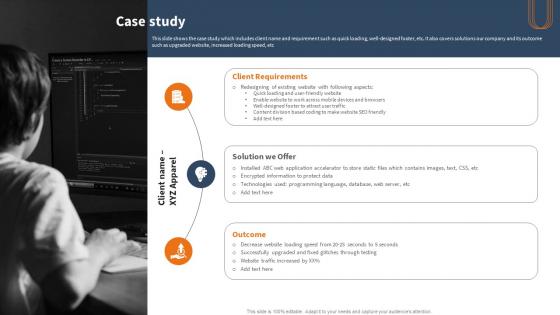
This slide shows the case study which includes client name and requirement such as quick loading, well designed footer, etc. It also covers solutions our company and its outcome such as upgraded website, increased loading speed, etc.
People who downloaded this PowerPoint presentation also viewed the following :
Website Development Solutions Company Profile Case Study with all 6 slides:
Use our Website Development Solutions Company Profile Case Study to effectively help you save your valuable time. They are readymade to fit into any presentation structure.






FAQs for Website Development Solutions Company
Key factors include scalability requirements, customization flexibility, security features, integration capabilities, and long-term maintenance costs. These considerations enable businesses to select platforms that streamline development processes, enhance user experiences, and support growth objectives, with many organizations finding that strategic platform choices ultimately deliver faster deployment times and reduced operational overhead.
Responsive design enhances user experience by automatically adapting layouts, navigation, and content to different screen sizes, ensuring seamless functionality across desktops, tablets, and smartphones. This approach delivers faster loading times, improved readability, and intuitive navigation, with many businesses finding that responsive websites significantly reduce bounce rates and increase customer engagement across all devices.
SEO principles serve as foundational guidelines that shape website architecture, content structure, page load speeds, mobile responsiveness, and technical optimization throughout the development process. By integrating these principles from the initial planning phase, businesses streamline search visibility, enhance user experiences, and ultimately deliver improved organic rankings and sustainable online growth.
Integrating APIs streamlines web development by enabling developers to leverage pre-built functionalities, reduce coding time, and enhance application capabilities without building everything from scratch. Through API integration, development teams accelerate project timelines, improve scalability, and deliver richer user experiences, with many organizations finding that strategic API usage significantly reduces development costs while enabling faster time-to-market.
Website security best practices during development include implementing secure coding standards, regular vulnerability testing, SSL certificates, input validation, and robust authentication systems. These approaches streamline protection by preventing common exploits, encrypting data transmission, and safeguarding user credentials, with many organizations finding that proactive security measures ultimately deliver enhanced customer trust and reduced breach risks.
Programming languages significantly impact website functionality through their capabilities for interactivity, database integration, security features, and scalability options. Different languages excel in specific areas, with JavaScript enhancing user experiences, Python streamlining backend operations, and PHP enabling robust content management, ultimately delivering faster load times and more responsive interfaces that give businesses competitive advantages in increasingly digital markets.
Websites should include intuitive navigation, fast loading speeds, mobile responsiveness, interactive elements like chatbots or forms, personalized content recommendations, and clear calls-to-action. These features streamline user experiences by reducing bounce rates, increasing session duration, and encouraging repeat visits, with many e-commerce and service companies finding that strategic website optimization ultimately delivers higher conversion rates and stronger customer loyalty.
Website analytics influence development decisions by revealing user behavior patterns, identifying high-performing content areas, pinpointing navigation bottlenecks, and highlighting conversion optimization opportunities. Through comprehensive data analysis, organizations can strategically prioritize feature enhancements, streamline user experiences, and allocate development resources more effectively, ultimately delivering improved engagement rates and competitive advantage in increasingly digital markets.
Templates offer cost-effectiveness, faster deployment, proven functionality, and reliable support systems, while custom designs provide unique branding, tailored user experiences, and scalable architectures. Many organizations find that templates work well for startups and small businesses seeking quick market entry, whereas custom solutions deliver competitive differentiation and strategic advantage for established enterprises requiring specialized functionality.
Developers manage client expectations through clear project scoping, regular milestone updates, transparent communication about timelines, and documented change request processes. By establishing realistic deliverable schedules, providing weekly progress reports, and involving clients in key decision points, development teams build trust while minimizing scope creep, ultimately delivering projects on time and within budget.
User testing is crucial for identifying usability issues, validating design decisions, gathering real user feedback, and ensuring optimal user experience before launch. Through systematic testing with target audiences, development teams can reduce bounce rates, increase conversion rates, and enhance overall site performance, while minimizing costly post-launch revisions, ultimately delivering websites that meet both user expectations and business objectives.
Content management systems simplify website maintenance by providing intuitive interfaces, automated updates, user-friendly editing tools, version control, and seamless content publishing workflows. Through platforms like WordPress or Drupal, businesses streamline content creation, reduce technical dependencies, and enable multiple team members to manage updates efficiently, ultimately delivering faster website modifications and lower operational costs.
Key trends include progressive web applications, voice user interfaces, artificial intelligence integration, headless CMS architecture, and enhanced cybersecurity protocols. These technologies streamline user experiences, automate customer interactions, and optimize site performance, with many organizations finding that early adoption delivers competitive advantages, improved conversion rates, and scalable digital infrastructure in an increasingly mobile-first marketplace.
Accessibility standards significantly impact website development by requiring inclusive design principles, WCAG compliance, semantic HTML structures, keyboard navigation support, and screen reader optimization. These requirements enhance user experiences across diverse abilities while expanding market reach, with many organizations finding that accessible websites deliver improved SEO performance, legal compliance, and ultimately broader customer engagement in today's inclusive digital landscape.
Common pitfalls include inadequate planning and requirements gathering, poor mobile optimization, neglecting security protocols, insufficient testing phases, and scope creep without proper change management. These challenges significantly impact project timelines and budgets, with many development teams finding that establishing clear communication channels, implementing agile methodologies, and conducting regular stakeholder reviews ultimately delivers smoother deployments and enhanced user experiences.
-
The designs by SlideTeam are honestly the best I have seen so far. Will be definitely coming back for more.
-
Great quality slides in rapid time.