

Well Architected Framework Of Cloud Migration




Try Before you Buy Download Free Sample Product
 Impress Your
 Audience
 100%
100% Editable
 Save Hours
 of Time


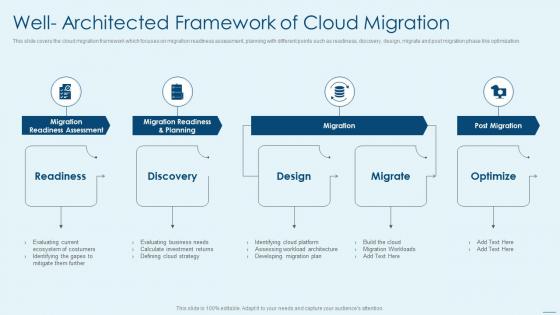
This slide covers the cloud migration framework which focuses on migration readiness assessment, planning with different points such as readiness, discovery, design, migrate and post migration phase like optimization.
People who downloaded this PowerPoint presentation also viewed the following :
Well Architected Framework Of Cloud Migration with all 6 slides:
Use our Well Architected Framework Of Cloud Migration to effectively help you save your valuable time. They are readymade to fit into any presentation structure.





FAQs for Well Architected Framework
So there's this six-phase thing most people follow: assess, plan, design, migrate, optimize, and operate. First you figure out what you've actually got and what's worth moving. Then you map out the whole thing and design your cloud setup. Migration's where it gets messy - timelines always go sideways here, just warning you now! After that you tune everything for performance and costs, then you're basically in maintenance mode. Honestly, don't skip the boring assessment stuff even though everyone wants to dive straight into the fun migration part. Trust me, do your homework first or you'll regret it later.
Start by doing a full inventory - catalog your apps, data, infrastructure, all of it. Map how everything connects because trust me, those dependencies will screw you over if you miss them. Then figure out what's actually ready for the cloud by looking at performance needs, compliance stuff, technical debt. Your network bandwidth matters too, obviously. Being honest about what you currently have is huge before deciding what goes where. Oh and definitely use automated discovery tools - way faster than doing it manually and you won't miss random things.
Honestly, data security freaks everyone out the most. Then you've got downtime hitting at the worst possible moments and budgets spiraling way beyond what anyone planned for. Your legacy systems? They're gonna fight you every step of the way - some old apps just refuse to work in the cloud, period. Most teams aren't ready for how different cloud tech is from regular IT stuff either. Compliance makes everything ten times harder if you're in banking or healthcare or whatever. Just do yourself a favor and map out everything you currently have before jumping in. Build in extra time and money because you'll need both.
Honestly, it comes down to how much you want to deal with. IaaS means you're managing servers, OS, all that fun stuff - but you get total control for weird custom setups. Most dev teams I know go with PaaS though. You just push code and they handle the infrastructure headaches. Way less stress. SaaS is obviously the no-brainer if someone already built what you need - just click and you're done, even if you can't tweak much. Quick test: ask yourself if you actually want to be a server admin or just build your thing. That'll tell you pretty fast.
Look, you absolutely need to do this before migrating anything to the cloud. Compare your upfront costs - migration tools, downtime, training your team - with what you'll save long-term on maintenance and scaling. I learned this the hard way watching other teams get slammed by surprise bills. The analysis shows you which workloads to move first and helps sell realistic budgets to leadership. Don't just count the obvious costs either. Factor in operational improvements too when you're building that business case. Trust me, it's worth the extra planning time.
Okay so first thing - encrypt everything, both when it's moving and stored. Map out your compliance stuff upfront because fixing gaps later is a nightmare. Access controls are huge too, you'll want to track who's doing what during the whole process. Make sure your cloud provider has the right certs for your industry (SOC 2, HIPAA, whatever applies). Run security checks on both sides before you start. Oh and create a data classification matrix first - sounds boring but you need to know exactly what you're moving and how to protect each piece. Don't skip the planning phase, trust me.
Phased migration is your best bet - don't try to move everything at once or you'll hate yourself. Start with the less important stuff to test your process. Blue-green deployments are solid too, where you build the whole new environment first then flip the switch. Database replication saves your ass with data-heavy apps. Most people totally botch the planning stage though - you need actual rollback plans for when shit hits the fan. Schedule critical moves during weekends when traffic's dead. Oh, and keep your team available during migrations because something always goes wrong.
Look at your apps through three lenses: how critical they are, technical complexity, and what ROI you'd get. Go for the easy wins first - simple web apps or dev environments where failure won't kill you. I'd honestly save the heavily customized stuff for later when you've got some victories behind you. Check each app's dependencies, data needs, and compliance requirements too. Group similar applications together in your roadmap. That way you can mess up on the first batch and actually learn something useful for round two. Don't overthink it initially.
Honestly, you've got a bunch of solid options here. AWS has Migration Hub and Database Migration Service. Azure's got Azure Migrate and Site Recovery. Google Cloud has Migrate for Compute Engine too. Third-party stuff like CloudEndure (AWS bought them) and Carbonite work well. Oh, and definitely run assessment tools like Cloudamize first - you'll want to know what you're actually dealing with before moving anything. The whole thing can feel pretty overwhelming at first glance. I'd start with whatever your target cloud's native tools are since they're usually free and don't require extra integration headaches.
Define who owns what first - seriously, this saves so much headache later. You'll want clear roles for provisioning and spending approval. Tag everything consistently from day one (learned this the hard way when we had mystery resources running for months). Use your cloud provider's built-in tools for automated security and cost policies. Regular reviews are key for monitoring spending and resource usage. A center of excellence team helps maintain standards across teams. Oh, and document your policies somewhere people can actually find them - governance fails if nobody follows it.
So you'll need both tech and business metrics to really see what's happening. Performance stuff like latency and uptime are obvious ones. Business-wise, track cost savings, user satisfaction, and how fast you can push new features. Oh, and mean time to recovery - seriously, nobody thinks about this until everything breaks at 2am and suddenly it's the only metric that matters. Team productivity is huge too, plus how quickly people are getting comfortable with the new setup. Definitely grab baseline numbers before you migrate though, otherwise you're just guessing if things actually got better.
Get your team involved from day one - nobody likes having changes forced on them. Tell them straight up why you're doing this and what they'll actually get out of it: better tools, way less annoying maintenance stuff, more time for the cool projects. Training helps a ton, but honestly? Some people will dig their heels in no matter what. Find a few cloud enthusiasts on different teams who can spread the word for you. They're worth their weight in gold. When you hit those early wins, make sure everyone hears about it. You want people thinking "cloud = success" instead of "ugh, more change."
Honestly, start with figuring out what you actually have first - do a real inventory of your infrastructure and apps. Don't try migrating everything at once (learned that one the hard way). Pick your least critical stuff for a pilot run to test things out. Map out which systems talk to each other because dependencies will bite you later. Get people from different teams involved early or you'll be dealing with surprised Pikachu faces when timelines slip. Oh, and build in extra time - these projects always take longer than you think. Security and compliance stuff needs to be sorted upfront too.
Yeah, cloud migration's gonna totally change how you handle IT stuff. You'll ditch the physical server headaches but spend way more time on orchestration and monitoring instead. Your team needs different skills now - less hardware geeks, more cloud platform and DevOps people. Tbh the whole thing feels pretty overwhelming at first. But here's the thing - most of your current staff can learn this stuff rather than you having to hire from scratch. Map out skill gaps early and throw some money at certifications. Trust me, it's way cheaper than replacing everyone. Just time your training with actual migration phases.
Yeah so multi-cloud lets you cherry-pick the best stuff from each provider instead of getting stuck with one. Avoiding vendor lock-in is clutch for bargaining later. If AWS crashes, your critical systems are still up on Azure or wherever. Sure, it gets messier to manage - I won't lie about that. But honestly? The cost savings make it worth it when you can hunt for better deals across platforms. I'd figure out what each cloud actually excels at first, then map that to what you need.
-
“I required a slide for a board meeting and was so satisfied with the final result !! So much went into designing the slide and the communication was amazing! Can’t wait to have my next slide!”
-
Appreciate the research and its presentable format.