


Workflow Process Of Blockchain Based Asset Tokenization Revolutionizing Investments With Asset BCT SS




Try Before you Buy Download Free Sample Product
 Impress Your
 Audience
 100%
100% Editable
 Save Hours
 of Time


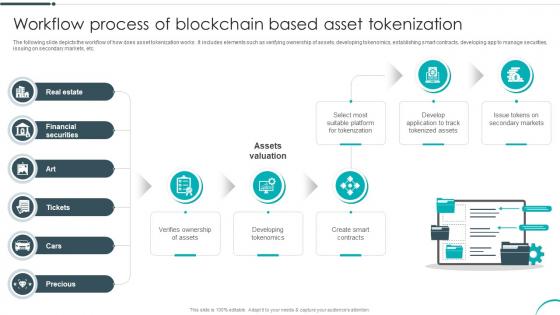
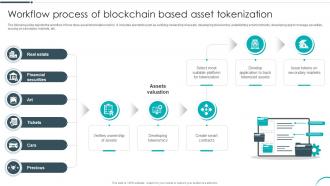
The following slide depicts the workflow of how does asset tokenization works . It includes elements such as verifying ownership of assets, developing tokenomics, establishing smart contracts, developing app to manage securities, issuing on secondary markets, etc.
People who downloaded this PowerPoint presentation also viewed the following :
Workflow Process Of Blockchain Based Asset Tokenization Revolutionizing Investments With Asset BCT SS with all 9 slides:
Use our Workflow Process Of Blockchain Based Asset Tokenization Revolutionizing Investments With Asset BCT SS to effectively help you save your valuable time. They are readymade to fit into any presentation structure.








FAQs for Workflow Process Of Blockchain Based Asset Tokenization Revolutionizing Investments With
Asset tokenization involves converting physical or digital assets into blockchain-based tokens that represent fractional ownership, enabling enhanced liquidity, transparency, and accessibility. This process allows real estate, art, commodities, and securities to be divided into smaller, tradeable units, with financial institutions and investment firms finding that tokenization streamlines transactions, reduces costs, and opens previously illiquid assets to broader investor participation.
Tokenization enhances liquidity by converting illiquid assets into digital tokens that can be traded on blockchain platforms, enabling fractional ownership, 24/7 trading, and reduced transaction costs. Through smart contracts and decentralized exchanges, investors can buy and sell portions of real estate, art, or private equity more easily, ultimately delivering faster price discovery and broader market access.
Legal and regulatory considerations in asset tokenization include securities compliance, anti-money laundering requirements, investor accreditation standards, cross-border jurisdiction issues, and smart contract legal frameworks. These regulatory challenges present both compliance obligations and strategic opportunities, with many financial institutions finding that proactive regulatory engagement streamlines tokenization processes while ensuring investor protection and market credibility.
Smart contracts facilitate automation by executing predefined rules automatically when conditions are met, eliminating intermediaries, reducing processing time, and ensuring transparent transaction records. Through blockchain integration, organizations streamline asset transfers, automate compliance checks, and enable real-time settlement across sectors like real estate and financial services, ultimately delivering faster transactions and reduced operational costs.
**INPUT**: What types of assets can be tokenized, and which are currently most popular in the market? **OUTPUT**: Tokenizable assets include real estate, commodities, stocks, bonds, art, intellectual property, and private equity investments. Real estate and commodities currently dominate the market, with many financial institutions finding that these tangible assets offer greater investor confidence and regulatory clarity, ultimately delivering enhanced liquidity and broader market access. [Word count: 50 words]
Asset tokenization enables fractional ownership by converting physical or digital assets into divisible blockchain tokens, allowing multiple investors to own portions of previously indivisible assets like real estate, art, or commodities. This approach democratizes investment access, enhances liquidity through secondary trading, and reduces minimum investment barriers, with many financial institutions finding that tokenized assets streamline portfolio diversification while delivering broader market participation and improved capital efficiency.
Tokenizing physical assets presents risks including regulatory uncertainty, custody complexities, liquidity challenges, valuation disputes, and technical vulnerabilities in smart contracts. While these challenges exist, many financial institutions and real estate firms are finding that proper due diligence, regulatory compliance frameworks, and robust security protocols enable successful tokenization programs, ultimately delivering enhanced liquidity and broader investor access.
Tokenization enhances transparency by recording all asset transactions on immutable blockchain ledgers, enabling real-time tracking of ownership changes, transaction histories, and asset provenance. This creates unprecedented traceability for institutions managing portfolios, with investment firms and real estate companies finding that stakeholders gain instant access to comprehensive asset data, ultimately delivering greater accountability and streamlined compliance processes.
Investors can assess tokenized assets by evaluating the underlying asset's fundamentals, examining smart contract audits, reviewing regulatory compliance, analyzing liquidity metrics, and assessing the platform's security infrastructure. Through comprehensive due diligence, financial institutions and individual investors streamline risk assessment, enhance portfolio transparency, and access diversified investment opportunities, while blockchain technology delivers immutable ownership records and real-time valuation tracking.
DeFi platforms serve as the foundational infrastructure for asset tokenization, providing decentralized exchanges, automated market makers, lending protocols, and yield farming opportunities that enable seamless trading and liquidity for tokenized assets. Through smart contracts and liquidity pools, these platforms allow investors to access fractional ownership opportunities, earn passive income through staking, and participate in global markets, ultimately delivering enhanced accessibility and financial inclusion across traditional asset classes.
Technological advancements driving asset tokenization include smart contracts, distributed ledger technology, interoperability protocols, advanced cryptographic security, and regulatory compliance frameworks. These innovations streamline asset digitization by automating transactions, enhancing transparency, and reducing intermediary costs, with financial institutions and real estate companies finding that tokenization delivers faster liquidity and broader investor access.
Companies leverage asset tokenization by fractionalizing real estate, art, commodities, and intellectual property into tradeable digital tokens, enabling broader investor access and liquidity. This approach creates multiple revenue streams through token sales, trading fees, and management services, with real estate firms and art galleries finding that tokenization significantly reduces investment minimums while generating ongoing transaction-based income and expanding their market reach.
Tokenization significantly impacts traditional financial institutions by enabling fractional ownership, reducing settlement times, and creating new revenue streams through digital asset services. Banks increasingly leverage tokenization for real estate, commodities, and securities, streamlining operations while enhancing liquidity and customer access, ultimately delivering competitive advantages in an evolving financial landscape.
Blockchain platforms vary significantly in tokenization suitability, with Ethereum offering extensive smart contract capabilities, Polygon providing cost-effective scaling, Binance Smart Chain delivering faster transactions, and enterprise platforms like Hyperledger emphasizing regulatory compliance. Financial institutions increasingly favor platforms balancing transaction speed, regulatory features, and interoperability, with many finding that multi-chain strategies optimize both operational efficiency and market reach.
Environmental considerations for blockchain tokenization include energy consumption from mining operations, carbon footprint from network validation, server infrastructure requirements, and electronic waste generation from specialized hardware. However, many tokenization platforms are increasingly adopting proof-of-stake consensus mechanisms and renewable energy sources, with financial institutions finding that these sustainable approaches deliver operational efficiency while minimizing environmental impact and supporting corporate sustainability goals.
-
Excellent products for quick understanding.
-
Extremely professional slides with attractive designs. I especially appreciate how easily they can be modified and come in different colors, shapes, and sizes!