


Workplace Medical Emergency Action Plan Essentials




Try Before you Buy Download Free Sample Product
 Impress Your
 Audience
 100%
100% Editable
 Save Hours
 of Time


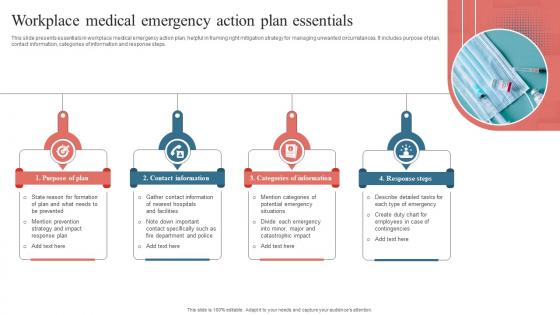
This slide presents essentials in workplace medical emergency action plan, helpful in framing right mitigation strategy for managing unwanted circumstances. It includes purpose of plan, contact information, categories of information and response steps.
People who downloaded this PowerPoint presentation also viewed the following :
Workplace Medical Emergency Action Plan Essentials with all 6 slides:
Use our Workplace Medical Emergency Action Plan Essentials to effectively help you save your valuable time. They are readymade to fit into any presentation structure.





FAQs for Workplace Medical Emergency
Effective workplace emergency plans include clear evacuation procedures, designated assembly points, communication protocols, emergency contact lists, and staff role assignments. These components work together by ensuring rapid response coordination, minimizing confusion during crises, and maintaining employee safety, with many organizations finding that comprehensive planning significantly reduces incident response times and enhances overall workplace resilience.
Workplace emergency plans should be reviewed annually at minimum, with updates triggered by organizational changes, facility modifications, new regulations, or after actual emergencies. Many organizations conduct quarterly assessments and post-incident evaluations, with sectors like healthcare and manufacturing requiring more frequent reviews, ultimately ensuring plans remain current, effective, and aligned with evolving workplace conditions and regulatory requirements.
Employee training serves as the cornerstone of effective workplace emergency plan implementation, encompassing evacuation procedures, communication protocols, equipment usage, role assignments, and response coordination. Through regular drills and comprehensive education programs, organizations ensure employees can execute emergency procedures confidently and efficiently, ultimately minimizing risks and enhancing overall workplace safety outcomes.
Businesses can assess potential risks by conducting comprehensive hazard analyses, reviewing historical incident data, evaluating facility vulnerabilities, consulting local emergency services, and engaging employees in risk identification processes. Through systematic workplace inspections, threat assessments, and collaboration with safety experts, organizations identify fire hazards, medical emergencies, natural disasters, and security threats, ultimately enabling targeted emergency protocols that enhance employee safety and operational continuity.
Emergency procedures should include evacuation routes and assembly points for fires, drop-cover-hold protocols for earthquakes, lockdown and communication systems for active shooters, shelter-in-place guidelines for chemical incidents, and severe weather responses. These comprehensive protocols enable organizations to minimize risks, ensure employee safety, and maintain business continuity, with many companies finding that regular drills and clear communication ultimately deliver faster emergency response and reduced liability.
Businesses ensure emergency plan awareness through regular training sessions, visual displays of evacuation routes, role-specific drills, and digital communication platforms. Through comprehensive orientation programs and quarterly practice exercises, organizations strengthen employee preparedness while identifying plan gaps, with many companies finding that hands-on simulations and clear role assignments significantly improve response times and overall workplace safety outcomes.
Legal requirements for workplace emergency plans typically include conducting hazard assessments, establishing evacuation procedures, designating emergency coordinators, providing employee training, and maintaining communication systems. These regulations vary by jurisdiction and industry, with manufacturing facilities, healthcare institutions, and high-rise offices often facing stricter compliance standards, ultimately ensuring worker safety while minimizing organizational liability and business continuity risks.
Businesses should address disability needs through accessible evacuation routes, specialized communication methods, designated assistance partners, and individualized emergency plans developed with each employee. These accommodations include visual and auditory alerts, wheelchair-accessible exits, and clear protocols for mobility, vision, or hearing impairments, ultimately ensuring comprehensive safety while maintaining workplace inclusivity and regulatory compliance.
Effective emergency communication strategies include mass notification systems, mobile alerts, digital signage, two-way radios, and designated communication coordinators for each department or floor. These approaches streamline information flow by providing multiple channels, ensuring redundancy, and enabling real-time updates, with many organizations finding that layered communication systems significantly reduce response times and enhance overall workplace safety.
Technology enhances workplace emergency preparedness through automated alert systems, real-time communication platforms, IoT sensors for hazard detection, mobile emergency apps, and GPS tracking for personnel location. These systems streamline evacuation procedures, enable instant notifications across multiple channels, and provide emergency coordinators with comprehensive situational awareness, ultimately delivering faster response times and improved employee safety outcomes.
Regular emergency drills should include scheduled fire, evacuation, and scenario-specific exercises, clear communication protocols, designated safety wardens, and comprehensive documentation of response times and participant actions. These systematic assessments enable organizations to identify procedural gaps, enhance employee preparedness, and refine response protocols, with many companies finding that quarterly drills significantly improve emergency readiness and regulatory compliance.
Businesses can cultivate safety culture through regular training sessions, open communication channels, leadership commitment, employee involvement in plan development, and recognition programs for safety-conscious behavior. Through consistent reinforcement and making safety a core value, organizations across industries like manufacturing, healthcare, and retail find that employees become proactive safety advocates, ultimately reducing incident response times and enhancing overall workplace preparedness.
A workplace emergency plan should include clearly marked primary and secondary evacuation routes, designated assembly points at safe distances from buildings, accessible pathways for disabled employees, and regular route inspections. These elements enable swift evacuation during fires, natural disasters, or security threats, with many organizations finding that multiple route options and well-positioned assembly areas significantly reduce evacuation times and enhance overall employee safety.
Psychological factors like panic, stress, and cognitive overload can impair decision-making during workplace emergencies, leading to delayed evacuations, poor communication, and increased risk of injury. Effective emergency plans address these challenges by incorporating regular training drills, clear communication protocols, and designated emergency coordinators, with many organizations finding that psychological preparedness ultimately reduces response times and enhances overall safety outcomes.
Emergency management agencies, local fire and police departments, OSHA consultants, Red Cross chapters, and specialized safety firms provide expertise in developing comprehensive workplace emergency plans. These organizations offer training programs, risk assessments, and regulatory compliance guidance, with many businesses finding that external partnerships enhance preparedness while ensuring plans meet industry standards and local requirements.
-
I am glad to have come across Slideteam. I was searching for some unique presentations and templates for my business. There are a lot of alternatives available here.
-
“There is so much choice. At first, it seems like there isn't but you have to just keep looking, there are endless amounts to explore.”