


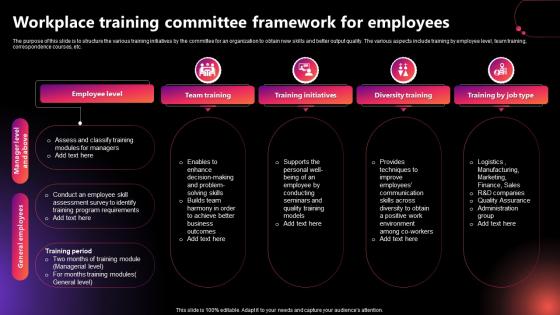
Workplace Training Committee Framework For Employees




Try Before you Buy Download Free Sample Product
 Impress Your
 Audience
 100%
100% Editable
 Save Hours
 of Time


The purpose of this slide is to structure the various training initiatives by the committee for an organization to obtain new skills and better output quality. The various aspects include training by employee level, team training, correspondence courses, etc.
People who downloaded this PowerPoint presentation also viewed the following :
Workplace Training Committee Framework For Employees with all 6 slides:
Use our Workplace Training Committee Framework For Employees to effectively help you save your valuable time. They are readymade to fit into any presentation structure.





FAQs for Workplace Training Committee
Primary objectives include identifying skill gaps, developing comprehensive training programs, ensuring regulatory compliance, allocating resources effectively, and measuring training outcomes across departments. These committees streamline organizational learning by coordinating with HR, management, and subject matter experts, ultimately delivering improved employee performance, reduced turnover, and enhanced competitive advantage through strategic workforce development.
A Workplace Training Committee ensures organizational alignment by establishing clear connections between training initiatives and strategic business objectives, conducting regular needs assessments, and involving key stakeholders from different departments in planning processes. Through systematic evaluation of skill gaps, performance metrics, and future business requirements, committees can design targeted programs that enhance productivity, reduce operational costs, and build competitive advantage, with many organizations finding that cross-functional committee representation delivers more strategic training outcomes.
Committee members should have clearly defined roles including training needs assessor, content developer, budget manager, compliance officer, and evaluation coordinator, with each responsible for specific deliverables and timelines. These roles ensure comprehensive coverage of training initiatives while maintaining accountability, with many organizations finding that rotating leadership responsibilities enhances engagement and develops internal expertise across departments.
Training program effectiveness can be evaluated through pre and post-training assessments, performance metrics tracking, employee feedback surveys, knowledge retention tests, and behavioral observation in real workplace scenarios. These evaluation methods enable committees to measure skill improvements, productivity gains, and ROI, with many organizations finding that comprehensive assessment frameworks ultimately deliver enhanced training outcomes and strategic workforce development advantages.
Employee engagement strategies include interactive workshops, peer-to-peer learning sessions, gamified training modules, mentorship programs, and skills-based challenges that connect directly to career advancement opportunities. These approaches streamline participation by making learning collaborative, competitive, and personally relevant, with many organizations finding that employees who actively participate in program design and delivery ultimately demonstrate higher retention rates and job satisfaction.
The committee can identify training needs through employee surveys, performance reviews, skills gap analyses, departmental manager consultations, and industry benchmarking assessments. These strategic approaches enable organizations to pinpoint specific competency gaps across departments, with many companies finding that regular needs assessments ultimately deliver more targeted training programs and improved workforce capabilities.
Training success metrics include completion rates, knowledge retention scores, skill application assessments, employee engagement levels, and business impact measurements like productivity gains and performance improvements. These comprehensive indicators help organizations evaluate training effectiveness through participant feedback, manager evaluations, and long-term behavioral changes, with many companies finding that combining quantitative data with qualitative insights ultimately delivers better training ROI and strategic workforce development outcomes.
The committee fosters continuous learning by establishing mentorship programs, creating knowledge-sharing platforms, implementing regular skill assessments, and recognizing learning achievements through formal rewards systems. These initiatives enhance employee engagement, improve retention rates, and build organizational expertise, with many companies finding that structured learning cultures deliver measurable productivity gains and competitive advantages in rapidly evolving markets.
Best practices for developing employee-tailored training curricula include conducting comprehensive skills assessments, analyzing performance gaps, gathering direct employee feedback, aligning with organizational goals, and incorporating multiple learning modalities. These approaches streamline development by identifying specific competency needs, creating personalized learning paths, and ensuring practical application, with many organizations finding that targeted curricula enhance retention rates and accelerate professional growth.
The committee can leverage technology through learning management systems, virtual reality simulations, AI-powered personalized learning paths, mobile training apps, and data analytics platforms. These technologies streamline content delivery, enable remote accessibility, and provide real-time progress tracking, with many organizations finding that digital training solutions reduce costs while delivering more engaging, scalable employee development experiences.
Remote and hybrid training models require considerations including technology infrastructure, engagement strategies, accessibility requirements, time zone coordination, and interactive content design. These approaches enhance flexibility and scalability while presenting challenges in maintaining personal connection, with many organizations finding that blended formats combining live virtual sessions, self-paced modules, and periodic in-person gatherings deliver optimal learning outcomes.
The committee facilitates collaboration by organizing cross-functional training sessions, creating mixed-team project assignments, establishing mentorship partnerships across departments, and implementing collaborative learning platforms. Through structured team-building exercises and shared learning objectives, organizations streamline knowledge transfer, enhance interdepartmental communication, and ultimately deliver improved project outcomes, with many companies finding that diverse training groups accelerate innovation and problem-solving capabilities.
Feedback serves as the cornerstone for continuous improvement, enabling training committees to identify gaps, measure effectiveness, assess learner satisfaction, and align programs with evolving business needs. Through systematic collection from participants, managers, and stakeholders, organizations can refine content delivery, update methodologies, and enhance engagement levels, ultimately delivering more impactful training outcomes and stronger competitive advantage.
The committee can address diverse learning styles by implementing multi-modal training approaches, including visual presentations, hands-on workshops, audio-based learning, interactive simulations, and peer-to-peer mentoring programs. Through personalized learning paths and flexible delivery methods, organizations streamline skill development while accommodating individual preferences, ultimately enhancing engagement and knowledge retention across departments.
Funding models for workplace training include government grants, tax incentives, employer-funded budgets, partnership programs with educational institutions, and industry association subsidies. Committees can access these by researching federal and state workforce development programs, leveraging tax credits for employee education, and partnering with local colleges or trade organizations, ultimately reducing training costs while enhancing skill development across the organization.
-
“I've always gotten excellent slides from them and the customer service is up to the mark.”
-
Editable, diversified, compatible with MS PPT and Google Slides, and on top of that finest graphics!! I mean in the words of the famous Ross Geller, “What more do you want!”