

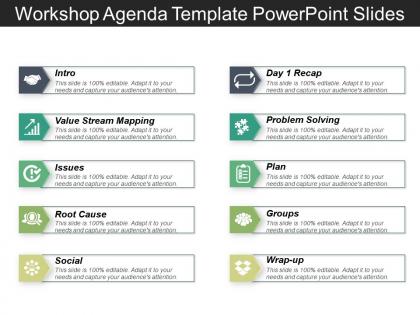
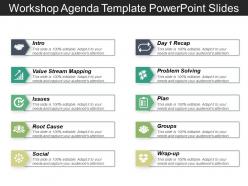
Workshop agenda template powerpoint slides





Try Before you Buy Download Free Sample Product
 Impress Your
 Audience
 100%
100% Editable
 Save Hours
 of Time


Prepare a list of all the activities using this Workshop Agenda Template PowerPoint Slides template. The list incorporates details of activities that need to be done in a workshop and also includes the other details of the workshop like what the workshop is about, what it promotes, common interests, goals, etc. Our professionally designed workshop agenda PowerPoint slide highlights how people should stick to an outline to make things fall into the right place. The workshop agenda example PPT template is useful to motivate people to take part in different activities for either learning something new, sharing knowledge, or even discovering one’s self. A user can use this workshop agenda slide for PowerPoint to demonstrate the step-by-step process of a workshop for fulfilling all the ideas that they have in mind. When you organize a workshop with the appropriate agenda presentation template, there are increased chances of its success.
People who downloaded this PowerPoint presentation also viewed the following :
Workshop agenda template powerpoint slides with all 5 slides:
Doubts begin to crumble with our Workshop Agenda Template Powerpoint Slides. They allow the facts to flow in.

FAQs for Workshop agenda
Your workshop agenda needs clear objectives and time blocks for each activity. Include who's doing what and when. Seriously, don't skip the coffee break timing - I learned that one the hard way. Add any prep work people need to do beforehand, plus what materials you'll need. Be super specific about timing so participants know what they're getting into. Oh, and build in some buffer time between sections because things always run over. Start simple and tweak it based on your audience. Contact info for facilitators is clutch too.
Definitely adjust based on who's showing up. Executives? Keep it short and high-level - they want the strategic stuff, not worksheets. Technical people need way more hands-on time to actually dig into problems. Mixed groups are honestly such a pain because you're trying to please everyone at once. Maybe break into smaller role-based groups for some activities? Also figure out their experience level first - newbies need tons more context while experts can dive right into the complex stuff. I always send a quick survey beforehand to get a feel for what I'm working with.
Honestly, visual layouts are a game-changer for workshop agendas. People can actually scan through sections and timelines instead of getting lost in boring text walls. Nobody wants to decode a novel when they're trying to figure out what's next, you know? Colors and icons help highlight breaks or key activities - super helpful during those marathon sessions when everyone's brain starts checking out. I learned this the hard way after watching people squint at my terrible text-heavy agendas for years. Now I make everything look more like a roadmap. Way better for keeping people on track.
Build in buffer time from the start - I usually add 10-15% extra to each block. Learned that one the hard way when a brainstorming session went totally off the rails! Don't just write "morning session" - put actual start/end times for everything. Get someone who's not facilitating to be your timekeeper, otherwise no one's watching the clock. Here's the thing - we're all terrible at estimating how long stuff actually takes. Your optimistic brain will betray you every time. Always have a few "nice to have" agenda items ready to cut when you inevitably run behind.
So I always mix high-energy stuff with quieter moments - otherwise people get totally fried. The 10-minute rule is gold: attention tanks after that, so throw in quick polls or partner chats to break things up. I bombed this once watching executives completely zone out during my endless presentation lol. Timing matters too - save the heavy collaborative work for mid-morning when everyone's actually awake. Oh and definitely have backup plans ready. Interactive activities are so unpredictable - they either drag on forever or wrap up way too fast.
Honestly, having a solid agenda forces you to figure out what people should actually learn - which is huge. You'll know if your activities make sense or if you're just winging it (seen way too many "let's just see what happens" workshops crash and burn). Participants can prep ahead of time and stay on track during discussions. Short sessions work better than marathon ones, trust me. Share those goals upfront so everyone knows what they're working toward. Otherwise you'll have people going in totally different directions and wondering why nothing stuck.
Honestly, feedback makes or breaks your workshop agenda. Before you even start planning, hit up 2-3 key people about what they're expecting and what problems they want solved. Nobody wants to sit through something that totally misses the point, you know? During the actual workshop, do quick pulse checks - like "how's this landing for everyone?" Then definitely debrief afterward. Oh, and timing is usually the first thing that goes sideways, so pay attention to that. This whole cycle helps you figure out what clicks with people and what doesn't. Trust me, it's worth the extra effort.
Honestly, digital tools totally change the game for workshop agendas. I'm obsessed with Miro and Figma right now—people can comment, vote on topics, even move stuff around while you're planning. Google Docs is solid too if you want something basic (that commenting feature though!). You can throw live polls right into your agenda with Slido. Project management apps help track timing. Oh, and definitely add hyperlinks to docs or breakout assignments—keeps everything connected. Way better than those static Word docs we used to make.
Don't jam-pack your agenda - seriously, you'll regret it. I always think I can squeeze in way more than actually fits (learned this one the hard way lol). Skip those generic session titles like "Discussion" - nobody knows what that means or how to prep. Give activities realistic time blocks and throw in breaks between heavy stuff. Oh, and here's what saves me every time: add like 15-20% buffer to whatever time you think each thing needs. Vague planning kills meetings faster than anything else.
Break every 60-90 minutes, trust me on this. People zone out way faster than you'd think - I've seen it happen around the 2-hour mark and it's brutal. Time them right after heavy content or when switching topics. Mid-morning and afternoon breaks should be longer (15-20 mins) because that's when everyone crashes naturally. Full day? Give them at least 45 minutes for lunch or they'll be useless afterward. Oh, and pad your schedule a bit - workshops always run late no matter how well you plan.
Switch things up every 15-20 minutes or people's brains just check out. Ask specific people direct questions instead of "any thoughts?" because we all know how that goes. Oh, and try the parking lot thing for random ideas - write them down so people feel heard but don't let them hijack your whole plan. Smaller groups work way better too. People actually talk in pairs instead of sitting there awkwardly in big circles. Real breaks are crucial, not just the quick bathroom ones. Give everyone a proper mental reset and they'll actually remember what you taught them.
Honestly, agendas are lifesavers for keeping discussions on track. Without one, you'll end up talking about someone's weekend plans for 20 minutes (guilty of this myself). Set time blocks for each topic and assign roles - someone needs to watch the clock or you're screwed. Share it ahead of time so people aren't caught off guard. Build in transition points between subjects. That way everyone knows what's coming next. Don't stress about sticking to it perfectly though. If something's generating good conversation, let it run a bit longer.
Think about how complex each topic is and whether you'll actually need to make decisions on it. Decision-making stuff always takes forever. Plus, you know how some people ramble on while others get straight to the point - factor that in too. Honestly, I'd estimate everything first, then tack on like 25% extra time because these things never go as planned. Put your biggest priorities up front when everyone's still paying attention. Oh, and definitely leave gaps between agenda items since something will definitely run long. Trust me on this one.
Honestly, I'd start by writing your main program goals right at the top of your agenda template. Then check that every single activity actually serves one of those goals. Like if you're trying to improve communication skills, make sure your role-playing and group discussions all point back to that. I've seen way too many workshops that just feel like a random grab bag of activities! Each piece needs to fit the bigger puzzle. Short version: be super intentional about connecting everything back to your main objectives, otherwise people leave confused about what they were supposed to learn.
Honestly, 3-5 days ahead works best - gives people time to actually look at it without spacing out completely. I'd put the main goals and timing right in the email body, not just as an attachment that nobody opens. Quick "here's why we're doing this" at the top helps too since people love context. Make sure to mention if they need to prep anything or bring materials. The reminder thing is clutch though - shoot them logistics and timing the day before. Oh, and don't overthink the format. Sometimes I just bullet point everything because it's easier to scan.
-
Excellent design and quick turnaround.
-
Design layout is very impressive.