


World economic outlook powerpoint slide presentation examples




Try Before you Buy Download Free Sample Product
 Impress Your
 Audience
 100%
100% Editable
 Save Hours
 of Time


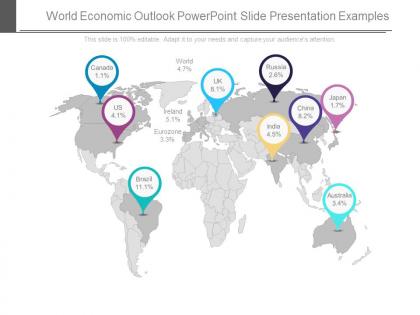
Establish the causes of differences with our World Economic Outlook Powerpoint Slide Presentation Examples. Create the foundation for building accord.
People who downloaded this PowerPoint presentation also viewed the following :
World economic outlook powerpoint slide presentation examples with all 7 slides:
Our World Economic Outlook Powerpoint Slide Presentation Examples enjoy exciting contests. Challenges bring out the best in them.





FAQs for World economic outlook powerpoint
Key indicators driving the global economic outlook include inflation rates, employment levels, central bank policy decisions, supply chain stability, and geopolitical tensions. These metrics influence economic forecasting by affecting consumer spending, business investment, and trade flows, with many financial institutions finding that monitoring commodity prices, currency fluctuations, and manufacturing indices ultimately delivers more accurate predictions for strategic planning.
Geopolitical tensions impact international trade by disrupting supply chains, increasing transportation costs, creating regulatory uncertainties, and triggering retaliatory tariffs between nations. These disruptions force organizations to diversify suppliers, restructure operations, and adjust pricing strategies, while economic growth projections typically decrease due to reduced investment flows, with many financial institutions finding that regional conflicts can slow global GDP growth by 0.5-2 percentage points.
Emerging markets are expected to demonstrate higher growth rates, greater resilience to global shocks, and increased domestic consumption compared to developed economies facing slower expansion and structural challenges. These economies benefit from younger demographics, expanding middle classes, and strategic infrastructure investments, with countries like India, Vietnam, and Brazil finding that diversified trade relationships and technological adoption ultimately deliver competitive advantages over traditional markets experiencing aging populations and debt constraints.
Inflation rates serve as critical indicators guiding central bank decisions, fiscal policy adjustments, interest rate modifications, and currency stabilization measures across global economies. Through careful monitoring of inflation trends, policymakers balance growth stimulation with price stability, with many developed economies finding that maintaining 2-3% inflation targets enables sustainable economic expansion while preserving consumer purchasing power.
Technology is enhancing global productivity through automation, AI-driven analytics, cloud computing, and digital platforms that streamline operations and reduce costs. While these innovations deliver significant efficiency gains and enable faster decision-making across industries like manufacturing and financial services, they also present workforce transition challenges, with many economies finding that strategic technology adoption ultimately drives competitive advantage and economic resilience.
Climate change initiatives present both challenges and opportunities for economic growth, with green investments, renewable energy transitions, and sustainable infrastructure creating new markets while requiring significant upfront capital allocation. While traditional industries face adaptation costs, many organizations find that energy efficiency improvements, carbon reduction technologies, and circular economy models ultimately deliver cost savings, competitive advantages, and access to emerging markets worth trillions globally.
Changing labor market dynamics create both forecasting opportunities and uncertainties through remote work adoption, skill mismatches, demographic shifts, and automation acceleration. These transformations complicate traditional economic models, with many forecasters finding that labor mobility, wage patterns, and productivity measurements require new analytical frameworks, ultimately delivering more nuanced predictions but demanding enhanced data collection and modeling sophistication.
Central banks' monetary policies significantly influence global economic outlook by adjusting interest rates, controlling money supply, and managing inflation expectations across interconnected markets. Through quantitative easing, rate coordination, and currency interventions, institutions like the Federal Reserve and European Central Bank shape international trade flows, investment patterns, and economic growth trajectories, ultimately delivering synchronized recovery or presenting coordinated challenges for emerging economies.
Supply chain disruptions create significant forecasting uncertainties by introducing unpredictable variables into inflation models, trade flow projections, and GDP calculations. These disruptions force economists to account for cascading effects across interconnected industries, with manufacturing, retail, and logistics sectors finding that traditional economic indicators become less reliable, ultimately requiring more dynamic forecasting approaches.
Demographic shifts reshape consumer behavior through changing age structures, urbanization patterns, and workforce compositions, influencing spending priorities, technology adoption, and service demands across markets. These transitions drive economic transformation in sectors like healthcare, housing, and retail, with aging populations in developed nations increasing healthcare spending while younger demographics in emerging markets fuel digital commerce growth, ultimately creating new investment opportunities and requiring strategic business model adaptations.
Fiscal policy significantly influences recovery trajectories through government spending, taxation adjustments, and debt management strategies that stimulate demand, support employment, and maintain economic stability. Countries with stronger fiscal space, like Germany and Canada, can implement expansive policies more sustainably, while debt-constrained nations face limited options, ultimately creating divergent recovery paths and competitive advantages for financially flexible economies.
Global debt levels are undermining economic resilience by constraining fiscal policy responses, increasing vulnerability to interest rate shocks, and limiting investment in growth-enhancing infrastructure across regions. While developed economies like Europe face sustainability challenges, emerging markets including Latin America and Sub-Saharan Africa experience reduced access to capital markets, ultimately creating divergent recovery paths and amplifying regional economic disparities in an increasingly interconnected global landscape.
Emerging gig economy trends include AI-powered platform matching, specialized skill marketplaces, hybrid employment models, cross-border remote work, and integration with traditional benefits systems. These developments are reshaping labor markets by offering greater workforce flexibility, enabling companies to access global talent pools, and creating new employment categories, with many organizations finding that strategic gig integration enhances operational efficiency while reducing overhead costs.
International investment flows accelerate economic growth in developing countries by providing capital for infrastructure development, technology transfer, and job creation. These investments enable countries to modernize manufacturing capabilities, enhance financial services, and improve telecommunications networks, with many emerging economies finding that foreign direct investment ultimately delivers faster industrialization and improved living standards while building competitive advantages in global markets.
COVID-19's long-term economic effects include accelerated digital transformation, restructured supply chains, altered work patterns, increased automation, and shifted consumer behaviors. These changes enable organizations to streamline operations, enhance remote capabilities, and build resilient business models, with many industries finding that strategic adaptation ultimately delivers competitive advantages and sustainable growth.
-
Designs have enough space to add content.
-
Qualitative and comprehensive slides.