


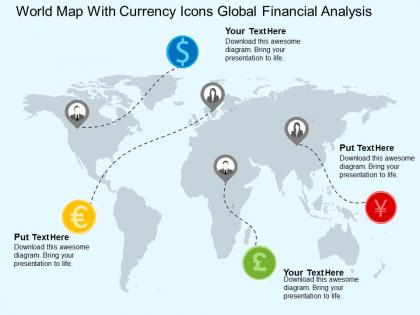
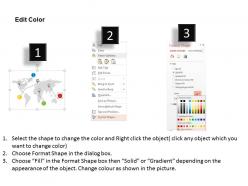
World map with currency icons global financial analysis flat powerpoint design




Try Before you Buy Download Free Sample Product
 Impress Your
 Audience
 100%
100% Editable
 Save Hours
 of Time


Bring the haughty down to earth with our World Map With Currency Icons Global Financial Analysis Flat Powerpoint Design. Give them a dose of hard facts.
People who downloaded this PowerPoint presentation also viewed the following :
World map with currency icons global financial analysis flat powerpoint design with all 4 slides:
Give due credit with our World Map With Currency Icons Global Financial Analysis Flat Powerpoint Design. Acknowledge everyone's excellent contribution.
FAQs for World map with currency icons global financial analysis
The most commonly recognized currency icons on world maps include the US dollar ($), euro (€), British pound (£), Japanese yen (¥), and Chinese yuan (¥). These symbols enhance financial presentations, economic reports, and business analytics by providing instant visual recognition of major economic regions, enabling organizations to streamline global market analysis and deliver more intuitive financial communications.
Currency icons contribute to understanding global economic trends by providing immediate visual recognition of market movements, exchange rate fluctuations, and regional economic performance across different monetary systems. These visual representations enable financial analysts, investors, and businesses to quickly identify opportunities in emerging markets, track currency strength patterns, and make informed decisions about international investments, ultimately delivering faster market analysis and enhanced global financial strategy development.
Clear typography with readable font sizes, consistent color schemes that align with brand guidelines, and balanced spacing between elements enhance currency icon presentations. These design principles streamline visual communication by reducing cognitive load, improving audience comprehension, and maintaining professional aesthetics, with many financial institutions finding that standardized iconography delivers faster decision-making and enhanced stakeholder engagement.
Culturally diverse currency symbols can be effectively represented through standardized iconography, consistent sizing, appropriate color coding, clear geographic placement, and culturally sensitive design choices. These visual elements enhance global financial presentations by ensuring accessibility across different audiences, maintaining professional clarity, and respecting cultural significance, while enabling organizations to communicate complex international data seamlessly and inclusively.
Currency icons serve as powerful visual anchors in economic presentations, enabling audiences to quickly identify markets, compare regional performance, and understand global financial flows at a glance. These visual elements streamline complex data interpretation by providing immediate geographic context, with many financial institutions and consulting firms finding that incorporating recognizable currency symbols significantly enhances audience engagement and comprehension during strategic discussions.
Businesses can integrate currency icons by incorporating them into pricing displays, international campaign visuals, website headers, email templates, and social media graphics to demonstrate global reach. These visual elements enhance brand credibility across diverse markets, streamline customer understanding of regional pricing, and signal international expertise, ultimately building trust with global audiences while reducing conversion barriers.
Popular currency symbols have fascinating historical origins rooted in trade, politics, and linguistic evolution. The dollar sign ($) likely evolved from Spanish peso abbreviations, the pound (£) derives from the Latin "libra," the euro (€) combines the Greek epsilon with European unity, the yen (¥) represents Japan's "en" meaning circle, and the rupee (₹) reflects India's "rupaya" from Sanskrit, with many financial institutions finding that understanding these origins enhances cross-cultural business communication and global market credibility.
Currency symbols reflect cultural identities through historical references, religious symbolism, and national heritage, with designs incorporating elements like crowns, crosses, and indigenous motifs. Many countries integrate traditional scripts, mythological figures, or founding principles into their currency iconography, ultimately creating distinctive financial identities that reinforce national pride and cultural continuity in global commerce.
While no single governing body mandates universal standards, several industry conventions guide currency icon design for digital maps, including ISO currency codes, recognizable symbols, and accessibility guidelines. Many mapping platforms like Google Maps, financial institutions, and e-commerce sites follow similar principles of clarity, cultural sensitivity, and scalability, ultimately delivering consistent user experiences across global applications.
Incorporating currency icons improves audience engagement by enhancing visual recognition, reducing cognitive load, and creating immediate contextual understanding of financial data across global markets. These visual elements streamline information processing, enable faster comprehension of international business metrics, and deliver more memorable presentations, with many financial institutions finding that currency-specific iconography significantly increases stakeholder retention and decision-making speed.
Emerging trends in currency icon representation include minimalist geometric designs, color-coded regional groupings, interactive hover effects, standardized sizing for comparison, and animated flow indicators. These modern approaches enhance financial infographics by improving visual hierarchy, reducing cognitive load, and enabling clearer cross-currency analysis, with many financial institutions finding that simplified iconography significantly increases audience engagement and comprehension rates.
Currency icons differ significantly across regions through cultural symbolism, economic associations, and historical context, with symbols like the dollar sign representing global commerce while the yen reflects precision and the euro symbolizes unity. These variations influence consumer psychology and business perceptions, with many multinational companies finding that locally relevant currency representations enhance user trust and engagement in regional markets, ultimately delivering stronger customer connections.
**INPUT**: What tools are available for creating custom currency icons for presentations? **OUTPUT**: Tools for creating custom currency icons include Adobe Illustrator, Canva, PowerPoint's built-in icon editor, Figma, and specialized financial design platforms like IconScout and Flaticon. These design solutions streamline visual storytelling by offering vector editing, template customization, and scalable formats, with many financial professionals finding that custom currency graphics enhance audience engagement and reinforce global business messaging effectively.
Currency icons simplify complex financial information by providing instant visual recognition, reducing cognitive load, and enabling quick data interpretation across language barriers. These standardized symbols streamline financial dashboards, reports, and presentations by replacing lengthy currency names with universally recognized graphics, ultimately enhancing user comprehension and decision-making speed in multinational business environments.
Adapting currency icons for diverse linguistic contexts presents challenges including right-to-left reading patterns, cultural color associations, symbol recognition variations, and local currency positioning preferences. These considerations require strategic design modifications, with many multinational organizations finding that flexible icon systems, culturally-neutral color palettes, and scalable typography ultimately deliver enhanced global user experiences and broader market accessibility.
-
Out of the box and creative design.
-
Appreciate the research and its presentable format.