


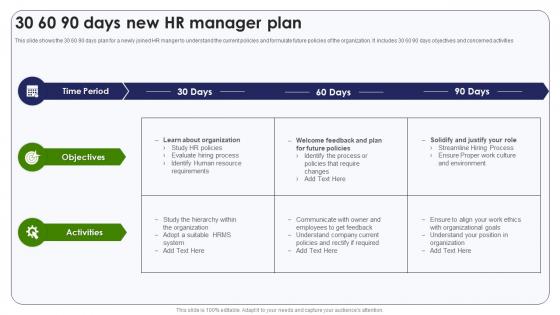
30 60 90 Days New HR Manager Plan




Try Before you Buy Download Free Sample Product
 Impress Your
 Audience
 100%
100% Editable
 Save Hours
 of Time


This slide shows the 30 60 90 days plan for a newly joined HR manger to understand the current policies and formulate future policies of the organization. It includes 30 60 90 days objectives and concerned activities
People who downloaded this PowerPoint presentation also viewed the following :
30 60 90 Days New HR Manager Plan with all 6 slides:
Use our 30 60 90 Days New HR Manager Plan to effectively help you save your valuable time. They are readymade to fit into any presentation structure.





FAQs for 30 60 90 Days New
Hit these four things: getting and keeping good people, developing your team, managing performance, and making sure everyone's actually aligned with company culture. Honestly, those old-school annual planning sessions are basically useless now - you've gotta be way more flexible. People will bolt if they can't see where they're headed, so continuous learning and clear career paths are huge. Building psychological safety matters more than ever since hybrid work made everything weird. I'd start by figuring out where you suck the most right now, then tackle that first. Don't try to fix everything at once.
Honestly, first figure out what your company's actually trying to do - growing fast, saving money, whatever. Then make your HR stuff support that instead of doing random initiatives that don't connect to anything (which happens ALL the time, it's ridiculous). Say they want 50% growth this year. Your hiring and training should directly help hit that number. Track metrics your CEO gives a damn about - revenue per employee, how fast new hires get productive, keeping your best people. Every HR decision needs to tie back to something that actually moves the business forward. Otherwise you're just... there.
Honestly, tech runs everything in HR these days. AI screens candidates, analytics predict who's gonna quit, and automation handles onboarding - it's wild how much has changed. Remote work tools opened up hiring globally too, which I think is the coolest part. But here's the thing: don't just grab every new platform because it looks fancy. Figure out what's actually breaking in your HR process first. Then find tech that fixes those specific headaches. Way better approach than trying to use every tool out there and ending up overwhelmed.
Focus on metrics that actually connect to what your business cares about - retention rates, how long it takes to hire someone, engagement scores, that kind of stuff. Don't go overboard though. Pick maybe 3-5 KPIs that really matter instead of trying to measure literally everything (been there, it's a nightmare). Mix up leading indicators like employee satisfaction with lagging ones - turnover costs hit different when you see the actual numbers. Pulse surveys and exit interviews are gold for this. Start with where you're at now, then check quarterly to see if you're making progress.
Look, most companies treat D&I like some afterthought, but you've gotta bake it into your actual performance goals and comp structure from day one. Post jobs on diverse boards, not just LinkedIn for the millionth time. Audit what you're doing wrong first - that'll save you headaches later. Employee resource groups are clutch, but give them real money and executive backing or they're useless. Oh, and don't forget to weave D&I into everything - recruiting, promotions, exit interviews. It's honestly the only way it sticks instead of being this random side project nobody cares about.
Honestly, if your employees aren't engaged, good luck getting any HR stuff to actually work. Engaged people are way more productive and they don't bail on you every six months. Plus they'll actually use the programs you create instead of ignoring them completely. Think about it - would you rather have a team that's excited about changes or one that rolls their eyes at everything? The engaged ones become your biggest cheerleaders, they refer great candidates, and they'll give you real feedback instead of just nodding politely. Bottom line: don't build anything if people won't care about it.
Ugh, honestly the hardest part is getting leadership to see HR as anything beyond just a cost center. Data's another nightmare - you'll need good metrics but HR analytics are usually a mess. Change management? People hate new processes even when they actually work better. Oh and you're constantly stuck between what employees want vs what the business needs, which is... fun. My take? Pick one small thing first. Show clear ROI with numbers they can't argue with, then build from there once you've got some street cred.
Honestly, you gotta flip your whole mindset here. Stop caring about hours and start tracking actual results instead. Get some decent collaboration tools - none of that outdated garbage everyone's still using. Communication becomes huge when people are scattered everywhere, so do regular check-ins and maybe some virtual coffee chats or whatever. Remote folks get forgotten way too easily. Your onboarding probably sucks for virtual people right now, so fix that. Oh, and flexible schedules are pretty much mandatory with different time zones. Start by just asking your remote team what's broken - they'll tell you everything.
So definitely track time-to-fill and cost-per-hire - those are like the basics everyone expects. But honestly, quality of hire matters way more than speed sometimes. Check new hire performance ratings and if people actually stick around at 90 days and a year. Candidate experience surveys are clutch too because people talk, especially in smaller industries. Figure out which job boards or sources actually work versus just spam you with resumes. Oh, and measure offer acceptance rates - that'll tell you if your process is scaring people off. Start with maybe 3 metrics that match your biggest headaches, then add more later.
Honestly, you gotta make learning part of the actual system, not just something you bolt on later. Connect it to career paths and performance reviews so people see the point. Mentorship programs work great too. Here's the thing though - budget for it from day one because scrambling for money later just kills everything. Make sure whatever training you do actually connects to business goals, otherwise leadership won't care. Oh, and be systematic about it. Employees should know exactly what skills they'll need for their next role and how to get there. Random training sessions don't really move the needle.
Honestly, remote work changed everything - that's probably the biggest shift. Mental health support isn't optional anymore either. Most companies are ditching the whole "you need a degree for this" thing and focusing more on actual skills instead. Flexible benefits are huge now too. People want learning opportunities that don't suck. Work-life balance? Yeah, that's basically required at this point - good luck hiring without it. Oh, and everyone's obsessed with HR analytics now (some of it's actually useful). My advice? Just ask your team what they want instead of guessing. You'll probably be surprised by their answers.
Honestly, stop guessing what talent wants and actually find out. Your current employees? They're your secret weapon - if they're happy, they'll bring in their friends. Get real employee stories on social media and encourage honest Glassdoor reviews (yeah, even the slightly critical ones build trust). Here's the thing though - your hiring process is basically a preview of working there. Don't waste people's time, give actual feedback, be transparent about next steps. Oh and audit your whole candidate experience from job post to first day. Every interaction either builds or kills your reputation. Trust me, word spreads fast in tight talent markets.
Honestly, it's like having superpowers for HR decisions. Instead of guessing why people quit or who'll be a good hire, you actually know what's happening. Track stuff like how long hiring takes, who's engaged vs checked out, what your best people have in common - suddenly patterns jump out at you. I got totally hooked once I started seeing the connections! Way better than making choices based on hunches or whatever your manager thinks sounds right. My advice? Don't try to analyze everything at once though. Pick one thing - maybe why people leave or recruitment stats - get some basic numbers together, then expand from there.
Honestly, you've got to bake feedback right into your HR processes instead of just talking about it. Monthly check-ins work way better than waiting for annual reviews - nobody remembers what happened 6 months ago anyway. Train your managers first though, because bad feedback is worse than no feedback. Set up 360 reviews and peer systems, but make upward feedback safe too. People hate feeling like they're screaming into the void. Oh, and tie it to promotions so everyone knows you're serious about it. The whole thing falls apart without consistency.
Focus on treating people fairly - pay equity, inclusive hiring, all that stuff. Privacy's huge too since companies hoard so much employee data now (kind of scary tbh). Don't do diversity just for show, and make sure performance reviews aren't biased. Give people safe ways to report problems. Layoffs, surveillance tech, work-life balance - these all have ethical angles you can't ignore. Honestly, just ask yourself: would I want to work under these policies? Audit your practices regularly. If something feels sketchy to you, it probably is.
-
Very well designed and informative templates.
-
Professionally designed slides with color coordinated themes and icons. Perfect for enhancing the style of the presentations.