

30 60 90 Days New Job Plan For Chief Financial Officer




Try Before you Buy Download Free Sample Product
 Impress Your
 Audience
 100%
100% Editable
 Save Hours
 of Time


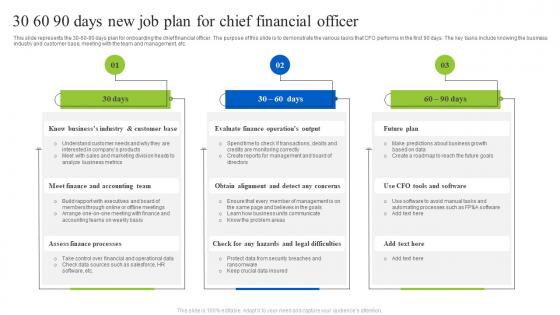
This slide represents the 30 60 90 days plan for onboarding the chief financial officer. The purpose of this slide is to demonstrate the various tasks that CFO performs in the first 90 days. The key tasks include knowing the business industry and customer base, meeting with the team and management, etc.
People who downloaded this PowerPoint presentation also viewed the following :
30 60 90 Days New Job Plan For Chief Financial Officer with all 6 slides:
Use our 30 60 90 Days New Job Plan For Chief Financial Officer to effectively help you save your valuable time. They are readymade to fit into any presentation structure.





FAQs for 30 60 90 Days New Job Plan For
Ok so CFO transitions are tricky but totally doable. Document everything now - processes, key relationships, ongoing fires you're putting out. Don't let investors and board members get blindsided, so map out who needs what info when. Your financial reporting can't skip a beat, which means cross-training staff and having backup systems ready. Honestly, timing is probably the hardest part since you never know what the market's gonna throw at you. If there's a gap between CFOs, figure out interim leadership early. I know it sounds like a lot, but seriously start the documentation piece today even if transition feels far off - future you will be so grateful when everything gets crazy.
Honestly, you need to start documenting everything like 3-6 months before your CFO bounces. Map out all the critical processes, compliance stuff, and deadlines so nothing falls through the cracks. The new person should get detailed handoffs on ongoing audits and any weird accounting quirks - trust me, those random exceptions will bite you later. Keep your auditors and board members in the loop too. I've seen companies get totally screwed when someone walked out with all that knowledge still in their head. Short version: write it all down before it's too late.
Honestly, talking to everyone is what saves you here. Keep your board, team, investors, and partners updated with clear messaging - otherwise you'll just create chaos and kill morale. I've watched transitions completely implode because nobody knew what was going on! Get your outgoing CFO to help shape the story and timeline. Set up regular check-ins with your direct reports too. Map this communication stuff out early. People would rather hear the truth than sit in silence wondering what's happening. Radio silence kills trust faster than bad news does.
Start with a solid handover doc covering all the critical stuff - processes, relationships, ongoing projects. Break up the knowledge transfer into multiple sessions because nobody absorbs everything in one massive brain dump. Tackle time-sensitive things first: board presentations, compliance deadlines, any audits happening. Your replacement needs face time with key people - your direct reports, external auditors, banking contacts, the whole crew. Honestly, the personal introductions matter more than people think. Set up a transition window where you're still reachable for questions after they officially start.
Start with the obvious stuff - financial reporting accuracy and timing, cash flow forecasts, budget variances. Any hiccups there and you'll know fast. But honestly? The relationship side is just as critical. Watch how they're meshing with department heads and whether they can explain financial stuff without making everyone's eyes glaze over. Board satisfaction matters too, obviously. Oh and audit readiness - that's always a fun one. I'd set up weekly check-ins rather than waiting for monthly reviews. Trust me, you don't want surprises with a new CFO.
Honestly, tech can save your ass during a CFO transition. Start by setting up automated dashboards for data collection - saves tons of manual work. Workflow tools help track milestones so nothing falls through cracks. Get your financial reporting automated ASAP so the new person isn't scrambling day one. Cloud systems are perfect since everything stays organized and accessible. The overlap period works way better with collaborative platforms where both CFOs can jump in simultaneously. Oh, and AI can actually spot gaps in your handover docs (didn't expect that to be useful but it is). Just audit your current setup first and automate what you can before things get crazy.
Okay so first thing - don't let people sit there wondering what's happening. The rumor mill gets absolutely vicious during leadership changes, trust me on this. Get your new or interim CFO out there meeting people right away, and hold regular team meetings where you actually answer questions. Yeah, change sucks and it's okay to say that out loud. But also talk up the stuff that's staying the same - their day-to-day work, team goals, whatever. Here's what really helps though: ask your team what they think is working and what isn't. Makes them feel like partners instead of just... I don't know, passengers?
Dude, stakeholder stuff is huge - seriously can make or break everything. The board, leadership team, investors, department heads... you need them all on your side from day one or you're screwed. I've watched new CFOs crash hard because they skipped the relationship building early on. Financial decisions affect everyone, right? So if people don't trust you or get what you're doing, they'll fight every change. Oh and map out your key people before you start - then hit those one-on-ones in your first two weeks. Can't stress this enough.
Don't rush the handover - that's probably the biggest mistake I've seen. Your outgoing CFO has years of knowledge locked in their brain, so get them to write stuff down before they bail. Oh, and don't keep the whole thing super hush-hush from your finance team. They're gonna freak out anyway, might as well give them time to process it. Try to overlap both CFOs for a few weeks minimum. Document all those key relationships early - banks, auditors, board contacts. Trust me, you don't want important stuff slipping through the cracks when everyone's scrambling.
Dude, culture is huge for this transition. When you've got teams that actually talk to each other and share info, your new CFO will hit the ground running. Siloed departments though? That's where things get messy - even rockstar CFOs can't break through those walls easily. Oh, and if everyone loved the old CFO, you're gonna deal with some "well Sarah used to do it this way" comments for months. Maybe have them sit in on a few key meetings right away to read the room? I'd honestly do some kind of culture check first so you know what you're working with.
Set up technical and cultural training for your new CFO. Start with deep dives into your financial systems and reporting processes. The stakeholder relationships are honestly massive - that part gets missed way too often. Try pairing them with your outgoing CFO for 2-4 weeks if you can swing it. Also set up one-on-ones with department heads and board members. Oh, and if you're in a specialized industry, don't skip that sector-specific training. You want them feeling confident in YOUR environment, not just general finance stuff. Get these sessions scheduled before they even start.
Look, don't just treat this like regular hiring - it's way bigger than that. Your new CFO needs to get your 3-5 year vision immediately, not figure it out months later. Map the transition timeline to your actual strategic milestones so nothing falls through the cracks. Focus knowledge transfer on what really drives your business forward - market expansion, digital stuff, whatever's on your roadmap. Most companies mess this up by doing generic finance handoffs instead of strategy-focused ones. Honestly, I've watched too many transitions fail because leadership treated it like paperwork. Get them running on day one with what actually matters for your future, not just basic operations.
Look, most people totally rush this part and it bites them later. Get your outgoing CFO to actually document everything - board cycles, vendor quirks, all that stuff that's never written down. Set up handover meetings where they can introduce the new person to department heads, auditors, bank contacts. Those relationships matter way more than people think. Map out a 90-day timeline with specific milestones so nothing falls through cracks. Oh, and definitely keep the old CFO on speed dial for a while after they're gone - trust me on this one.
Set up 30-60-90 day goals from day one - relationship building, learning systems, grabbing some quick wins. Don't try to revolutionize everything immediately (that's a rookie mistake). Track the obvious stuff like report accuracy and deadlines, but also pay attention to how stakeholders respond to you and whether the team's warming up. First few months? You're drinking from a fire hose, not performing miracles. Regular CEO and board check-ins help keep everyone aligned. After six months you can shift into more traditional metrics around financial leadership. Oh, and document everything - future you will thank you for having that baseline.
Okay so succession planning for your CFO role is huge - don't sleep on this. Start identifying internal candidates like 12-18 months out, give them board exposure, let them tackle bigger decisions. Cross-training is key too. Most places totally botch this timing and end up panicking later (I've seen it happen so many times). You'll want both permanent candidates AND interim coverage mapped out - you never know when someone might bail unexpectedly. Oh, and definitely audit your finance team's current skills now. Trust me on this one.
-
Easy to edit slides with easy to understand instructions.
-
“I really like the convenient operation and professionalism I saw on the SlideTeam website. I want to express my regards and appreciation to the team.”