

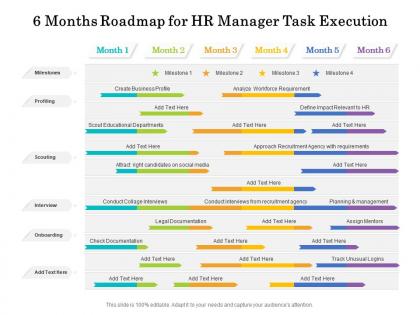
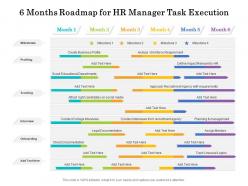
6 months roadmap for hr manager task execution




Try Before you Buy Download Free Sample Product
 Impress Your
 Audience
 100%
100% Editable
 Save Hours
 of Time


A well thought out action plan makes execution easier and increases the possibility of success significantly. Ensure hitting all the milestones within the deadlines by introducing our fully customizable 6 Months Roadmap For HR Manager Task Execution. Streamline the work related information, budget, timeframe, key deliverable, landmarks, and major steps involved, all in one place to give an organized overview of the project by utilizing our PowerPoint theme. Minimize time lag and increase work efficiency by providing insight into the process with our comprehensively researched roadmap PowerPoint layout. Color coding helps in highlighting the process and grabs the attention of the audience. Download our handy 6 Months Roadmap For HR Manager Task Execution to identify the possible problem areas in a much shorter time and propose solutions. Have a productive brainstorming session with your workforce by utilizing our action plan visualization tool.
People who downloaded this PowerPoint presentation also viewed the following :
6 months roadmap for hr manager task execution with all 2 slides:
Use our 6 Months Roadmap For HR Manager Task Execution to effectively help you save your valuable time. They are readymade to fit into any presentation structure.
FAQs for 6 months roadmap for hr
HR manager responsibilities include talent acquisition and retention, employee development and training, performance management, compensation planning, workplace culture initiatives, and regulatory compliance. These functions streamline organizational effectiveness by attracting top talent, enhancing employee engagement, and ensuring legal adherence, with many companies finding that strategic HR management ultimately delivers improved productivity, reduced turnover costs, and sustainable competitive advantage.
HR managers can effectively align workplace culture with business goals by establishing clear values that reflect strategic objectives, implementing performance metrics that reinforce desired behaviors, and creating communication channels that consistently connect daily work to company vision. Through strategic initiatives like goal-setting workshops, recognition programs, and cross-departmental collaboration projects, organizations streamline cultural transformation while enhancing employee engagement, ultimately delivering improved productivity and stronger competitive positioning in their respective markets.
HR managers can implement strategies including flexible work arrangements, comprehensive professional development programs, regular feedback sessions, competitive compensation packages, and recognition systems. These approaches enhance workplace satisfaction by fostering career growth, improving work-life balance, and creating supportive environments, with many organizations finding that engaged employees deliver higher productivity and significantly lower turnover rates.
HR managers handle conflict resolution through active listening, mediation facilitation, root cause analysis, neutral investigation processes, and structured communication frameworks. These approaches enable managers to address workplace tensions systematically, restore team collaboration, and prevent future disputes, with many organizations finding that proactive conflict management ultimately delivers improved productivity, enhanced employee retention, and stronger workplace relationships.
Technology revolutionizes modern HR management through automated recruitment systems, AI-powered candidate screening, cloud-based employee management platforms, predictive analytics for workforce planning, and digital performance tracking tools. These innovations streamline administrative tasks, enhance decision-making accuracy, and improve employee experiences, with many organizations finding that strategic technology integration delivers significant operational efficiency and competitive talent acquisition advantages.
HR managers can develop comprehensive training programs by conducting skills gap analyses, aligning learning objectives with business goals, creating diverse delivery methods, establishing mentorship initiatives, and implementing performance tracking systems. Through strategic combination of workshops, e-learning platforms, and on-the-job training, organizations streamline employee development while enhancing retention rates, ultimately delivering improved productivity and competitive advantage in increasingly talent-driven markets.
HR managers should track employee retention rates, time-to-fill positions, employee engagement scores, training completion rates, and performance improvement metrics. These indicators streamline talent management by identifying recruitment bottlenecks, measuring workforce satisfaction, and evaluating development programs, with many organizations finding that comprehensive metrics ultimately deliver enhanced productivity, reduced turnover costs, and stronger competitive advantage.
HR managers can foster diversity and inclusion by implementing comprehensive recruitment strategies, establishing mentorship programs, conducting regular bias training, creating employee resource groups, and ensuring equitable advancement opportunities. Through these initiatives, organizations streamline talent acquisition from diverse backgrounds while enhancing workplace culture, with many companies finding that inclusive environments deliver improved innovation, employee retention, and competitive advantage in increasingly diverse markets.
Best practices for conducting performance appraisals include setting clear expectations upfront, gathering comprehensive feedback from multiple sources, focusing on specific behavioral examples, maintaining regular documentation throughout the review period, and creating collaborative development plans. These approaches enhance manager-employee relationships by fostering transparent communication, identifying growth opportunities, and aligning individual goals with organizational objectives, ultimately delivering improved retention and performance outcomes.
HR managers should approach recruitment by leveraging strategic employer branding, utilizing diverse sourcing channels, implementing data-driven assessment methods, and creating compelling candidate experiences throughout the hiring process. Through targeted social media campaigns, employee referral programs, and streamlined interview processes, organizations enhance their talent acquisition capabilities while reducing time-to-hire, ultimately delivering competitive workforce advantages and stronger organizational performance.
HR managers can ensure compliance through regular policy audits, comprehensive employee training programs, systematic documentation processes, legal consultation partnerships, and automated compliance tracking systems. These strategies work by minimizing legal risks, standardizing procedures, and maintaining current regulatory knowledge, with many organizations finding that proactive compliance management ultimately delivers reduced litigation costs, improved employee relations, and stronger operational efficiency.
HR managers manage remote work through structured communication protocols, digital collaboration platforms, virtual team-building activities, performance tracking systems, and flexible scheduling frameworks. These approaches streamline coordination by establishing regular check-ins, maintaining project transparency, and fostering personal connections, with many organizations finding that strategic virtual engagement ultimately delivers stronger team relationships and enhanced productivity across distributed workforces.
Aspiring HR managers should develop strategic thinking, data analytics, employee relations, compliance knowledge, and digital HR technology proficiency. These competencies enable professionals to streamline recruitment processes, enhance workplace culture, and deliver measurable business outcomes, with many organizations finding that skilled HR managers significantly reduce turnover while improving operational efficiency.
HR managers facilitate effective communication by implementing open-door policies, establishing regular feedback channels, organizing cross-departmental meetings, and leveraging digital collaboration platforms. These strategies streamline information flow and enhance transparency, with many organizations finding that structured communication frameworks significantly improve employee engagement, reduce workplace conflicts, and ultimately deliver stronger organizational alignment and productivity.
Emerging HR trends include remote work optimization, AI-powered recruitment, employee experience platforms, skills-based hiring, and wellness-focused benefits programs. These developments streamline talent acquisition, enhance workforce flexibility, and improve retention rates, with many organizations finding that strategic adoption of these trends delivers competitive advantages in increasingly tight labor markets.
-
Top Quality presentations that are easily editable.
-
Excellent design and quick turnaround.