

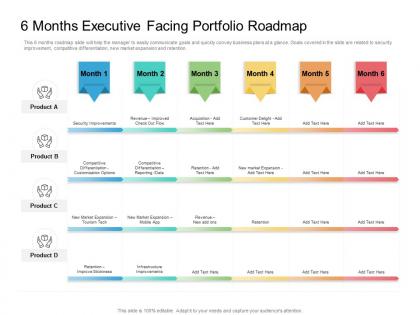
6 months executive facing portfolio roadmap timeline powerpoint template




Try Before you Buy Download Free Sample Product
 Impress Your
 Audience
 100%
100% Editable
 Save Hours
 of Time


Our 6 Months Executive Facing Portfolio Roadmap Timeline Powerpoint Template are topically designed to provide an attractive backdrop to any subject. Use them to look like a presentation pro.
People who downloaded this PowerPoint presentation also viewed the following :
6 months executive facing portfolio roadmap timeline powerpoint template with all 2 slides:
Use our 6 Months Executive Facing Portfolio Roadmap Timeline Powerpoint Template to effectively help you save your valuable time. They are readymade to fit into any presentation structure.

FAQs for 6 months executive facing portfolio roadmap
So basically you want strategic initiatives tied to actual business results, realistic timelines, and clear resource plans. Map out dependencies between projects - seriously, this will save your sanity when everything starts overlapping (and it will). Risk assessments are crucial, plus success metrics and who owns what. Everything needs to connect back to company strategy obviously. Keep it visual though - swimlanes work great since execs want to scan fast, not read novels. Oh, and prioritize your biggest impact stuff first. That's where I'd start anyway.
So basically, this roadmap thing lets you see how all your projects actually tie back to what your company's trying to accomplish. You can figure out which ones are worth the effort and which are just... there. Honestly, it's pretty useful when someone asks "why are we even doing this project?" in those endless meetings. The template helps you focus your team's energy on stuff that actually matters instead of random busy work. You'll spot holes too - like where you might need to start something new. I'd say review it monthly or whatever works, just so you're not spinning wheels on things that don't push your goals forward.
Use traffic light colors for priority - red, yellow, green. Makes scanning super easy for execs. Clean timeline bars with status icons work best. Don't go crazy with colors though - I've seen roadmaps that look like a kindergarten art project! Stick to 4-5 colors max. Typography matters too. Make important stuff pop with good hierarchy and consistent spacing. Throw in some milestone markers and simple progress bars. The whole thing should be scannable in 30 seconds during those rushed executive meetings.
Honestly, start with a simple scoring system - map each project against your top strategic goals and rate them on business value, feasibility, and urgency. ROI matters but don't obsess over it exclusively. Some lower-ROI stuff actually unlocks bigger opportunities down the road. Plot everything on a grid so you can see the trade-offs visually. Oh, and this is crucial - get leadership to agree on your scoring method first. Otherwise they'll change their minds every few months and you'll be back to square one. Trust me on that one.
You really can't skip stakeholder feedback - trust me on this one. Get input from your execs, department heads, and team leads upfront. They'll tell you what's actually doable versus what sounds good on paper. I've watched so many roadmaps crash because someone thought they could just figure it out alone. The feedback helps you spot dependencies you missed and sequence things in a way that makes sense. Plus people are way more likely to support something they had a voice in shaping. Oh, and don't just ask once at the beginning - check in regularly so you can adjust course if needed.
Honestly, treat your Executive Portfolio Roadmap like a Google Doc that gets tweaked every quarter. Market stuff changes fast, so don't get married to specific features - focus on bigger outcomes instead. That way when customers want something totally different, you're not screwed. Monthly check-ins are clutch for staying on top of what sales is hearing and what research shows. Oh, and build in those "decision points" where you actually pause and ask if something's still worth doing. I've watched teams waste months on dead-end projects because they never stopped to reassess. Smart roadmaps have escape routes built right in.
Focus on stuff executives actually care about - ROI, revenue impact, cost savings, how fast you're getting to market. Customer satisfaction and market share matter too since they directly hit the bottom line. Don't get sucked into vanity metrics that look cool but mean nothing. Track both leading indicators like milestone completion and lagging ones like actual revenue. I learned this the hard way on my last project tbh. Pick 3-5 solid metrics per project that you can report quarterly without wanting to cry. Ask each stakeholder what success looks like first, then build your measurement around that.
So yeah, every industry totally tweaks these roadmaps differently. Tech companies are obsessed with innovation cycles and how fast they can scale things up. Healthcare? They're all about hitting compliance deadlines and actually helping patients - which honestly makes sense given all the regulations they deal with. Manufacturing focuses more on keeping supply chains running smooth and efficient operations. Financial services throw in tons of risk management stuff and regulatory boxes to check. The trick is figuring out what really matters in your specific industry first, then building your template around that. Way better than trying to jam some cookie-cutter approach into your situation.
Honestly? Getting everyone on the same page is the worst part - stakeholders all want different things on different timelines. Scope creep will kill you too since everyone thinks their project is the most important one. Oh, and good luck getting decent data from people sometimes. Here's what actually works though: nail down your strategic goals first and make sure executives are bought in before you do anything else. Create some kind of scoring system so you're not just picking favorites. Set boundaries early or you'll be adding random stuff forever. Regular check-ins help catch problems before they blow up your whole roadmap.
Honestly, project management tools like Asana or Monday are game-changers for building visual timelines and tracking who's doing what. Miro and Figma are great too - you can make interactive roadmaps that people actually want to look at instead of boring PowerPoint decks. Real-time dashboards through Tableau or Power BI help you see what's working and pivot fast when things change (which they always do). My advice? Pick maybe 2-3 tools tops. Otherwise you'll spend more time managing the tools than actually getting work done. Getting everyone to use them consistently is the real challenge though.
Honestly, just focus on three things. First, figure out what each group actually cares about - like execs want ROI numbers but team leads need to know about resources. Visual roadmaps are so much better than those boring slide decks everyone hates. Set up regular check-ins too - maybe monthly for executives, quarterly for everyone else. Oh and make it two-way! Don't just dump info on people. Give them ways to ask questions about how this stuff affects their day-to-day work. Multiple touchpoints work way better than one big presentation.
Honestly, having that big-picture view is a game changer for catching problems early. Dependencies between projects become super obvious, and you'll spot resource conflicts before they turn into disasters. The visual aspect helps too - like when you realize three major projects are all hitting crunch time in the same week (been there, not fun). Instead of just checking individual projects, you're forced to look at everything together during reviews. Map out what you've got running now and how they connect - I bet you'll find some risks hiding in plain sight. Worth the effort for sure.
Honestly, timelines are what separate real roadmaps from those fancy charts that just collect dust. They make your team actually accountable for hitting deadlines and help you catch resource conflicts early. Stakeholders get realistic expectations instead of constantly asking "when will this be done?" Dependencies become super obvious too - like oh wait, we can't launch the mobile app until the API is finished. Also learned this the hard way: always pad your estimates because stuff inevitably takes longer than you think it will.
Stick to the big picture stuff - execs want strategy, not nitty-gritty project details. Lead with visuals that show your whole portfolio at once. Trust me, I've watched presentations crash and burn because people got lost in tactical weeds nobody cares about. Dependencies and resource conflicts? Make those crystal clear since that's what they actually need to decide on. Don't overload your slides, and definitely prep for hard questions about priorities. Oh, and bring 2-3 concrete recommendations they can act on right away - otherwise you'll just get another meeting scheduled.
Think of it as your strategy GPS - you'll finally see where your resources are actually going versus where they should be. Map out your top 5-7 initiatives first (trust me, don't try to do everything at once). The visual timeline is a game-changer because you can spot when projects are fighting over the same people or budget. No more executives blindly grabbing for talent! Gaps and overlaps become super obvious. Honestly, it's one of those tools that makes you wonder how you managed without it. Smart trade-offs happen when you can see the whole picture.
-
Unique research projects to present in meeting.
-
Design layout is very impressive.
-
Great experience, I would definitely use your services further.
-
Great product with highly impressive and engaging designs.
-
Great product with effective design. Helped a lot in our corporate presentations. Easy to edit and stunning visuals.
-
Awesome presentation, really professional and easy to edit.
-
Great experience, I would definitely use your services further.
-
Thanks for all your great templates they have saved me lots of time and accelerate my presentations. Great product, keep them up!