


360 Marketing Strategy Plan With Impact





Try Before you Buy Download Free Sample Product
 Impress Your
 Audience
 100%
100% Editable
 Save Hours
 of Time


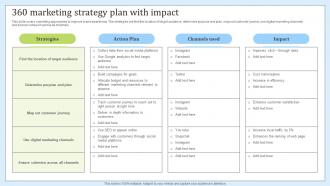
This slide covers marketing approaches to improve brand awareness. The strategies are find the location of target audience, determine purpose and plan, map out customer journey, use digital marketing channels and ensure cohesion across all channels.
People who downloaded this PowerPoint presentation also viewed the following :
360 Marketing Strategy Plan With Impact with all 6 slides:
Use our 360 Marketing Strategy Plan With Impact to effectively help you save your valuable time. They are readymade to fit into any presentation structure.





FAQs for 360 Marketing Strategy
A successful 360 marketing strategy includes integrated digital and traditional channels, consistent brand messaging, customer journey mapping, data analytics, and omnichannel experiences. These components work together by aligning touchpoints across platforms, personalizing customer interactions, and optimizing campaigns through real-time insights, with many organizations finding that this comprehensive approach significantly enhances brand visibility and customer engagement.
Brands can effectively integrate online and offline channels through unified messaging, synchronized timing, cross-channel data sharing, consistent visual identity, and seamless customer touchpoints. By leveraging technologies like CRM systems and marketing automation, companies in retail, hospitality, and financial services create cohesive customer journeys, ultimately delivering enhanced brand recognition and improved conversion rates.
Customer feedback serves as the foundation for 360 marketing strategy development, informing content creation, channel selection, messaging refinement, and campaign optimization across all touchpoints. This comprehensive input enables marketers to align their omnichannel approach with actual customer preferences and behaviors, with retail brands, financial services, and healthcare organizations finding that feedback-driven strategies deliver higher engagement rates, improved customer satisfaction, and ultimately stronger ROI.
Data analytics enhances 360 marketing by providing comprehensive customer insights, tracking cross-channel performance, and enabling real-time campaign optimization across all touchpoints. Through advanced analytics platforms, marketers can identify customer journey patterns, measure attribution accurately, and personalize experiences seamlessly, ultimately delivering higher ROI and more cohesive brand experiences that drive competitive advantage.
Common pitfalls include inconsistent messaging across channels, lack of data integration, insufficient budget allocation, poor timing coordination, and neglecting audience segmentation. These challenges often arise when organizations rush implementation without strategic planning, with many retail and financial services brands finding that successful 360 strategies require dedicated cross-functional teams, unified analytics platforms, and phased rollouts to ensure consistent customer experiences.
Social media serves as a central hub in 360 marketing by enabling consistent messaging across platforms, facilitating real-time customer engagement, and providing valuable data insights for campaign optimization. Through strategic content distribution, targeted advertising, and community building, brands can create seamless customer experiences that connect online interactions with offline touchpoints, ultimately delivering enhanced brand visibility and measurable ROI across all marketing channels.
Customer segmentation is fundamental to 360 marketing strategy as it enables personalized messaging, targeted channel selection, and optimized resource allocation across all customer touchpoints. Through detailed demographic, behavioral, and psychographic analysis, organizations can deliver highly relevant experiences at every interaction point, while streamlining campaign effectiveness and maximizing ROI, ultimately creating cohesive customer journeys that drive engagement and loyalty.
Brands ensure consistent messaging through centralized brand guidelines, unified content calendars, cross-channel collaboration tools, and regular communication audits across all touchpoints. This strategic coordination enables seamless customer experiences, whether through social media, email, retail, or traditional advertising, with many organizations finding that integrated messaging significantly enhances brand recognition and customer trust.
Businesses can measure 360 marketing success using analytics platforms like Google Analytics, social media insights, CRM systems, marketing automation tools, and attribution modeling software. These technologies streamline performance tracking by consolidating data across channels, identifying customer touchpoints, and measuring ROI, with many organizations finding that integrated dashboards ultimately deliver clearer visibility into campaign effectiveness and competitive advantage.
Content marketing serves as the foundational element of a 360 marketing strategy, providing valuable information that educates customers across all touchpoints, from social media and email campaigns to SEO and paid advertising. This strategic approach enables brands to maintain consistent messaging while delivering targeted content for different audience segments, ultimately building trust and driving conversions across multiple channels simultaneously.
Personalization significantly enhances 360 marketing effectiveness by increasing engagement rates, improving customer satisfaction, and driving higher conversion rates across all touchpoints. Through tailored messaging and customized experiences, companies like Netflix and Amazon deliver relevant content that resonates with individual preferences, ultimately creating stronger brand loyalty and measurable revenue growth.
AI and VR enhance 360 marketing strategies by enabling hyper-personalized content delivery, immersive customer experiences, and real-time behavioral analytics across all touchpoints. These technologies streamline campaign optimization through predictive insights, virtual product demonstrations, and automated customer journey mapping, with retail brands and automotive companies finding that integrated AI-VR approaches ultimately deliver higher engagement rates and stronger brand loyalty.
Brands should establish clear budget allocation across digital channels, traditional media, content creation, analytics tools, and contingency reserves, typically following the 70-20-10 rule for proven, experimental, and innovative tactics. Through integrated planning, companies like Nike and Coca-Cola maximize ROI by tracking cross-channel performance metrics, ensuring consistent messaging investments, and maintaining flexibility for real-time optimization based on consumer response data.
Influencer partnerships enhance 360 marketing strategies by extending reach across multiple touchpoints, creating authentic content that resonates with diverse audiences, and amplifying brand messaging through trusted voices. These collaborations streamline customer engagement by leveraging influencers' established communities, ultimately delivering broader market penetration and enhanced credibility across traditional and digital channels.
A 360 marketing strategy delivers comprehensive brand visibility, consistent messaging across all touchpoints, enhanced customer engagement, and improved ROI through integrated campaigns. In today's fragmented media landscape, this holistic approach enables organizations to reach customers wherever they are, from social media to retail environments, ultimately creating seamless brand experiences that drive loyalty and competitive advantage.
-
I have just started downloading templates for my presentations and I must say this is a great design. It helped accelerate my presentation design process and made it more visually appealing.
-
Time saving slide with creative ideas. Help a lot in quick presentations..