


360 Degree Marketing Strategies For Brand Comprehensive Guide To 360 Degree Marketing Strategy




Try Before you Buy Download Free Sample Product
 Impress Your
 Audience
 100%
100% Editable
 Save Hours
 of Time


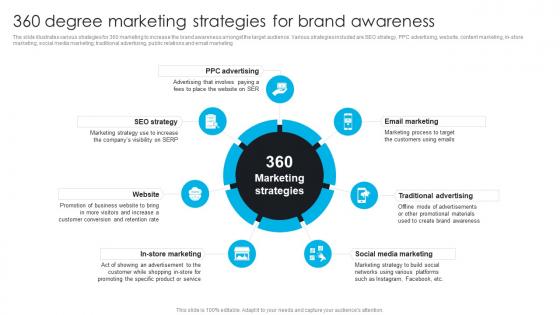
The slide illustrates various strategies for 360 marketing to increase the brand awareness amongst the target audience. Various strategies included are SEO strategy, PPC advertising, website, content marketing, in store marketing, social media marketing, traditional advertising, public relations and email marketing
People who downloaded this PowerPoint presentation also viewed the following :
360 Degree Marketing Strategies For Brand Comprehensive Guide To 360 Degree Marketing Strategy with all 9 slides:
Use our 360 Degree Marketing Strategies For Brand Comprehensive Guide To 360 Degree Marketing Strategy to effectively help you save your valuable time. They are readymade to fit into any presentation structure.








FAQs for 360 Degree Marketing Strategies For Brand Comprehensive Guide To 360
So you want to hit people from every direction - digital ads, social, email, PR stuff, even how your customer service team talks. The trick is making sure your brand story flows the same way whether someone finds you on Instagram or actually visits your store. Track everything so you can see what's working. I know it sounds like a lot at first (honestly gave me a headache when I started), but begin by looking at what you're already doing across platforms. Then spot where your messaging gets weird or disconnected. Data helps you connect those dots and optimize each channel.
Honestly, tracking cross-channel stuff is a total pain because people jump around everywhere. Start with UTM codes on everything - that's your foundation. Map out where your tracking is already broken first though. Attribution models help you see the whole journey, not just last-click nonsense. Set up unified customer IDs if you can swing it. Your social posts might look useless conversion-wise, but they're probably feeding your email list like crazy. Brand lift surveys work too if you want the full picture. Focus on how channels play together, not just individual ROI.
Think of social media as the glue that holds your whole marketing thing together. It drives people to your website, shows off your PR wins, and backs up your email campaigns. Honestly, people are already doom-scrolling anyway - you might as well catch them while they're there! The magic happens when you connect it to everything else you're doing. Don't just post randomly. Cross-promote between platforms and let what you learn from social inform your other decisions. It's way more powerful when it's not just sitting there by itself.
You want people hitting your message from every angle, right? Someone sees your billboard, then boom - your Instagram ad pops up later. Then maybe they get an email. It all connects back to the same story you're telling. The cool part is tracking how everything works together. Your in-person events can boost online buzz, while your digital stuff drives people to your actual store. Just keep your messaging consistent across the board - I learned this the hard way with a client once. Set up proper tracking so you can see which combos actually move the needle.
Make one solid piece of content, then chop it up for different platforms. Your LinkedIn post hits different than your TikTok, but the main message stays the same. Blog post becomes podcast clips, social posts, newsletter stuff - whatever makes sense. I always track what's actually working so I can focus there instead of just throwing content everywhere. Oh, and don't try to sound corporate on Instagram if that's not your vibe. People can smell fake from miles away. The whole point is getting your message out wider without losing what makes you... you.
Honestly, personas are like the GPS for your whole marketing strategy. They show you if your people are scrolling TikTok or networking on LinkedIn. Do they want emails or quick texts? What actually keeps them up at night? Once you know that stuff, everything else falls into place - your content, where you spend money, which channels matter most. I always start by figuring out where each persona likes to hang out first. Then build around that. Otherwise you're basically just guessing and wasting budget on the wrong platforms.
Honestly, start with a decent CRM - HubSpot's pretty user-friendly, Salesforce if you want something beefier. Marketing automation is huge too. Marketo and Pardot are solid choices for running campaigns across different channels. You'll definitely need something like Hootsuite for social media management, keeps everything consistent. For tracking performance, Google Analytics is obvious but Adobe Analytics is worth looking at too. Oh, and attribution platforms like Bizible - seriously, they'll blow your mind when you see the actual customer journey mapped out. Just make sure whatever you pick actually integrates together. Nothing worse than spending money on tools that don't talk to each other.
Honestly, data analytics is like having x-ray vision for your marketing. Track how people move between your social, email, website, ads - all that stuff - and you'll actually see where they're engaging vs where you think they are. The best part? You can figure out which channels play nice together and stop wasting money on the ones that don't. I used to just guess at this stuff and it was awful. Set up tracking everywhere first, then hunt for where people are bailing out. Those dropoff points are pure gold for improvements.
Honestly, the biggest trap is thinking you need to be on every single platform. You'll just burn through your budget and confuse your message. TikTok people want totally different stuff than LinkedIn professionals - seems obvious but so many brands mess this up. Plus when you don't connect your channels, customers get this weird choppy experience jumping between them. Oh and the internal coordination part? Way more work than anyone expects. Teams always underestimate that. I'd map out your customer journey first, then pick maybe 3-4 channels you can actually nail instead of half-assing it across 8 different platforms.
Okay so personalization is what makes 360 marketing actually work instead of just annoying people. You're basically using customer data to tailor everything - emails, social posts, ads, your website - so it feels like you actually know them. Way better than those generic blasts everyone ignores. Each touchpoint should feel connected and relevant to their specific behavior and preferences. Honestly, I've seen campaigns totally flop because they skipped this part. Start simple though - create like 3-4 customer personas and customize one campaign across all your channels. The difference is pretty wild once you see it in action.
Honestly, feedback is what saves your whole strategy from being a hot mess. Your omnichannel plan might look amazing on paper, but customers will straight-up tell you if your emails are annoying or your social posts sound weird. They'll also catch those awkward gaps - like seeing your promo on Instagram but then it's nowhere on your site. Super frustrating for them. I'd set up ways to collect feedback at each touchpoint and actually look at it monthly. Otherwise you're just guessing what works.
Dude, partnerships are like instant audience multiplication. You tap into their followers, they get yours - win-win. The cool part? People actually trust recs from brands they already follow, so it doesn't feel pushy like regular ads do. Look for brands that complement yours but aren't competing directly. Like, if you sell workout gear, maybe partner with a protein company or fitness app. Their audiences probably overlap with yours anyway. Honestly, I'd map out 3-5 potential partners first. Then pitch something where you both get equal shine - nobody likes feeling used in these deals.
Ugh, honestly the worst part is trying to keep everything consistent across like 6+ platforms. Your messaging gets so watered down because Instagram wants one thing, LinkedIn wants another, and don't even get me started on TikTok. Different teams end up handling different channels and nobody talks to each other - total mess. Measuring success becomes impossible when everyone's tracking different stuff. I learned this the hard way last year lol. Make a brand guide that's actually useful (not some 50-page document nobody reads) and force those teams to meet regularly. Saves your sanity.
Here's the thing - video can work everywhere in your strategy, but you've gotta switch up the format. Short clips for social, longer deep-dives for your website. Email campaigns? Try personalized video messages (they actually convert pretty well). Instead of making tons of separate videos, just repurpose one solid concept into different formats. Way easier. Your brand story should stay consistent whether it's an Instagram reel or a YouTube pre-roll ad. Oh, and map out your customer journey first - figure out where video will actually move the needle at each step.
Honestly, understanding how your customers actually behave is what separates a solid 360-degree strategy from just blasting content everywhere and praying something works. You need to figure out how people think and shop across different channels. Nobody wants to get retargeted for stuff they already bought - so annoying, right? Map out your customer journey first. Then you can spot those key moments where you can actually influence what they do next. When you know their patterns, you'll be there with the right message when they need it most. Way better than guessing.
-
“I've always gotten excellent slides from them and the customer service is up to the mark.”
-
The team is highly dedicated and professional. They deliver their work on time and with perfection.