

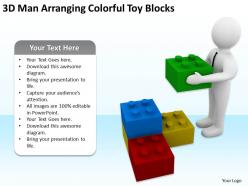
3d Man Arranging Colorful Toy Blocks Ppt Graphics Icons Powerpoint

You must be logged in to download this presentation.




Try Before you Buy Download Free Sample Product
 Impress Your
Audience
 100%
Editable
 Save Hours
of Time


Are you eager to know about the driving factors leading to success and achievement? To help you we have come up with 3D man arranging colorful toy presentation templates explaining the concept of team, success, achievement, creativity and many other interrelated topics. Our PowerPoint slides describe how to sustain in this competitive market. In addition, these PPT templates will make you aware of how to manage team and about the strategy that would lead to meet your objectives. In a nutshell, these PowerPoint designs help to understand the strategy which should be adopted for the successful business. Best part is that you can download these Presentation graphics to explore your knowledge and can make outstanding presentations before the target audience. Our experts are available to help you. Don’t wait now! Just click on our presentation graphics and widen your knowledge. Our 3D Man Arranging Colorful Toy Blocks Ppt Graphics Icons Powerpoint give you the controls. Your thoughts will take charge of the situation.
People who downloaded this PowerPoint presentation also viewed the following :
3d Man Arranging Colorful Toy Blocks Ppt Graphics Icons Powerpoint with all 3 slides:
Let your ideas take charge of the situation. Our 3D Man Arranging Colorful Toy Blocks Ppt Graphics Icons Powerpoint will faithfully obey your instructions.


FAQs for 3d Man Arranging Colorful Toy Blocks Ppt
3D toy blocks enhance early childhood development by improving spatial reasoning, fine motor skills, problem-solving abilities, creativity, and mathematical concepts like geometry and patterns. Through hands-on construction activities, children develop critical thinking and coordination while exploring engineering principles, with many educators finding that block play ultimately delivers stronger cognitive foundations and prepares students for STEM learning in increasingly interactive educational environments.
3D toy blocks enhance spatial awareness by allowing children to visualize three-dimensional relationships, understand geometric concepts, and develop hand-eye coordination through physical manipulation and construction. Through stacking, rotating, and connecting blocks, children strengthen problem-solving abilities, learn cause-and-effect relationships, and build critical thinking skills, with educators increasingly finding that block-based play delivers improved mathematical reasoning and enhanced creativity.
Common materials for 3D toy blocks include wood, plastic, foam, cardboard, and silicone, each offering distinct advantages for different applications. Wood provides durability and natural appeal, plastic enables intricate designs and easy cleaning, while foam delivers safety for younger children, with many toy manufacturers finding that strategic material combinations enhance play value and market reach across diverse age groups.
3D toy blocks integrate into STEM education by developing spatial reasoning, mathematical concepts, engineering principles, and problem-solving skills through hands-on construction activities. Educational institutions increasingly use these tools to teach geometry, measurement, and basic physics concepts, with many elementary schools finding that block-based learning enhances student engagement while building foundational skills for advanced STEM subjects.
Colors and shapes in 3D toy blocks serve as fundamental learning tools, stimulating visual development, pattern recognition, spatial reasoning, and creative expression while making play inherently engaging and educational. These design elements help children develop fine motor skills, problem-solving abilities, and cognitive mapping through hands-on exploration, with many early childhood educators finding that vibrant, varied block sets enhance concentration and imaginative play.
Manufacturers should adhere to ASTM F963, EN 71, CPSIA lead content limits, choking hazard size requirements, and non-toxic material certifications when producing 3D toy blocks. These standards streamline safety compliance by ensuring appropriate block dimensions, chemical testing, and age-appropriate labeling, with many toy companies finding that rigorous adherence ultimately delivers enhanced consumer trust and competitive market advantage.
Parents and educators can encourage creativity through 3D toy blocks by providing open-ended challenges, avoiding rigid instructions, and celebrating unconventional designs that promote spatial reasoning and problem-solving skills. Through guided exploration and collaborative building sessions, children develop engineering thinking, mathematical concepts, and artistic expression, with many educational institutions finding that block-based learning enhances cognitive development and prepares students for STEM careers.
3D toy blocks serve therapeutic purposes in educational settings through fine motor skill development, spatial reasoning enhancement, cognitive rehabilitation, sensory integration therapy, and social-emotional learning exercises. These tactile tools enable occupational therapists and special education teachers to address developmental delays, autism spectrum challenges, and learning disabilities, while fostering collaborative problem-solving and self-confidence in structured classroom environments.
Innovative 3D toy block designs include augmented reality integration, magnetic connectivity systems, programmable LED components, modular electronic circuits, and app-controlled interactive elements. These advanced features enhance traditional building experiences by enabling digital storytelling, simplified construction methods, and educational coding opportunities, with many toy manufacturers finding that technology-enhanced blocks deliver greater engagement while maintaining hands-on creativity and learning benefits.
Age-appropriate 3D toy block sets differ through progressive complexity levels, piece counts, connection mechanisms, and cognitive challenges tailored to developmental stages. Toddler sets feature larger, simpler interlocking pieces for basic stacking, while advanced sets for older children incorporate intricate geometric shapes, mechanical elements, and multi-step building processes, ultimately delivering enhanced spatial reasoning skills and sustained creative engagement.
Yes, 3D toy blocks naturally foster collaborative play by encouraging children to share ideas, negotiate designs, divide building tasks, and work together toward common construction goals. Through collaborative block play, children develop essential teamwork skills like communication, compromise, and shared problem-solving, while creating more complex structures than they could build individually, ultimately enhancing social development and cooperative learning abilities.
3D toy blocks significantly enhance fine motor skills development by strengthening hand-eye coordination, improving finger dexterity, and refining grasping abilities through repetitive stacking, connecting, and manipulation activities. These tactile experiences enable children to develop precise muscle control, bilateral coordination, and spatial awareness, with many early childhood educators finding that regular block play ultimately delivers stronger writing readiness and improved manual dexterity.
Technology has revolutionized traditional 3D toy blocks through digital integration, smart sensors, augmented reality features, programmable elements, and app connectivity. These innovations enable interactive learning experiences, real-time feedback, and enhanced creativity, with many educational institutions and parents finding that tech-enhanced blocks deliver improved spatial reasoning, coding skills, and collaborative play experiences.
Environmental considerations in 3D toy block production include material sourcing, manufacturing energy consumption, packaging waste, transportation emissions, and end-of-life disposal challenges. While traditional plastic blocks present recycling difficulties, many manufacturers increasingly adopt biodegradable materials, local production methods, and take-back programs, ultimately delivering reduced carbon footprints and enhanced sustainability credentials for environmentally conscious consumers.
3D toy blocks can be adapted for children with special needs through larger sizes for improved grip, textured surfaces for sensory stimulation, magnetic connections for easier assembly, and high-contrast colors for visual accessibility. These modifications enable enhanced motor skill development, cognitive engagement, and inclusive play experiences, with many occupational therapists and special education programs finding that adapted blocks deliver significant therapeutic benefits while maintaining the fundamental joy of creative construction.
-
Nice presentation
-
Awesome use of colors and designs in product templates.
-
Thanks for all your great templates they have saved me lots of time and accelerate my presentations. Great product, keep them up!