

4 disciplines of execution focus on important goals




Try Before you Buy Download Free Sample Product
 Impress Your
 Audience
 100%
100% Editable
 Save Hours
 of Time


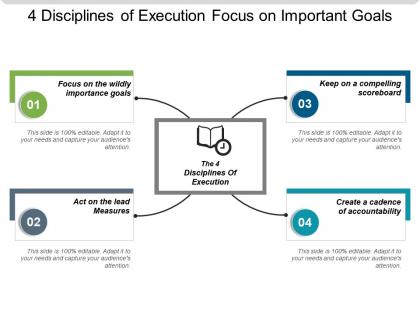
Introducing 4 Disciplines Of Execution Focus On Important Goals presentation. Employ this organizational discipline PPT graphic to assist your employees in improving teamwork so that group goals can be reached. Ensure that there is no wastage of time due to performance drops or irrelevant tasks with this rules compliance PowerPoint infographic. Also, this regulation PPT template is completely adaptable and you can replace the text in the placeholders with your own relevant content. You can also showcase the key ideas which can help you master the art of disciplined execution to make your presentation attention-grabbing. Discuss the rules to determine your WIG such as defining the lag measures, begin with a verb, etc. This 4DX execution framework PPT slideshow will help leaders and teams execute the business strategy. Explain how the four disciplines of execution are implemented by downloading our ready to use 4DX methodology PPT slide design. Download this amazing code of conduct PowerPoint presentation and succeed in developing unity between employees and management.
People who downloaded this PowerPoint presentation also viewed the following :
4 disciplines of execution focus on important goals with all 5 slides:
Our 4 Disciplines Of Execution Focus On Important Goals are the basis for good growth. An excellent foundation for development.

FAQs for 4 disciplines of execution focus
Honestly, you need someone who actually owns each piece - shared responsibility is just code for "nobody's fault when it fails." Regular check-ins are huge for catching problems before they blow up. Track metrics that actually mean something, not just pretty numbers for slides. But here's the thing that trips up most teams: people need real authority to make decisions AND the resources to execute. I've seen so many good strategies get murdered by endless committee meetings because nobody can actually pull the trigger on anything. Oh, and consistent communication obviously - keeps everyone from working in silos.
Honestly, visualization is a game changer for messy projects. Gantt charts and kanban boards help you see the whole picture instead of drowning in details. I still love sticky note walls though - yeah it's old school but there's something about physically moving stuff around that clicks. Flowcharts work too for mapping out those annoying dependencies. The point is getting everything out of your head so problems jump out at you early. Your team stays on the same page way easier when they can actually see what's happening. Try sketching your main project phases this week and watch how obvious the gaps become.
Honestly, collaboration can totally make or break your project. Poor communication creates those awful "wait, I thought YOU were doing that" situations - trust me, I've been there. Good teamwork means catching problems early and actually solving them faster since you've got different people looking at the same issue. Your work ends up way better quality too because teammates can spot things you missed. The key is setting up regular check-ins right from the start, not waiting until things go sideways. Oh, and having clear ways for everyone to communicate - like actually clear, not just "we'll figure it out as we go."
Honestly? Bad communication kills more projects than anything else. Everyone needs to know what they're doing and when - otherwise people just sit around confused or start making stuff up. I'd rather annoy people with too many updates than have someone realize three weeks later they were supposed to be working on something totally different. Set up regular check-ins from the start. Short ones work fine, but make them consistent. Oh, and always have a way for people to ask questions without it being this whole formal thing. Trust me on this one.
Track completion rates, timelines, and budget stuff - the usual suspects. But honestly, the process metrics are where you'll catch problems early. How fast are decisions getting made? Are resources going to the right places? That's gold. Don't just measure outputs though. Connect everything back to actual business results or you're just collecting vanity metrics. Monthly check-ins work well - see what's clicking and what's falling flat. Oh, and start with maybe 3-5 key things. You'll go crazy trying to track everything at once.
Honestly, the two biggest things that kill execution are fuzzy ownership and trying to juggle everything at once. Don't just say "marketing handles this" - make Sarah specifically own lead gen numbers by Q2. I'm guilty of this too, but stop chasing every new shiny thing that comes up. Communication breakdowns between teams will absolutely wreck your progress, so way over-communicate on what's working and what's stuck. Oh, and start every week with this question: what are the 2-3 must-dos to stay on track? Sounds simple but it works.
Honestly, feedback loops are total lifesavers - they help you spot problems while they're still manageable instead of waiting until everything's on fire. I'm talking about simple stuff like weekly team check-ins or those quick pulse surveys (though let's be real, half the surveys I get at work just vanish into thin air). The real trick isn't collecting feedback - it's actually doing something with it. Maybe start with one thing you can try this week? Could be as basic as a 15-minute Friday recap with your team. Just pick something and stick with it.
Honestly, start with a decent project management tool - Asana or ClickUp work great. Don't overthink it though, your team needs to actually want to use whatever you pick. OKRs help keep everyone focused on the big picture stuff that matters. Weekly check-ins catch problems before they blow up. Gantt charts are clutch for complicated projects, but maybe overkill if you're just tracking basic tasks? I'd say pick one tool and stick with it rather than constantly switching platforms. Build up your routine first, then get fancy with features later.
Honestly, how you lead makes or breaks execution. Too hands-off and people feel lost when problems pop up. But micromanage? You'll crush any initiative they have - I've definitely fallen into that trap before. What works is being super clear about what you want while letting them figure out their own process. Oh, and you gotta adjust based on whether it's a complex project or if your team knows their stuff already. Really though, just ask yourself this: am I actually helping my team get things done or am I the one slowing them down?
Start by breaking your big goals into specific targets for each team and person - like actually measurable stuff. Weekly check-ins help too, but focus on how work connects to those bigger objectives instead of just task updates. So many teams I've worked with get totally buried in daily stuff without asking "wait, does this even matter for what we're trying to do?" Build dashboards showing both your execution metrics AND business results. Oh, and give people permission to hit pause when things start drifting. That's honestly the hardest part but super important.
Honestly, templates are lifesavers because they force you to actually organize your thoughts instead of just winging it. You'll have dedicated spots for timelines, who's doing what, key milestones - all that stuff stakeholders need to see. Non-technical people especially love this since they can jump straight to what matters without drowning in details. Once your team gets used to the same format, meetings go way smoother too. Everyone knows where to find their answers. Oh, and definitely build in space for those random "but what happens if..." questions that someone always throws out at the last minute.
Oh totally, speed vs quality is such a real struggle. Sometimes "good enough" shipped fast actually beats perfect delivered way too late - learned that the hard way on a few projects. The trick is figuring out what you absolutely can't mess up quality-wise, then go fast on everything else. Like if you're racing to beat competitors, maybe speed wins. But safety-critical stuff? Yeah, don't cut corners there. I always try to decide upfront which parts are non-negotiable quality, then optimize for speed everywhere else. It's honestly more about being smart with your trade-offs than trying to do everything perfectly.
Make risk assessment part of your normal routine, not something you scramble to do when stuff hits the fan. I'd suggest weekly check-ins where the team spots new issues and updates old ones - yeah, they're boring but trust me, they'll save you later. Build risk tracking into your regular dashboards so problems show up early. Oh and definitely kick off every sprint planning with like a 10-minute risk discussion. Honestly, most teams skip this step and then wonder why they're always firefighting. It's way easier when it becomes muscle memory instead of an afterthought.
Honestly, every company that nails execution does one thing really well - they keep it stupidly simple. Amazon, Toyota, Southwest... they're all obsessed with making sure everyone gets the goal. No confusion, no fancy jargon. They chop big projects into bite-sized pieces you can actually measure. Here's what's wild though - they over-communicate like crazy, even when it feels annoying. Quick feedback loops so teams can pivot fast. And they throw little celebrations for wins along the way because momentum matters. For your thing, just ask: can your whole team explain the goal in one sentence? If not, you're already in trouble.
Dude, this stuff is huge - what crushes it in NYC can totally bomb in Tokyo or São Paulo. Germans want every detail mapped out before you even start. Meanwhile, Asian teams often need way more consensus-building, which honestly feels like forever if you're not used to it. Communication styles are all over the place too. Even how people think about deadlines changes by culture. Your whole approach - how you delegate, give feedback, set timelines - needs to shift based on where you're working. Seriously though, just bring local people into your planning from day one. They'll catch the cultural landmines before you step on them.
-
Qualitative and comprehensive slides.
-
Great designs, Easily Editable.